You are searching for lifetime music distribution because you understood something important: paying every year forever to keep your own music on Spotify makes no structural sense. You write the song. You record it. You master it. You pay to release it. And then you keep paying every year just for it to stay alive on platforms that earn the streaming revenue. The yearly model is convenient for distributors. It is rarely the best deal for artists, especially Indian artists already dealing with USD billing and forex on top.
Lifetime music distribution exists as the alternative. Pay once per release, music stays live forever, no recurring cost, no takedown risk if you skip a payment. For Indian artists building a catalog over years, this model is structurally better in almost every realistic scenario. The only question is which lifetime distribution service actually fits Indian artists best, and whether the savings versus yearly models genuinely materialize over the years you plan to release music.
This blog answers both questions honestly. We explain how lifetime distribution actually works, which services genuinely offer it in 2026, the real 5 to 10 year cost math versus yearly models, and which lifetime distributor fits best specifically for Indian artists. By the end you will know exactly whether the lifetime model suits you and which service to choose.
What Lifetime Music Distribution Actually Means
Lifetime music distribution is a one-time payment model. You pay a single fee per release, and the distributor continues delivering your music to streaming platforms and paying you royalties indefinitely. No yearly renewal, no monthly subscription, no surprise charges. The relationship persists for the lifetime of the release, hence the name.
What It Is Not
- Not a free service: You pay upfront per release, just once
- Not unlimited uploads: Typically per-release pricing, not subscription
- Not a contract or lock-in: You can switch to another distributor anytime
- Not a promise of platform changes: Spotify or Apple Music could change their rules, distributor cannot prevent that
How It Differs From Other Pricing Models
| Feature | Lifetime | Yearly Sub | Free + Share |
| Upfront cost | Per release | Per year | Zero |
| Recurring cost | None | Yearly forever | Revenue share forever |
| Stop paying impact | No effect | Music can be removed | Stays with share |
| Catalog scaling cost | Linear in releases | Grows with both releases and time | Grows with earnings |
| Forex impact (if USD) | Once | Every year | On every payout |
The structural advantage: Lifetime distribution converts an indefinite recurring liability into a fixed one-time cost. For any artist who plans to keep releasing music over multiple years, this is structurally cheaper and more predictable than yearly models. The only scenario where lifetime is not the best fit is for hyper-prolific artists releasing 50+ tracks per year who specifically want unlimited-upload subscription value.
Why Lifetime Matters Especially for Indian Artists
Lifetime distribution is structurally better globally, but it matters even more for Indian artists for three specific reasons:
Reason 1: INR Lifetime Removes Forex Friction
Yearly USD-priced services hit Indian cards with 1 to 3 percent forex conversion plus exchange rate fluctuation, every single year. INR-native lifetime services like The Black Turn remove this entirely. Over 5 to 10 years across multiple releases, the cumulative forex saving alone can equal the lifetime fee itself.
Reason 2: Lifetime Protects Caller Tune Earnings
Indian artists often have caller tunes as their largest revenue stream. A yearly model that lapses can take down both streaming AND caller tune simultaneously, killing recurring monthly revenue. Lifetime keeps the caller tune flowing without payment risk. See caller tune revenue impact.
Reason 3: Indian Artist Income Patterns Favor Lifetime
Indian indie artist income is often lumpy, growing slowly in early years before scaling. A yearly fee model demands payment regardless of whether income is high or low that year. Lifetime fee is paid once when you can afford it, then no further demand on your wallet, no matter how income fluctuates. For artists balancing music with day jobs or transitioning careers, this predictability is significant.
Which Services Actually Offer Lifetime in 2026
Despite many distributors using the word “lifetime” loosely in marketing, the strict definition (one-time per-release fee, music stays live indefinitely, no recurring cost) narrows the list significantly:
| Service | True Lifetime? | Currency | Caller Tune Included |
| The Black Turn | Yes | INR (₹599-799) | Yes (all 4 networks) |
| CD Baby | Yes | USD + forex | No |
| RouteNote Premium (per-release) | Partial / per-release | USD | No |
| DistroKid | No (yearly subscription) | USD yearly | No |
| TuneCore | No (yearly per-release) | USD yearly | No |
| Amuse Pro | No (yearly subscription) | USD yearly | No |
| Free tiers (with rev share) | Technically stays but rev share is recurring | USD-based | No |
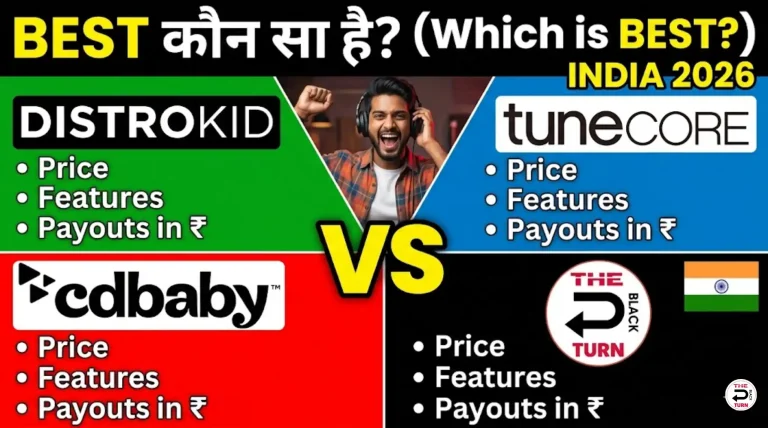
Marketing language vs reality: Some yearly distributors use the phrase “lifetime” in marketing to suggest catalog stays alive, but the model is still yearly with takedown risk. The strict test is simple: does the music stay live and earning royalty even if you never pay another rupee? If yes, it is lifetime. If no, it is not. Only The Black Turn, CD Baby, and arguably RouteNote per-release Premium pass this test for paid models. Among them, only The Black Turn is INR-native and includes Indian caller tune.
For a complete master pricing comparison of all services across all models, see our music distribution price comparison India 2026 reference table.
Ranked. Best Lifetime Music Distribution for Indian Artists
1. The Black Turn (Best Lifetime for India)
The Black Turn is the strongest lifetime music distribution option specifically for Indian artists because it combines true lifetime pricing with India-specific features no other lifetime service offers.
| Lifetime Factor | The Black Turn |
| Pricing | ₹599-799 one-time per release in INR |
| Music stays live forever | Yes, no recurring payment required |
| Currency | INR native, no forex |
| Royalty pass-through | Approximately 95 percent |
| Caller tune (4 networks) | All 4 included (Jio, Airtel, Vi, BSNL) |
| Platform coverage | Spotify, Apple Music, JioSaavn, YouTube Music, 150+ platforms |
| YouTube Content ID | Included |
| India payout | Direct INR to Indian bank accounts |
See current pricing and what is included with The Black Turn lifetime distribution or
2. CD Baby (Honest Mention for Global Non-Caller-Tune Use)
CD Baby offers a genuine one-time per-release lifetime model in USD. The music stays live indefinitely after the initial payment. Disadvantages for India: USD pricing with forex on Indian cards, no Indian caller tune coverage, weaker India-context support. Reasonable for global-focused Indian artists who specifically do not need caller tune. See CD Baby comparison.
3. RouteNote Premium Per-Release (Limited Lifetime)
RouteNote Premium offers a per-release paid tier in USD which is closer to lifetime than yearly, but with specific terms and limitations. No Indian caller tune. Reasonable as a backup option if you want a non-Indian alternative. See RouteNote review for India.
Honest summary: For Indian artists looking specifically for lifetime music distribution in 2026, the practical market is essentially The Black Turn and CD Baby. Between them, The Black Turn wins decisively for Indian-audience-focused artists because of INR pricing and caller tune inclusion. CD Baby wins narrowly only for purely Western-focused Indian artists who do not need caller tune. The other distributors do not actually offer lifetime; they market the concept while using yearly models structurally.
The Lifetime Math. 5-Year and 10-Year Scenarios
The real value of lifetime distribution becomes obvious over multiple years and multiple releases. Take a realistic Indian artist scenario:
Scenario: 5 Releases Over 5 Years, Kept Live Permanently
| Service | Year 1 Cost | 5-Year Total Cost |
| The Black Turn (lifetime INR) | ₹2,995-3,995 once | ₹2,995-3,995 (no growth) |
| CD Baby (lifetime USD) | USD per-release fee x 5 + forex | Same as Year 1 (USD lifetime) |
| DistroKid (yearly sub USD) | Yearly sub once | 5x yearly sub + forex |
| TuneCore (yearly per-release USD) | 5x yearly USD + forex | Up to 25 release-year instances |
| Free tier (revenue share) | ₹0 + revenue share starts | 5 years of revenue share growing |
Scenario: 10 Releases Over 10 Years
| Service | 10-Year Total | Cost Pattern |
| The Black Turn | ₹5,990-7,990 once | Flat, fully paid |
| CD Baby | 10x USD one-time + forex | Flat in USD, fluctuates in INR |
| DistroKid (yearly) | 10x yearly sub + forex | Compounds significantly |
| TuneCore | Up to 100 release-year instances | Compounds severely |
| Free + rev share | 10 years of share on 10 songs | Highest over 10 years if music earns |
The 10-year truth: Over a real artist’s 10-year career horizon, the lifetime model is usually the cheapest by a significant margin, especially for Indian artists where INR-native lifetime removes forex on top. The yearly model only matches lifetime if you happen to release very low volume AND release that volume only once with no recurring annual catalog. Most artists release more, year over year, and the gap widens dramatically.
For the full cost analysis of all pricing models, see our cheapest music distribution India 2026 guide.
3 Myths About Lifetime Music Distribution
Myth 1: “Lifetime Means the Distributor Will Always Exist”
Lifetime refers to the lifetime of your release, meaning no recurring cost. It does not mean the distributor company is guaranteed to exist forever (no company is). If a distributor ever shut down, you would migrate to another with ISRC carry-forward. The risk of distributor shutdown applies to yearly models too, often more acutely. Lifetime does not promise immortal companies, just no recurring cost while the company operates.
Myth 2: “Lifetime Must Be More Expensive Than Yearly”
On Day 1, lifetime per-release sticker price is higher than the first year of a yearly model. By year 3 or 4, the yearly cumulative typically exceeds lifetime. By year 5 and beyond, the gap widens. The math is straightforward: a fixed payment beats a recurring one over time.
Myth 3: “Lifetime Is Lower Quality Because It Is Cheaper Long Term”
The pricing model has nothing to do with delivery quality. A lifetime distributor uses the same Spotify, Apple Music, and JioSaavn pipelines as yearly distributors. The structural difference is in how the distributor charges you, not in how music reaches platforms. Quality of delivery depends on distributor relationships with platforms, not pricing model.
When Yearly Might Actually Be Better
Honest contrast. Lifetime is not always the right answer. Yearly subscription can be better in specific narrow cases:
- Hyper-prolific artists releasing 50+ tracks per year for Western audiences: DistroKid’s unlimited-uploads yearly subscription value beats per-release lifetime at that volume
- Single-experiment release with no plans to continue: If you release one experimental track and have zero intention of continuing music, yearly might cost less than lifetime upfront
- Artists wanting publishing administration bundled: Some yearly per-release services (TuneCore) bundle publishing admin which is harder to find lifetime
- Specific feature dependencies: If you depend on a specific yearly-model distributor’s unique feature that lifetime services do not offer
These narrow cases are rare: Most Indian artists do not fit these profiles. Most plan multiple releases over multiple years. Most do not release 50+ tracks per year. Most do not need bundled publishing admin (IPRS/PPL direct registration is better for India anyway). For the broad majority of Indian independent artists, lifetime is structurally better. The exceptions exist but should not drive default decisions.
How to Switch From Yearly to Lifetime
Step 1: Document Existing ISRCs
From your current yearly distributor dashboard, document every released track with its existing ISRC code. See ISRC code guide.
Step 2: Confirm ISRC Carry-Forward with Lifetime Distributor
Before any other step, confirm the lifetime distributor will accept your existing ISRCs. This is what preserves streaming history.
Step 3: Upload to Lifetime Distributor
Upload each release with the existing ISRC. Pay the one-time lifetime fee per release.
Step 4: Verify Live on Platforms
Wait 7 to 14 days for delivery to propagate. Verify each track is live via the new source on Spotify and other platforms.
Step 5: Take Down Old Yearly Distribution
Only after verified live, request the old yearly distributor to take down. Cancel the yearly renewal. Music continues to live through the new lifetime distributor without any gap.
Specific switching guides by distributor:
If you are switching from DistroKid see DistroKid alternative for Indian artists. From TuneCore see
5 Mistakes Indian Artists Make on Lifetime Distribution
1. Comparing Day 1 Cost Only
A yearly fee that looks cheaper at Day 1 compounds across years. Always calculate 5-10 year total cost across your real release plan, not single-year.
2. Picking USD Lifetime Without INR Math
CD Baby lifetime in USD plus forex on Indian cards costs more in INR than the headline USD suggests. INR-native lifetime removes this entirely.
3. Choosing a Lifetime Service Without Caller Tune
Saving on lifetime fees while losing caller tune revenue across all 4 Indian networks is a bad trade. Caller tune can out-earn streaming for Indian genres.
4. Assuming Lifetime Means Locked In
Lifetime distribution has no contract or lock-in. You can switch to another distributor anytime with ISRC carry-forward. The fee is non-refundable but does not constrain your future choices.
5. Not Carrying Forward ISRCs When Switching In
Switching to a lifetime distributor with fresh ISRCs splits streaming history. Always carry forward existing ISRCs from your old yearly distributor to preserve accumulated streams and royalty data.
Frequently Asked Questions
What is the best lifetime music distribution in India in 2026?
The Black Turn. ₹599-799 INR one-time lifetime per release, ~95% royalty, all 4 caller tune networks, native JioSaavn, YouTube Content ID, direct INR payout. Decisively beats other lifetime options for Indian artists.
What is lifetime music distribution?
One-time payment per release with music staying live on platforms forever. No yearly renewal, no monthly subscription, no recurring cost. Pay once, music continues earning royalties indefinitely without further charges.
Is lifetime better than yearly for Indian artists?
Yes for most Indian artists. Lifetime stays flat, yearly compounds. Lifetime protects catalog from takedown if payment lapses. INR-native lifetime removes forex. Over 5-10 years across a growing catalog, lifetime is usually significantly cheaper.
Which distributors offer true lifetime in India?
True lifetime (one-time per-release, music stays live indefinitely): The Black Turn (INR with caller tune), CD Baby (USD without caller tune). DistroKid, TuneCore, Amuse Pro use yearly models. See full music distribution price comparison.
How much does lifetime music distribution cost?
The Black Turn: approximately ₹599-799 per release once. CD Baby: USD one-time per release plus forex. Over 5 years with 5 releases, TBT total ~₹2,995-3,995 versus yearly USD models accumulating to multiples over the same period.
Can I switch yearly distribution to lifetime without losing streams?
Yes, with the same ISRC carried forward. Same ISRC = streams preserved on Spotify. Upload to lifetime distributor first, verify live, then take down yearly. See ISRC guide.
5-year cost difference between lifetime and yearly?
For 5 releases over 5 years: TBT lifetime ₹2,995-3,995 once. Yearly subscription accumulates 5x year fee. Yearly per-release accumulates 5 releases x 5 years = 25 instances. Lifetime is usually cheaper by significant margin.
Are there hidden charges in lifetime distribution?
Should have no recurring charges. Check for forex (USD options), payment gateway, withdrawal fees, add-ons, migration fees. INR-native lifetime services have cleanest pricing.
Conclusion
Lifetime music distribution is structurally the better pricing model for most Indian artists in 2026. Yearly subscriptions and yearly per-release fees compound across time and catalog in ways that lifetime models do not. Add forex exposure on USD-priced yearly services and the gap widens further. For an Indian artist planning to release music over multiple years, lifetime is usually cheaper, more predictable, and less risky to catalog longevity.
Within the lifetime category, the practical choice for Indian artists narrows to two: The Black Turn and CD Baby. The Black Turn wins decisively for Indian-audience-focused artists because of INR pricing and full caller tune coverage across all 4 networks. CD Baby works narrowly for purely Western-focused Indian artists who do not need caller tune. Other distributors using “lifetime” language while running yearly models do not actually offer lifetime in the structural sense.
Ready to switch to true lifetime distribution? Get started with The Black Turn and distribute to Spotify, Apple Music, JioSaavn, YouTube Music, all 4 caller tune networks (Jio, Airtel, Vi, BSNL), Instagram, and 150+ platforms in one INR lifetime payment per release.
Pay once per release. Keep music alive forever. No yearly worry, no forex surprise, no catalog takedown risk. For most Indian artists, this is what structural math points to in 2026. The lifetime model exists because the yearly model was never the artist-favorable choice. It was the distributor-favorable choice.