Every music distributor wants you to focus on one number: royalty percentage. “We pass through 100 percent of your royalty.” “95 percent royalty to the artist.” “Keep more of what you earn.” These claims are designed to make the decision feel simple. Pick the highest percentage, end of story.
Here is what those claims do not tell you. A distributor passing 100 percent of streaming royalty but charging yearly USD fees in forex can leave less actual INR in your account than a distributor passing 95 percent with no recurring fees. A distributor with a high percentage but zero caller tune coverage can earn an Indian artist a fraction of what a slightly-lower percentage with full caller tune coverage earns. Headline royalty percentage is the wrong question. “Net royalty in INR after everything” is the right question.
This blog answers the right question. We compare royalty percentages as advertised, then layer in fees, currency conversion, what revenue streams are even covered, and India-specific factors like caller tune. The result is a clearer picture of which distributor actually puts the most money in an Indian artist’s account. No marketing math. Just net rupees.
First, Understand What Royalty Percentage Actually Means
Royalty percentage is the share of platform earnings (Spotify, Apple Music, etc.) that the distributor pays to you after their own cut. If a distributor says “95 percent pass-through,” they keep 5 percent and pay you 95. If they say “100 percent pass-through,” they recover their costs through fees instead of a royalty cut.
Both models are valid. Neither is automatically better. The math depends on:
- Volume of earnings: Higher earnings make percentage matter more relative to flat fees
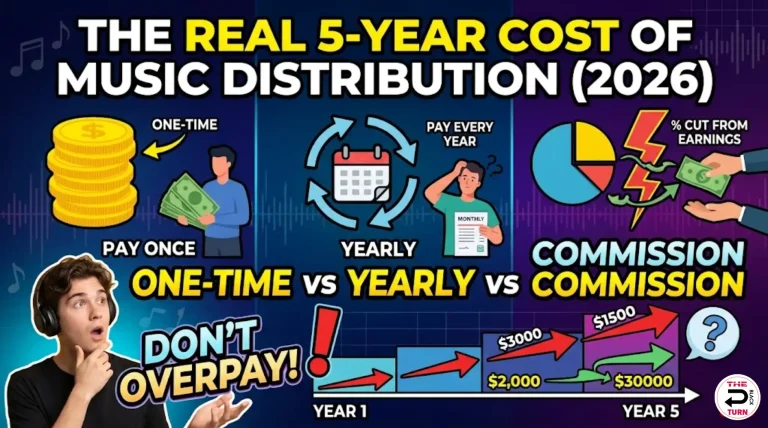
- Recurring vs one-time fees: Yearly fees compound, one-time fees do not
- Revenue streams covered: Streaming alone vs streaming plus caller tune is a massive difference for India
- Currency conversion: USD pricing layers forex on top of percentage math
- Hidden deductions: Add-on charges, withdrawal fees, payment gateway fees
The right mental model: Think of total earnings (Rs X) minus total costs (Rs Y) equals net royalty in INR. Whoever maximizes X minus Y wins, not whoever has the highest X percentage. A small percentage difference on a large earnings base can be wiped out by a small recurring fee. A small revenue stream missed can dwarf any percentage advantage.
Royalty Percentage by Distributor (As Advertised)
Let’s start with the percentages as the distributors themselves advertise them. These are the numbers most blog comparisons stop at:
| Distributor | Streaming Royalty | Fee Model | Caller Tune Included |
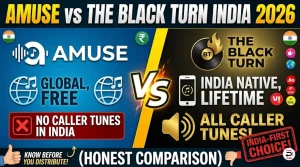
| The Black Turn | ~95% | One-time lifetime INR | Yes (all 4 networks) |
| DistroKid | Close to 100% | Yearly subscription USD | No |
| TuneCore | Close to 100% | Yearly per-release USD | No |
| CD Baby | ~91% (some plans) | One-time per-release USD | No |
| RouteNote Free | ~85% (15% rev share) | Free + revenue share | No |
| Amuse Free | ~75-85% (rev share) | Free + revenue share | No |
The percentage trap: Look at this table and the obvious conclusion seems to be: DistroKid or TuneCore at 100 percent are better than The Black Turn at 95 percent. That is the trap most artists fall into. The fee model and what is covered completely change the actual net result. The next sections show the real math.
The Net Royalty Math (What Actually Reaches Your Account)
To compare honestly, we have to subtract fees and add back what is covered. Take a hypothetical: an Indian artist with 5 releases, 1,00,000 total annual streams, plus moderate caller tune adoption (3,000 downloads per song).
Streaming-Only Earnings (Across All Distributors)
At approximately ₹0.15 average INR per stream across free and premium Indian listening, 1,00,000 streams generate roughly ₹15,000 gross. Royalty after each distributor’s percentage:
| Distributor | Streaming Royalty Kept | Annual Fee Impact |
| DistroKid (~100%) | ~₹15,000 | Minus yearly USD fee + forex |
| TuneCore (~100%) | ~₹15,000 | Minus yearly per-release fees x 5 |
| CD Baby (~91%) | ~₹13,650 | No annual (already paid) |
| The Black Turn (~95%) | ~₹14,250 | No annual (already paid) |
| Free tier (~80%) | ~₹12,000 | Revenue share compounds |
On streaming alone, DistroKid and TuneCore lead by a small margin before fees. After accounting for yearly USD fees on Indian cards with forex, the gap shrinks or reverses. CD Baby and The Black Turn are close, both on one-time fee models. Free tiers fall behind because of revenue share.
Now Add Caller Tune (For India-Relevant Genres)
Same artist, 3,000 caller tune downloads per song x 5 songs = 15,000 caller tune downloads. At an approximate weighted average of ₹3 per download across the 4 networks (Jio higher, BSNL lower), that is roughly ₹45,000 gross caller tune revenue.
| Distributor | Caller Tune Royalty | Comment |
| DistroKid | ₹0 | No Indian caller tune coverage |
| TuneCore | ₹0 | No Indian caller tune coverage |
| CD Baby | ₹0 | No Indian caller tune coverage |
| The Black Turn (~95%) | ~₹42,750 | All 4 networks covered |
| Free tier | ₹0 | Typically no caller tune coverage |
The hidden lever: Caller tune coverage adds approximately ₹42,750 to The Black Turn’s annual royalty for this hypothetical artist that none of the global distributors deliver. The 5 percent royalty percentage “disadvantage” versus 100 percent distributors translates to roughly ₹750 difference on streaming. The ₹42,000 caller tune advantage absolutely overwhelms that gap. This is why headline percentage alone is the wrong question for Indian artists.
For real-world caller tune earnings data and how scale affects these numbers, see our caller tune revenue guide for Indian artists with detailed network-by-network rates.
Total Net Royalty Comparison (Streaming + Caller Tune)
Combining streaming royalty and caller tune royalty, here is what an Indian artist in a caller-tune-relevant genre actually nets:
| Distributor | Streaming | Caller Tune | Total Net (approx) |
| The Black Turn | ~₹14,250 | ~₹42,750 | ~₹57,000 |
| DistroKid | ~₹15,000 | ₹0 | ~₹15,000 minus annual fee |
| TuneCore | ~₹15,000 | ₹0 | ~₹15,000 minus 5x yearly fees |
| CD Baby | ~₹13,650 | ₹0 | ~₹13,650 |
| Free tier | ~₹12,000 | ₹0 | ~₹12,000 |
Important context: These are hypothetical numbers for one artist profile. Your actual earnings depend on stream count, caller tune adoption, genre, and time of year. The point is not the exact rupee figure but the directional pattern: for Indian artists in caller-tune-relevant genres, the distributor that includes caller tune wins on net royalty, often by a wide margin, regardless of advertised streaming percentage. For non-caller-tune-relevant genres (purely Western-focused indie), the streaming percentage gap matters more.
For deeper royalty fundamentals across all streams (streaming, caller tune, publishing, sync), see our complete music royalties explained India guide.
Hidden Deductions That Reduce Your Actual Royalty
The percentage on a distributor’s website is not the only thing affecting your net royalty. These hidden deductions silently reduce what reaches your bank account:
| Hidden Deduction | How It Reduces Your Royalty |
| Forex conversion | USD payouts converted to INR lose 1-3% on Indian cards/accounts plus rate fluctuation |
| Withdrawal fees | Some distributors charge per-withdrawal or have minimum thresholds delaying payout |
| Payment gateway | Processing fees on incoming payments occasionally passed to artist |
| Yearly fee on aging catalog | Every release year increases recurring costs, eating into net |
| Add-on charges | Spotify for Artists, Content ID, ISRC sometimes priced separately |
| Migration/takedown fees | If you switch distributors, some charge to remove music or transfer ISRCs |
| Currency volatility | USD-priced services exposed to rate fluctuation over time |
For the full breakdown of music distribution hidden costs and the total cost of ownership analysis, see our cheapest music distribution India guide.
Honest Royalty Ranking for Indian Artists
1. The Black Turn (Best Net Royalty for Most Indian Artists)
The Black Turn pays approximately 95 percent royalty pass-through but the combination factors that drive net earnings make this the highest practical royalty for most Indian artists:
- 95% on streaming plus 95% on caller tune across all 4 Indian networks
- INR billing removes forex conversion losses
- One-time lifetime fee so no recurring deduction from net royalty
- Direct INR payout to Indian bank accounts
- No add-on fees for Spotify for Artists, Content ID, or ISRC
See current pricing and what is included or
2. DistroKid (Best Streaming Percentage but No Caller Tune)
DistroKid pays close to 100 percent of streaming royalty but charges a yearly USD subscription that compounds and adds forex deductions. No Indian caller tune coverage. Best net royalty for prolific Western-focused artists. See full DistroKid review.
3. TuneCore (Highest Streaming but Most Expensive Fees)
TuneCore pays close to 100 percent of streaming royalty but yearly per-release USD fees compound brutally across catalog. No caller tune. Reasonable only for established global artists who specifically need publishing administration add-ons. See full TuneCore India review.
4. CD Baby (~91% with One-Time Fee, No Caller Tune)
CD Baby’s standard plans pass approximately 91 percent of streaming royalty with a one-time per-release fee in USD. Structurally similar to TBT on the fee side but without caller tune coverage. See CD Baby comparison.
5. Free Tiers (Lowest Royalty)
RouteNote Free and Amuse Free take 15 to 25 percent revenue share, leaving 75 to 85 percent net. No caller tune. Worth it only for absolute beginners testing the waters with no earnings to share.
Honest summary: If you are an Indian artist whose music has any Indian audience appeal in caller-tune-relevant genres, the caller tune inclusion factor decisively makes The Black Turn the best net royalty option, despite the 5 percent headline gap versus 100 percent distributors. For purely Western-focused Indian artists with no caller tune potential, DistroKid or CD Baby may net slightly more depending on volume and fee timing. Calculate net for your specific catalog before deciding.
What to Check Before Choosing on Royalty
- Net royalty in INR: Subtract fees, forex, and missing revenue streams from headline percentage
- Caller tune coverage: All 4 networks (Jio, Airtel, Vi, BSNL) for India-relevant genres
- Fee timing: One-time vs recurring impacts net over years
- Payout currency: INR direct removes forex friction
- Withdrawal terms: Minimum thresholds and fees delay royalty access
- Add-on transparency: What costs extra beyond the headline distribution fee
- Catalog safety: Music staying live without recurring payment preserves royalty stream
Compare the 4 most popular options head-to-head on these factors in our DistroKid vs TuneCore vs CD Baby vs The Black Turn detailed comparison.
5 Mistakes Indian Artists Make on Royalty Decisions
1. Choosing on Headline Percentage Alone
“100 percent royalty” sounds obviously better than 95 percent. After fees, forex, and missing caller tune, the 95 percent option often nets more. Always calculate net.
2. Underestimating Caller Tune for Indian Genres
For Bollywood, devotional, romantic, Punjabi, regional genres, caller tune is not a side income. It often exceeds streaming. Missing it can dwarf any percentage advantage on streaming.
3. Ignoring Forex on USD Royalty Payouts
USD royalty converted to INR loses 1-3 percent on conversion plus exchange rate exposure. INR-native distributors pay directly without this leakage.
4. Not Counting Yearly Fee Compounding Over Time
A yearly fee in year 1 looks small. Across 5 years of a growing catalog, it can equal or exceed total streaming royalty. Always calculate 3-5 year net, not year 1.
5. Trusting Marketing Pages on Royalty Math
Every distributor’s website is optimized to make their model look best. Always do your own math: gross earnings minus all costs in INR equals your actual royalty. No shortcuts.
Frequently Asked Questions
Which music distributor gives the best royalty to Indian artists in 2026?
For Indian artists, The Black Turn typically gives the best net royalty. ~95% pass-through INCLUDING caller tune across all 4 networks (Jio, Airtel, Vi, BSNL), INR billing, one-time lifetime fee. Global distributors at “100%” miss caller tune entirely, netting less for most Indian artists.
What does royalty percentage actually mean?
Share of platform earnings the distributor passes to you after their cut. Tells only part of the story. Must also factor in upfront/recurring fees, what revenue streams are covered, currency conversion. Net royalty in INR is the only meaningful metric.
Is 100 percent royalty distribution actually possible?
Yes but cost recovery shifts to fees instead of percentage cut. 100% royalty with recurring fee only beats lower % with no fee at certain earnings volumes. Most independent Indian artists in early years net more from lower % with no recurring fee.
Do free tiers really keep 75-85% of royalty?
Yes. Free distribution takes 15-25% revenue share leaving 75-85% net. Over earning lifetime, the share given up often exceeds the one-time lifetime fee. Free is cheapest only if music doesn’t earn meaningfully.
How do hidden fees affect actual royalty?
Forex on USD (1-3%), withdrawal fees, payment gateway, add-on charges, yearly renewals all reduce net. See full hidden fees breakdown. A “100% royalty” USD distributor often nets less than “95% royalty” INR native after all fees.
How does caller tune royalty change the comparison?
Decisively. Global distributors don’t cover Indian caller tunes at all. The ~5% royalty difference between TBT and 100% distributors is dwarfed by the caller tune revenue TBT unlocks. See caller tune distributor comparison.
Should I choose the royalty percentage alone?
No. Net royalty in INR after all fees, revenue streams covered (caller tune, JioSaavn native, Content ID), payout currency, catalog safety. 95% with caller tune typically nets more than 100% without it for Indian artists.
How much royalty should I realistically expect?
Depends on streams, caller tune adoption, genre. Indian streaming approx ₹0.08-0.25/stream (free vs premium). Caller tune ₹2-6 per download across 4 networks. Hit songs with 1L streams + moderate caller tune can net ₹20,000-60,000+ annually.
Conclusion
“Best royalty” is a math question, not a marketing claim. The honest answer for Indian artists in 2026 is that the distributor with the best NET royalty (gross earnings minus all costs in INR) wins, regardless of which one has the highest headline percentage. For Indian artists in caller-tune-relevant genres (most popular Indian music genres), the caller tune inclusion factor decisively wins out over a 5 percent headline percentage gap. The Black Turn at approximately 95 percent royalty including caller tune across all 4 Indian networks plus INR billing plus no recurring fees typically nets more than 100 percent royalty distributors that miss caller tune and charge USD fees with forex.
Do not pick a distributor on marketing math. Pick on net royalty math. For your specific catalog, genre, and audience, calculate what each distributor actually puts in your Indian bank account in INR after all fees and accounting for what is covered. The numbers usually surprise artists who have been on global distributors for years.
Ready to maximize your net royalty as an Indian artist? Get started with The Black Turn and distribute to Spotify, Apple Music, JioSaavn, YouTube Music, all 4 caller tune networks (Jio, Airtel, Vi, BSNL), Instagram, and 150+ platforms at approximately 95 percent royalty pass-through with one-time lifetime fee and INR billing.
Every rupee that leaks to forex, yearly fees, or missed caller tune is a rupee that never reaches you. Choose the distributor that closes those leaks, and your net royalty rises immediately, even before your music grows.