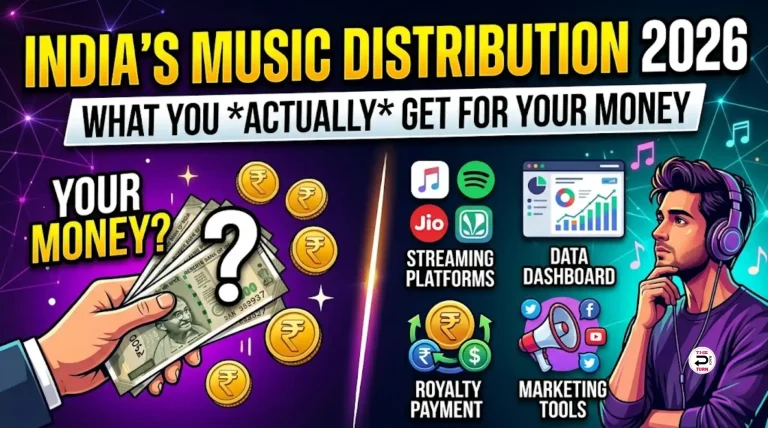
You opened 6 different distributor websites to compare prices. Each one displays cost differently. One is yearly. One is per-release. One is yearly per-release (which somehow exists). One is free with a catch. One is in USD that you have to mentally convert. By tab 7, the prices have stopped making sense and you are not sure which one is actually cheapest for you in India.
This is the reference page that should have existed already. Every major music distribution service for Indian artists in 2026, all in one comparison table, with INR pricing where available and USD-with-forex notes where not. Plus scenario calculations across realistic catalog sizes and timeframes. Plus hidden fees most blog posts skip. Plus what is actually included at each price point so you can compare like for like.
Save this page. Come back to it when you are deciding. The pricing landscape changes occasionally, so we note approximate ranges and link to each provider’s official pricing for the current exact number. The structural comparisons (one-time vs yearly, INR vs USD, what is included) stay accurate even when individual numbers move.
First, Understand the 4 Pricing Models
Before comparing numbers, understand the structural difference between pricing models. The same headline price can mean completely different things across these:
| Model | How It Works |
| One-time Lifetime | Pay once per release, music stays live forever, no recurring cost ever |
| Yearly Subscription | Pay annually for unlimited uploads, music removed if you stop paying |
| Yearly Per-Release | Pay annually for each release, every release accumulates yearly cost |
| Free + Revenue Share | No upfront cost but distributor takes a percentage of streaming royalty |
Why this matters: A Rs 700 one-time fee and a Rs 700 yearly fee look identical at year 1. By year 5 across 5 releases, the one-time cost remains Rs 3500 total while the yearly per-release model has accumulated to Rs 17500 plus. The pricing MODEL matters more than the individual number. Always check structure first, sticker price second.
Master Price Comparison Table (All Major Services)
Approximate pricing for 2026. Always verify exact current numbers on each provider’s official pricing page before committing. INR equivalents for USD services depend on current exchange rate and your card’s forex fee.
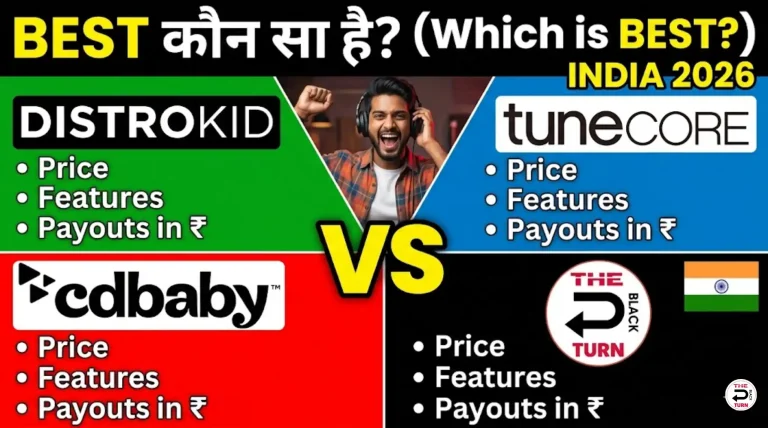
| Service | Pricing Model | Approx Cost (INR) | Currency | Caller Tune |
| The Black Turn | One-time lifetime | ₹599-799 per release | INR native | Yes (all 4) |
| RouteNote Free | Free + revenue share | ₹0 upfront | USD-based | No |
| Amuse Free | Free + revenue share | ₹0 upfront | USD-based | No |
| CD Baby | One-time per-release | USD + forex on card | USD | No |
| DistroKid | Yearly subscription | USD + forex yearly | USD | No |
| TuneCore | Yearly per-release | USD + forex yearly per release | USD | No |
| Ditto Music | Yearly subscription | USD + forex yearly | USD | No |
| ONErpm | Revenue share (no upfront) | ₹0 upfront | USD-based | Limited |
Read the table fairly: Lower upfront cost does not equal lower total cost. Free tiers and revenue share models have no INR sticker but extract value through royalty share. USD services have forex layered on top. The Black Turn is the only INR-native option with caller tune included. Always compare total earnings net of total cost across 3 to 5 years, not just headline upfront.
See current The Black Turn pricing and what is included for the most up-to-date INR numbers. For a detailed analysis of why the cheapest sticker is not always cheapest, see
Scenario Costs. What You Actually Pay Across Real Catalogs
Headline pricing is misleading because realistic artists release multiple songs over multiple years. Here is what each model actually costs across three common scenarios:
Scenario 1: 1 Release Over 3 Years
| Service | Year 1 | 3-Year Total |
| The Black Turn | ₹599-799 once | ₹599-799 |
| CD Baby | USD fee + forex (one-time) | Same as Year 1 |
| TuneCore | USD fee + forex | 3x Year 1 USD |
| DistroKid | USD yearly sub + forex | 3x Year 1 USD |
| Free tier | ₹0 + revenue share | Revenue share accumulating |
Scenario 2: 5 Releases Over 3 Years
| Service | Year 1 | 3-Year Total |
| The Black Turn | ₹2,995-3,995 once | Same (stays flat) |
| CD Baby | 5x USD fee + forex | Same as Year 1 total |
| TuneCore | 5x yearly USD + forex | 15x yearly USD by Year 3 |
| DistroKid | Yearly sub USD | 3x yearly sub USD |
| Free tier | ₹0 + revenue share on 5 songs | 3 years of revenue share |
Scenario 3: 10 Releases Over 5 Years
| Service | Total Paid | Cost Pattern |
| The Black Turn | ₹5,990-7,990 once | Flat, no growth |
| CD Baby | 10x USD + forex one-time | Flat, no growth |
| TuneCore | Up to 50 release-year instances | Compounds heavily |
| DistroKid | 5x yearly sub USD | Compounds with time |
| Free tier | ₹0 + 5 years of revenue share on 10 songs | Quietly highest if music earns |
The scenario pattern: One-time models (The Black Turn, CD Baby) stay flat regardless of time. Yearly subscriptions compound with time. Yearly per-release compounds with BOTH time and catalog. Free tiers cost ₹0 visible but extract value through revenue share that grows as your earnings grow. For most Indian artists with multi-year catalog plans, a one-time INR model is the lowest total cost.
For a side-by-side feature comparison of the top 4 services see DistroKid vs TuneCore vs CD Baby vs The Black Turn India. For the ranked overall verdict see
Hidden Fees Most Blog Posts Skip
The sticker price is rarely the full price. These are the hidden costs Indian artists report most often:
| Hidden Cost | What It Is |
| Forex conversion | Indian cards add 1 to 3 percent on USD transactions, plus exchange rate fluctuation |
| Payment gateway fees | Some services pass payment processor fees on top of headline price |
| Royalty withdrawal fees | Flat fee or threshold for transferring earnings to your Indian bank account |
| Add-on charges | Spotify for Artists pitching credits, YouTube Content ID upgrade, ISRC own-prefix sometimes priced separately |
| Takedown / migration fees | Some services charge to remove music or transfer ISRCs when you switch |
| Yearly renewal compounding | Year 1 looks cheap, Year 5 reveals you have paid more than a lifetime model would have |
| Free tier revenue share | Not a fee on paper but a continuous deduction often exceeding a one-time fee over time |
| Currency rate slip | USD-INR rate moves, so your effective INR cost varies even at constant USD price |
How to find these: Read the full pricing page including FAQ and terms of service. Check Reddit, indie music forums, and YouTube reviews for the specific distributor plus phrases like “hidden fees”, “unexpected charges”, or “what they do not tell you”. Real user experiences surface what marketing pages quietly omit. Total cost in INR after all fees is the only honest comparison.
What Is Actually Included at Each Price Point
A low price is only low if it includes what you actually need. Here is what is typically included across the major options:
| Feature | Free Tier | Global Paid (USD) | INR Lifetime (TBT) |
| Spotify / Apple Music / YouTube Music | Yes | Yes | Yes |
| JioSaavn | Limited (via partners) | Limited (via partners) | Native delivery |
| Caller tune (all 4 networks) | No | No | Yes |
| YouTube Content ID | Often limited | Yes | Yes |
| Royalty pass-through | Revenue share kept | High | ~95% |
| Catalog stays live without payment | Yes (with share) | Only one-time models | Yes (lifetime) |
| INR billing native | No | No | Yes |
| INR payout direct | Via conversion | Via conversion | Direct |
Cheapest Service By Use Case
| Your Situation | Cheapest Smart Choice |
| Absolute zero budget, single experimental release | Free tier (RouteNote / Amuse) accepting revenue share |
| Indian artist, 1-20 releases, caller-tune-relevant genre | The Black Turn (₹599-799 lifetime per release) |
| Lowest 5-year total cost across growing catalog | The Black Turn (lifetime stays flat) |
| Releasing 50-plus tracks per year, Western focus | DistroKid yearly subscription (unlimited uploads) |
| Want INR billing, no forex friction | The Black Turn (INR native) |
| Want one-time but global market, no caller tune need | CD Baby (one-time USD per release) |
| Established global artist, want publishing admin | TuneCore (yearly per release with admin add-on) |
If you are currently on a specific service and looking to switch, see DistroKid alternative,
How to Budget for Music Distribution Realistically
If you are planning your release budget for the next year, here is the realistic Indian artist breakdown:
- Distribution (per release): ₹599-799 on one-time lifetime model. For 5 releases planned over the year, that is ₹2,995-3,995 total in distribution.
**Mastering (per release, optional):** Free (BandLab AI) to ₹15,000 (professional engineer). Affordable AI services around ₹200-1000 per song are reasonable starting point. See mastering guide for options.
**Cover art (per release):** Free (Canva, DIY) or ₹500-5000 (designer). Free option works well for beginners. Cover art guide here.
- Promotion (per release, optional): ₹0 (organic Reels) to ₹5,000-20,000 (small targeted ads) per release. Optional but Reels strategy is free and effective.
- Total realistic year-1 budget: ₹5,000-15,000 for 5 releases professionally distributed and basic mastering or higher with premium production.
Budget reality: Music distribution itself is the smallest part of an Indian artist budget. The hidden expensive things are usually professional studio time, video production, and paid promotion. Distribution on a one-time INR lifetime model is genuinely affordable. Do not let “distribution price” be the friction blocking your release.
5 Common Music Distribution Pricing Mistakes
1. Comparing Headline Prices Across Different Models
A Rs 700 one-time and a Rs 700 yearly look identical but are completely different over time. Always compare structure first, then total cost across 3 to 5 years.
2. Ignoring Forex on USD Services
A USD service that quotes $20 costs more than Rs 1700 in INR after forex and rate variation. The real INR cost is what matters, not the headline USD price.
3. Assuming Free Is Free
Free tiers take revenue share. Over a song’s earning life, the share given up often exceeds what a one-time lifetime fee would cost. Free is free only on Day 1.
4. Picking Cheapest Without Checking What Is Included
Cheapest distribution missing caller tune costs MORE than slightly higher distribution including caller tune, because the caller tune revenue more than offsets the price difference for Indian artists in caller-tune-relevant genres.
5. Not Calculating Catalog Total
Most artists evaluate based on one release. By year 5 with 10 releases on a compounding model, the cost is dramatically different from a one-time model. Always calculate full catalog cost, not single release.
Frequently Asked Questions
What is the price of music distribution in India in 2026?
Varies by model. One-time lifetime per release at The Black Turn around ₹599-799 INR. Yearly subscription services in USD (DistroKid, Ditto). Yearly per release in USD (TuneCore). One-time per release in USD (CD Baby). Free tiers with revenue share (RouteNote, Amuse). Always verify current exact official pricing.
Which has the lowest price in India?
Free tiers (RouteNote, Amuse) on upfront. Among paid lifetime, The Black Turn at ₹599-799 INR per release. On total 3-5 year cost across a catalog, one-time INR lifetime usually wins. Lowest sticker is not always lowest total.
How much do DistroKid TuneCore CD Baby cost in INR after forex?
USD priced services add 1-3% forex on Indian cards plus rate fluctuation. Exact INR depends on current rate and your card. Always check official current USD pricing and your card statement for actual INR amount.
Is free music distribution actually free?
Free upfront but takes revenue share from earnings. Often lacks caller tune. Free becomes more expensive than paid lifetime once your music earns. Fine for testing, expensive once earning.
What is the total cost over 5 years?
Lifetime stays flat. Yearly subscriptions compound with time. Yearly per release compounds with time AND catalog. Free shares revenue indefinitely. For typical Indian artist with 5-20 song catalog, INR lifetime usually wins.
Which has hidden charges in India?
Watch for: forex conversion on USD pricing, payment gateway fees, royalty withdrawal fees, add-on charges, takedown/migration fees, yearly renewal compounding, free tier revenue share, currency rate slip. Read full pricing FAQ and check user discussions.
Price difference between lifetime and yearly?
Lifetime: pay once, stays forever, no recurring cost. Yearly: pay every year, music removed if you stop. Across 5 years with growing catalog, lifetime usually significantly cheaper while also removing forex and takedown risk.
How much should I budget per release?
Realistic budget: ₹599-1500 per release on one-time lifetime with full Indian coverage. Below ₹599 typically means trade-offs. Above ₹1500 usually paying for unused features. Add separately for mastering. See current pricing.
The Bottom Line
Music distribution pricing in India in 2026 is not actually complicated once you separate structure from sticker. There are 4 pricing models: one-time lifetime, yearly subscription, yearly per-release, and free with revenue share. Each has a math pattern: lifetime stays flat, yearly compounds with time, yearly per-release compounds with both time and catalog, free shares revenue forever. Pick your model first, then your service within that model.
For most Indian artists releasing for an Indian audience in 2026, the math points to one-time INR-native lifetime per release that includes caller tune across all 4 networks. The Black Turn at approximately ₹599-799 per release fits this for the broadest set of situations. Free tiers work for absolute beginners testing the waters. Yearly subscription works for hyper-prolific Western-focused releasers. Yearly per-release rarely makes sense for Indian artists. CD Baby works for non-caller-tune global one-time use cases.
Ready to release at the lowest real INR cost with full Indian coverage? Get started with The Black Turn and distribute to Spotify, Apple Music, JioSaavn, YouTube Music, all 4 caller tune networks (Jio, Airtel, Vi, BSNL), Instagram, and 150+ platforms on a one-time lifetime per-release fee.
Save this page and come back when you are deciding. The structural comparisons hold up over time even when individual prices move. The most important thing you can do is pick your pricing model intentionally, then optimize within that model. For Indian artists in 2026, one-time INR lifetime is usually the model. Within it, The Black Turn is the answer.