You went with CD Baby because the one-time payment model felt right. No yearly renewals. No takedown risk hanging over your old catalog. Just pay once per release and move on. The structural model made sense, and it still does. The issue is not the pricing structure. The issue is everything else: caller tune that does not reach Indian networks, USD billing with forex on every transaction, customer support that does not understand the Indian market, and JioSaavn coverage that goes through partners rather than direct.
You are searching for a CD Baby alternative for a reason that is specific and clear. Not because the one-time model is wrong, but because you want the same model with India fit. That answer exists. It is not DistroKid (yearly subscription, same caller tune gap). It is not TuneCore (yearly per-release, even more expensive over time). It is an India-built distributor that uses the same one-time per-release model CD Baby uses, plus everything CD Baby is missing for Indian artists.
This is an honest, India-first look at CD Baby alternatives in 2026. We give CD Baby genuine credit for what it does well, explain exactly why Indian artists migrate away, rank the alternatives specifically for Indian artists, walk through the switch process safely, and show how to preserve your accumulated streams. No bashing. Just a clear answer to what brought you here.
First, Credit Where It Is Due
CD Baby is not a bad distributor. It has been in business since 1998 and has specific strengths worth acknowledging:
- One-time per-release model that avoids the yearly takedown risk of DistroKid and TuneCore
- Established global brand with long indie distributor history
- Sync licensing services for placement in film, TV, ads in Western markets
- Physical distribution options for artists wanting CDs and vinyl
- Stable global delivery to major streaming platforms
Honest framing: If you are a globally-focused Indian artist whose audience is primarily Western, who actively uses Western sync placement services, and who does not depend on Indian caller tune or JioSaavn-native delivery, CD Baby remains a reasonable choice. That profile is a narrow slice of Indian artists. For everyone else, especially those releasing for Indian audiences, an India-built one-time alternative typically wins on real earnings.
Why Indian Artists Actually Leave CD Baby
Five specific reasons drive Indian artists to look for CD Baby alternatives:
Reason 1: No Caller Tune Coverage (The Biggest Gap)
CD Baby does not distribute to Indian caller tune networks (Jio, Airtel, Vi, BSNL). For Indian artists in Bollywood-style, devotional, romantic, Punjabi, or regional genres, caller tune can out-earn streaming. Missing all 4 networks on CD Baby is leaving real Indian revenue uncollected. See exactly how much caller tune actually pays Indian artists.
Reason 2: USD Pricing With Forex Charges
CD Baby prices per release in USD. Indian credit and debit cards add 1 to 3 percent forex conversion on every transaction. A CD Baby fee that looks reasonable in USD shows up larger on your INR card statement, plus exposure to USD-INR rate fluctuation. An INR-native alternative removes this entirely.
Reason 3: Limited India-Market Context
CD Baby is a US-based company. Indian artists report support responses that do not understand caller tune economics, JioSaavn dynamics, IPRS/PPL registration, Indian payout flows, or India-specific release strategies. India-built distributors operate in this context natively.
Reason 4: JioSaavn Coverage Via Partners
CD Baby can reach JioSaavn but typically through partner aggregation rather than native direct relationships. India-focused distributors with direct JioSaavn relationships often deliver more reliably and with better metadata handling for the Indian audience that uses JioSaavn heavily.
Reason 5: Customer Service Concerns
User feedback in indie music communities has flagged inconsistent customer support response times and quality at CD Baby in recent years. This is a recurring concern Indian artists mention as a reason for considering alternatives, particularly when issues require India-context understanding.
For a fuller side-by-side breakdown that includes CD Baby in the comparison, see our detailed CD Baby vs DistroKid vs The Black Turn comparison.
What an Ideal CD Baby Alternative for Indian Artists Looks Like
The good news: you do not have to give up the one-time payment model to fix the India gaps. An ideal alternative keeps the structural payment advantage while adding the India-specific features. The criteria:
- One-time per-release pricing (keep the structural advantage CD Baby offered)
- INR native billing with no forex friction
- All 4 caller tune networks (Jio, Airtel, Vi, BSNL)
- Native JioSaavn delivery not via partners
- High royalty pass-through
- YouTube Content ID included
- Direct INR payout to Indian bank accounts
- India-market context in support and product
Top CD Baby Alternatives for Indian Artists (Ranked)
1. The Black Turn (Best Overall for Indian Artists)
The Black Turn is the strongest CD Baby alternative specifically for Indian artists because it preserves the one-time payment model you liked about CD Baby while addressing every India-specific gap CD Baby leaves.
| Factor | CD Baby | The Black Turn |
| Pricing model | One-time per-release | One-time lifetime per-release |
| Currency | USD + forex | INR native |
| Caller tune (4 networks) | No | Yes (all 4) |
| Royalty pass-through | High | ~95% |
| JioSaavn delivery | Via partners | Native |
| YouTube Content ID | Yes | Yes |
| INR payout to bank | USD-based with conversion | Direct INR |
| India-context support | Limited | Native |
See current The Black Turn pricing and what is included or read the full
2. DistroKid (Honest Mention for High-Volume Western-Focused)
DistroKid uses a yearly subscription model so it actually trades CD Baby’s structural advantage for unlimited uploads instead. Reasonable only if you release very high volume for Western audiences and accept the takedown risk if payments lapse. Still no Indian caller tune. See DistroKid review.
3. TuneCore (Honest Mention for Established Global Artists)
TuneCore charges yearly per-release in USD with publishing admin add-ons. Switching from CD Baby to TuneCore actually makes the recurring cost situation worse over time. Better only if you specifically need publishing administration. Still no Indian caller tune. See TuneCore India review.
4. RouteNote Free (Honest Mention for Zero-Budget Testers)
RouteNote’s free tier eliminates the upfront cost completely but takes revenue share and lacks caller tune. Fine for absolute beginners testing the waters, not a serious CD Baby replacement for active artists. See RouteNote India review.
Honest summary: For Indian artists who chose CD Baby specifically for the one-time payment model and want to keep that structural advantage while fixing the India gaps, The Black Turn is the direct answer. DistroKid and TuneCore actually move you AWAY from the one-time model. RouteNote loses serious functionality. The Black Turn keeps what worked about CD Baby and adds what was missing.
CD Baby vs The Black Turn for Indian Artists. The Real Math
Take a realistic Indian artist scenario: 6 releases over the next 3 years, all kept active for the long term.
| CD Baby (USD one-time) | The Black Turn (INR lifetime) |
| Each release: USD fee + forex on Indian card | Each release: ₹599-799 INR, no forex |
| Caller tune earnings: ₹0 (not covered) | Caller tune earnings: full (all 4 networks) |
| JioSaavn: via partners | JioSaavn: native delivery |
| Royalty: high but USD-based | Royalty: ~95% in INR direct |
| Support: limited India context | Support: India-native |
| INR cost after forex: variable | INR cost: flat, predictable |
For a complete head-to-head detailed feature comparison see DistroKid vs TuneCore vs CD Baby vs The Black Turn. If price specifically is your concern,
How to Switch from CD Baby Safely (Step by Step)
Step 1: Extract Your CD Baby ISRCs
From your CD Baby dashboard, document every released track with its CD Baby-assigned ISRC code. This is critical because CD Baby assigns ISRCs by default, and you need these exact codes carried forward to preserve streaming history. See the ISRC code guide for context.
Step 2: Confirm ISRC Carry-Forward With New Distributor
Before any other step, confirm the new distributor will accept your existing CD Baby-assigned ISRCs. If they insist on assigning fresh ISRCs, your Spotify and other platform streaming history will split. This is a hard requirement, not a preference.
Step 3: Upload Your Catalog With Existing ISRCs
Upload each release to the new distributor with the CD Baby-assigned ISRC for that recording. This is what tells Spotify and Apple Music to treat the new source as the same recording, preserving streams and playlist placements.
Step 4: Wait for New Distribution to Go Live
Allow 7 to 14 days for new distributor delivery to fully propagate to Spotify, Apple Music, JioSaavn, and others. Verify each track is live via the new source before proceeding.
Step 5: Handle CD Baby Sync or Other Active Services
If you have active CD Baby sync registrations or other ancillary services, decide whether to continue those separately or close them. Sync deals already placed will continue per the deal terms even after distribution moves.
Step 6: Take Down CD Baby Releases
Only after the new distribution is verified live, request CD Baby to take down those releases. This sequencing avoids any gap where your music is unavailable to listeners or platforms.
Step 7: Verify Stream and Royalty Continuity
Confirm on Spotify for Artists that streaming history is preserved and the new distributor’s royalty pipeline begins (first royalty payment takes 3 to 4 months due to standard reporting cycles, this is normal).
Most common CD Baby switching mistake: Letting the new distributor auto-assign fresh ISRCs without verifying. CD Baby originally gave you specific ISRC codes per recording. If the new distributor does not use those exact codes, Spotify treats it as a different recording and your streaming history splits across two entries. Always pass the existing ISRCs and confirm they are accepted.
What to Expect After Switching
- Stream continuity: If ISRCs were carried forward correctly, Spotify and other platform history is preserved
- No more forex on future releases: INR billing and INR payout from now on
- Caller tune revenue unlocks: CRBT royalty from Jio, Airtel, Vi, BSNL starts flowing
- Native JioSaavn delivery: More reliable metadata and faster updates on Indian streaming
- India-context support: Issues resolved with understanding of caller tune, IPRS, GST, and Indian payouts
- First royalty delay normal: 3 to 4 months for first new-distributor royalty is industry standard
5 Mistakes Indian Artists Make Switching from CD Baby
1. Letting New Distributor Assign Fresh ISRCs
CD Baby’s ISRCs must carry forward exactly. Fresh ISRCs split streaming history. Always pass the existing CD Baby ISRCs and confirm they are accepted.
2. Cancelling CD Baby Before New Distribution Is Live
Creates a takedown gap. Always overlap, never gap. Upload new first, verify live, then take down CD Baby.
3. Choosing an Alternative Without Caller Tune
Switching from CD Baby to DistroKid or TuneCore changes the pricing model but does not solve the caller tune gap. For Indian artists in caller-tune-relevant genres, this is a partial solution that misses the main reason to switch.
4. Trading Down From One-Time to Yearly Model
Moving from CD Baby (one-time) to DistroKid or TuneCore (yearly) gives up CD Baby’s structural advantage. If you valued the one-time model, look for a one-time alternative that adds India fit, not a yearly model.
5. Ignoring INR Forex Total
Many artists never total the forex they paid CD Baby across all releases. Pull statements, calculate the actual INR cost including conversion fees. The number is often higher than expected, especially across multiple releases.
Frequently Asked Questions
What is the best CD Baby alternative for Indian artists in 2026?
The Black Turn. Same one-time per-release payment model CD Baby uses, plus INR billing, all 4 caller tune networks, native JioSaavn, ~95% royalty pass-through, and India-context support. Directly addresses every CD Baby gap for Indian artists.
Why do Indian artists leave CD Baby?
No caller tune coverage across Indian networks, USD pricing with forex, limited India-market context, JioSaavn coverage via partners not native, customer support concerns. The one-time pricing model itself is not the issue; the India gaps around it are.
Does CD Baby offer caller tune in India?
No. Built for Western markets, no integration with Indian telecom CRBT (Jio, Airtel, Vi, BSNL). See caller tune earnings for what Indian artists miss.
Is The Black Turn cheaper than CD Baby?
Typically yes. The Black Turn at ₹599-799 INR per release is usually lower than CD Baby’s USD per-release fee after forex conversion on Indian cards. See full price analysis.
Can I switch from CD Baby without losing streams?
Yes, with CD Baby ISRCs carried forward to the new distributor. Same ISRC = streams preserved. Fresh ISRC = history splits. Always confirm ISRC handling. See ISRC guide.
Does CD Baby pay royalty in INR?
Not natively. CD Baby pays through USD-based accounting and converts/transfers to INR via standard payment processors with associated fees. India-native distributors pay directly in INR to Indian bank accounts without conversion friction.
What is the difference between CD Baby one-time and The Black Turn one-time?
Both are one-time per-release models. Difference: CD Baby is USD-priced, no Indian caller tune, JioSaavn via partners, global sync focus. The Black Turn is INR-priced (₹599-799), all 4 caller tune networks, native JioSaavn, Content ID included, India-context support.
What should I check before switching from CD Baby?
ISRC carry-forward policy, all target platforms including caller tune, total cost in INR after forex comparison, royalty percentage, INR billing/payout, how active CD Baby sync registrations are handled, and switching timing to avoid takedown gaps.
Conclusion
If you chose CD Baby specifically for the one-time payment model, you do not have to give that up to fix the India-specific gaps. The structural advantage that brought you to CD Baby (no yearly renewal, no takedown risk on missed payment, predictable per-release cost) is preserved when you switch to a one-time alternative built for India. You lose nothing structurally and gain caller tune, INR billing, native JioSaavn, and India context.
For Indian artists in 2026, The Black Turn is the direct one-time-to-one-time switch from CD Baby. Same payment model, same long-term catalog safety, plus everything CD Baby was missing for the Indian market. Switching badly preserves streams but loses momentum; switching well, with ISRCs carried forward and new distribution verified live before CD Baby takedown, keeps everything intact while unlocking the revenue streams that were not flowing before.
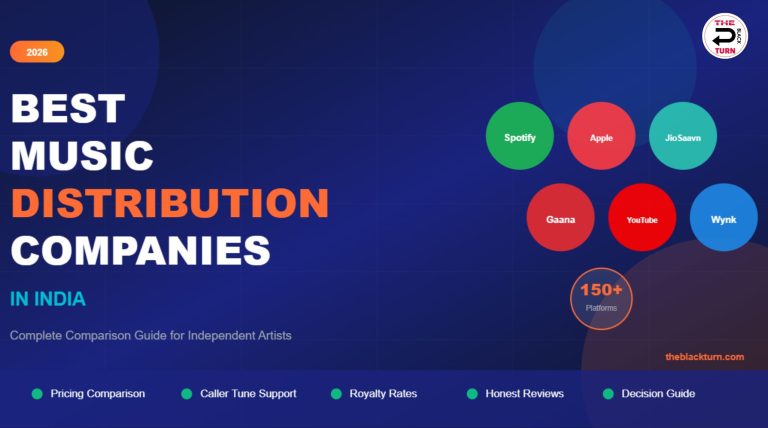
Ready to switch? Get started with The Black Turn and distribute to Spotify, Apple Music, JioSaavn, YouTube Music, all 4 caller tune networks (Jio, Airtel, Vi, BSNL), Instagram, and 150+ platforms on a one-time lifetime per-release fee in INR.
You came to CD Baby for the model. Keep the model. Switch the fit. Indian artists in 2026 deserve a one-time distributor that actually understands the Indian market, prices in their currency, and reaches the revenue streams that exist in their genres. That distributor exists. The switch takes 2 to 6 weeks if done in the right order. The earnings improvement starts as soon as the first caller tune royalty cycle lands.