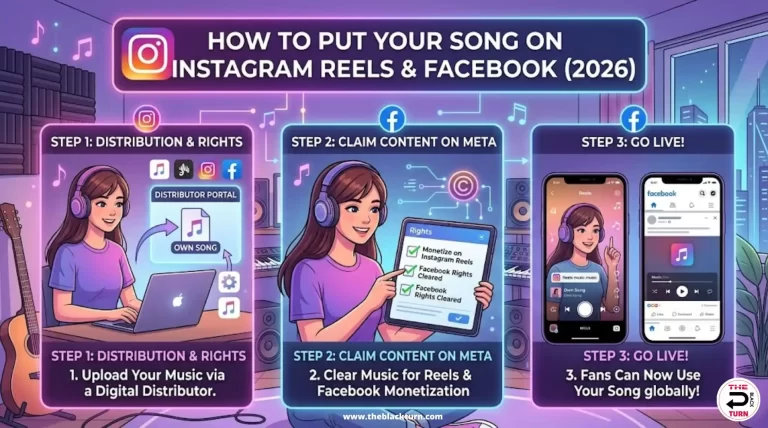
Releasing your first song is exciting and confusing at the same time. You have spent weeks or months making something, and now you need to deal with distributors, metadata, ISRC codes, cover art sizes, release dates, editorial pitching and a lot of other things nobody explained. Most blog posts assume you already know these terms, most distributor pages are full of jargon, and a lot of the advice online is written for Western artists.
This guide starts from zero. It explains what a distributor actually does, what you need ready before you upload, what a first release really costs, the mistakes most beginners make, and what to do in the first 30 days after your song goes live. Every important term is explained in plain words, so you do not need any music industry background to follow along.
If you encounter any unfamiliar term while reading, see our music distribution glossary which defines every music industry term with India-specific context. Bookmark it for reference throughout your music career.
Understanding Music Distribution. What It Actually Does
Music distribution is the service that delivers your song from you to streaming platforms like JioSaavn, Spotify, Apple Music, YouTube Music and others. As an individual you cannot upload directly to most major streaming platforms. They accept music from approved distributors. The distributor is your middleman: it delivers the song, sends the right details (metadata) with it, collects the money the platforms owe you and pays it into your account.
What Distribution Services Do
- Deliver your song to streaming platforms (JioSaavn, Gaana, Spotify, Apple Music, YouTube Music, Amazon Music, etc.)
- Assign ISRC and UPC codes that uniquely identify your track and your release
- Manage metadata so your name, title and credits show correctly everywhere
- Collect royalty from platforms on your behalf
- Pay you (INR to your Indian bank account with Indian distributors, usually USD with foreign ones)
- Provide reports showing which platforms and countries your earnings come from
- Activate YouTube Content ID so you earn from fan videos that use your song
- Cover Indian caller tune networks (Jio, Airtel, Vi, BSNL; only some distributors offer this)
What Distribution Does NOT Do
- Promote your music • Distribution delivers but does not market
- Guarantee earnings • Streaming revenue depends on your audience
- Replace a record label • Labels provide marketing money, advances and industry connections
- Pitch to editorial for you • You pitch your own song to Spotify’s editors through Spotify for Artists
- Manage publishing rights • Songwriter royalties (IPRS and similar societies) are a separate registration
How to Become an Independent Artist in India
An independent artist is simply an artist who releases music without a record label deal. You own your recordings, you decide when and what to release, and you keep most of the royalty. The flip side is that you also pay for production and do your own promotion.
Becoming one does not need any registration or licence. In practice it comes down to four things:
- Own what you release • Your own lyrics and composition, a beat you bought exclusively or made yourself, and written permission from anyone else who worked on it
- Pick one artist name • Check it on JioSaavn and Spotify first, so you do not end up merged with another artist of the same name
- Use a distributor • This is how your song reaches streaming platforms and caller tune networks
- Release regularly • One song rarely builds a career; a steady catalog does
Before You Release. What You Need Ready
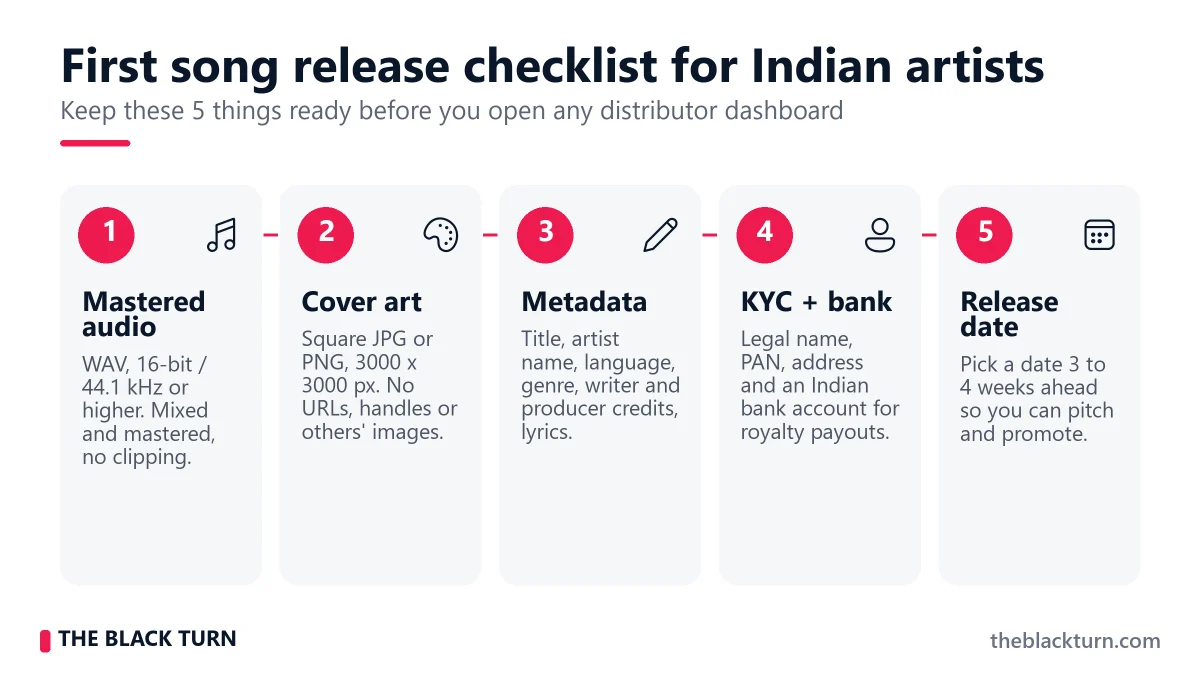
Before approaching any distributor, your song and supporting materials need to meet platform requirements. Most rejections happen because of preventable issues with these basics:
1. Your Song Audio File
Upload a WAV file at 16-bit / 44.1 kHz or higher. Most distributors do not accept MP3, and even where they do, it is lower quality. Get the song properly mixed and mastered before submission. Mastering makes your song sound balanced and competitive in loudness next to other songs in a playlist. Spotify turns every track up or down to about -14 LUFS (its loudness normalization page explains this), so crushing your song to be as loud as possible does not help.
If you cannot afford an engineer, there are online and AI mastering services. If you release with The Black Turn, mixing and mastering through TrackFix is free and unlimited, so you can fix the master before you upload.
2. Cover Art
Cover art should be a square JPEG or PNG at 3000×3000 pixels, which is what most distributors ask for. The artwork cannot contain URLs, social media handles, prices, unauthorized celebrity images, film stills, copyrighted characters or anything offensive. Your artist name and song title can appear on the cover but it is not required. If the name on the cover does not match the name in your metadata, the release can be sent back.
3. Metadata Information
You will need to provide: song title (exactly as it will appear on platforms), artist name (the same spelling on every release), album name (for a single, usually the same as the song title), release date (schedule 3-4 weeks ahead), genre, language, songwriter and composer credits (you and anyone else who wrote it), producer credits if applicable, and lyrics (some platforms show them).
4. Personal Identity Verification
Distributors verify identity before paying royalty. Keep ready your full legal name, address, PAN card for tax compliance, an email address you check, and bank account details for payouts. Indian distributors pay directly to your Indian bank account in INR. Foreign distributors usually pay in USD through PayPal or bank transfer, so you lose a little to currency conversion.
Pre-release checklist: Before signing up with any distributor, have your finished mastered audio file, 3000×3000 pixel cover art, song metadata details, and personal verification documents ready. Most first-time artist frustration comes from discovering these requirements mid-submission. Get them ready first.
Which Platforms Should a New Artist Release On?
Short answer: all of them. Releasing on more platforms costs nothing extra with most distributors, and you cannot predict where your first listeners will come from. For Indian listeners, these are the ones that matter most in 2026:
| Platform | Why it matters for a first release |
| JioSaavn | One of the biggest Indian streaming apps; strong for Hindi, Punjabi and regional music |
| Spotify | Best artist tools (Spotify for Artists, editorial pitching, Release Radar) |
| YouTube Music + Content ID | Indian fans discover music on YouTube; Content ID earns from fan videos and Shorts |
| Instagram / Facebook music | Lets people use your song in Reels and Stories, which is how many songs spread |
| Gaana, Apple Music, Amazon Music | Smaller but real audiences; no reason to skip them |
| Caller tunes (Jio, Airtel, Vi, BSNL) | Useful for Hindi, Punjabi, Haryanvi, Bhojpuri and devotional songs; needs a distributor that supports it |
Ignore old lists that still mention Wynk Music, Resso or Hungama Music. All three have shut down in India. Airtel caller tunes are now called Airtel Hellotunes, and fans set them in the Airtel Thanks app (see how fans set an Airtel Hello Tune). If caller tunes matter for your genre, read about caller tune distribution in India.
Choosing Your First Distributor
There are three ways distributors charge: a one-time fee per release, a yearly subscription, or “free” with a cut of your royalty. For first-time Indian artists, the realistic options are below. Prices are as of October 2026 and change often, so confirm on each company’s own pricing page before you pay.
| Distributor | Cost (as of October 2026) | Pros | Cons |
| The Black Turn | ₹599 one-time per single; ₹799 with caller tunes; ₹1,999 for an album/EP (up to 7 songs) | INR pricing, caller tunes on Jio/Airtel/Vi/BSNL, 95% lifetime royalty with no renewal, free Content ID, ISRC and UPC | Pay per release (unlimited only on the ₹4,999/year label plan); keeps 5%, while some yearly-plan services pass on 100% of streaming royalty |
| RouteNote Free | ₹0 upfront | Free to start, no commitment | RouteNote keeps 15% of earnings (you get 85%), no caller tunes, USD payouts |
| DistroKid | From $24.99 per year | Unlimited uploads, you keep 100% of streaming royalty | Yearly fee adds up, USD billing, no caller tunes |
| CD Baby | $9.99 one-time per single | Established global service, no yearly fee | Keeps 9% of earnings, USD billing, no caller tunes |
| Amuse | Paid plans from $23.99 per year | App-based, simple to use | No longer has a free plan, yearly USD fee, no caller tunes |
Also budget for the costs that come before distribution: recording, beat or music production, mixing and mastering, cover art and some promotion. These vary a lot by city and by who you work with, so get two or three quotes before you start.
The Honest Recommendation for First-Time Indian Artists
If your first song is in Hindi, Punjabi, Haryanvi, Bhojpuri, any regional language or devotional, a distributor that covers caller tunes makes sense, because none of the global services above do. The Black Turn charges ₹799 one-time for a single with caller tunes (₹599 without), you keep 95% of royalty for life, and earnings continue even if you never pay again. Royalty is paid quarterly. Releases are usually approved within 24 hours and go live on most stores in 1-3 days. Support is on call and WhatsApp. See The Black Turn pricing for all plans.
If you have literally zero budget for your first release and want to test the waters, a free tier like RouteNote Free is an acceptable starting point. See free vs paid analysis for honest comparison.
If you make English music for a global or diaspora audience and plan to release many songs a year, a yearly plan like DistroKid can work out cheaper per song and passes on 100% of streaming royalty. Just remember the yearly fee keeps coming. See indie distribution guide for sub-segment analysis.
Decision shortcut: Hindi, Punjabi, regional or devotional song where caller tunes matter: pick a distributor with caller tune coverage. English song, many releases a year: compare yearly plans. Zero budget: start on a free tier, and plan to move once the songs earn.
The Step-by-Step First Release Process
Step 1. Have Everything Ready (Week 1)
Mastered audio file. Cover art (3000×3000). Metadata details written down. PAN and bank account details. Ideally finish all this before starting distributor signup.
Step 2. Sign Up With Distributor (Day 1 of Release Process)
Create an account with the chosen distributor. Verify identity. Add bank account details. For The Black Turn, sign up at theblackturn.com. For free tiers, register at respective platforms. Choose carefully: moving a song to another distributor later means taking it down and uploading it again. Keep the same ISRC when you move, so the song keeps its history.
Step 3. Upload Your Song (Day 1-3)
Through the distributor dashboard, create a new release. Upload your audio file and cover art. Fill in metadata: song title, artist name, release date (schedule 21-28 days ahead), genre, language, songwriter credits, producer credits if applicable. If you already have songs out, pick your existing artist profile on Spotify and other platforms so the new song does not land on a new or wrong page. Submit for review.
Step 4. Distributor Review and Platform Delivery
The distributor checks your release against platform rules. If something is wrong (cover art, credits, audio), they ask you to fix it. Once approved, the song is delivered to the stores, and each platform processes it on its own schedule. At The Black Turn, approval usually happens within 24 hours and songs go live on most stores in 1-3 days. Caller tunes take longer to activate on the telecom side. With a future release date, the song simply waits and goes live on that date.
Step 5. Claim Spotify for Artists (Before Release Day)
You do not have to wait for the song to go live. Once your release is delivered, ask your distributor for your Spotify artist link, then request access at artists.spotify.com. For a first release, Spotify asks for your artist link and the UPC of your upcoming release (see Spotify’s getting access page). With access before release day, you can pitch even your very first song to Spotify’s editors. If your song is already live, claim the profile the normal way. See SFA claim guide.
Step 6. Pitch and Set Up Other Profiles
Pitch the song in Spotify for Artists at least 7 days before release. Spotify says a song pitched this early also gets added to your followers’ Release Radar, but editorial placement itself is never guaranteed (Spotify’s pitching rules). After Spotify, claim Apple Music for Artists at artists.apple.com and your YouTube Official Artist Channel. Each has its own verification process.
Step 7. Pre-Release Promotion (Final 2-3 Weeks Before Release Date)
With a release 21-28 days ahead, you have time to build up to it. Set up a pre-save or smart link, post teasers on Instagram, and tell your WhatsApp contacts, friends and family the date. Plays and saves in the first days help Spotify understand who to recommend the song to.
Your First 30 Days After Release
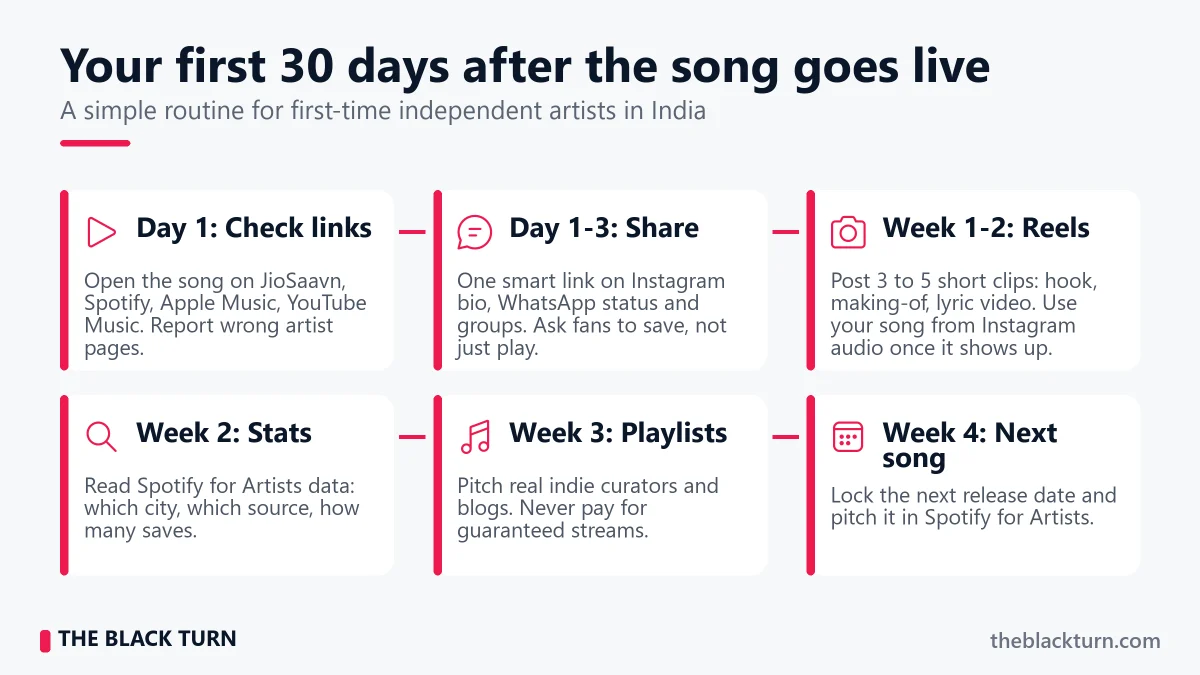
This is where most independent artist promotion actually happens. You do not need a big budget, but you do need a routine. A simple plan for the first month:
- Day 1: Check every link • Open the song on JioSaavn, Spotify, Apple Music and YouTube Music. If it shows on the wrong artist page, tell your distributor the same day.
- Day 1-3: Share one link everywhere • Instagram bio, WhatsApp status, family and college groups. Ask people to save the song and add it to a playlist, not just play it once.
- Week 1-2: Post short videos • 3-5 Reels or Shorts: the hook, a making-of clip, a lyric video, a live performance. Use your song from Instagram audio once it appears there.
- Week 2: Read your data • Spotify for Artists shows which cities listen and where they found you. Put your effort into the places that work.
- Week 3: Reach out • Contact genuine independent playlist curators, music blogs and local artists for collaborations. Never pay for “guaranteed streams”; fake streams can get your song removed.
- Week 4: Plan the next song • Fix a release date for your next song and pitch it in Spotify for Artists well before release. Music marketing for independent artists works best as a steady habit, not a one-week push.
Realistic Earnings Expectations for First-Time Artists
Honest reality check: Most first songs from new independent artists earn very little at first, often just a few hundred rupees or less, unless the artist already has an audience. This is normal. First songs are usually learning experiences, not income. We are not giving a fixed rupee range here, because earnings depend on things no distributor controls: which country the listener is in, whether they pay for a subscription, which platform they use, and what share your distributor keeps.
How to Estimate Your Own Earnings
Platforms do not pay a fixed amount per stream. Use your own reports instead: once your first royalty statement arrives, divide the amount paid for a platform by the streams on that platform. That gives you your real per-stream rate, and you can multiply it by your expected streams for the next song. Then add Content ID income from YouTube and, if you have them, caller tune earnings. Remember that your share is what is left after the distributor’s cut (5% at The Black Turn, 15% on RouteNote Free, 0% of streaming on DistroKid’s yearly plan).
What Drives First-Song Earnings
- Existing audience size • Social media following, friend network, community presence
- Promotion effort • Active marketing during release week and after
- Editorial placement • Getting on Spotify or JioSaavn editorial playlist
- Genre and language • Hindi, Punjabi and devotional songs can also earn from caller tunes; English indie depends mostly on streaming
- Song quality • Production, songwriting, vocal performance all matter
- Distribution coverage • Caller tune and Content ID coverage matter for the right genres
- Algorithmic discovery • Spotify Release Radar, Discover Weekly add streams over time
What the First Year Usually Looks Like
| Timeline | What typically happens |
| Month 1 | Mostly friends and family; very little organic discovery yet |
| Month 2-3 | First royalty report arrives (reports lag by a few months); some organic discovery if you kept promoting |
| Month 4-6 | Second and third songs out; algorithms have more data about who likes your music |
| Month 7-12 | Catalog effect: listeners who find one song stream the others |
The catalog effect: Earnings usually grow with your catalog rather than from the first song. New listeners discovering you through one song explore your other songs. This is why consistent releases (every 4-8 weeks) work better than focusing on one single. Plan for a catalog career, not a viral single.
Common Mistakes First-Time Indian Artists Make
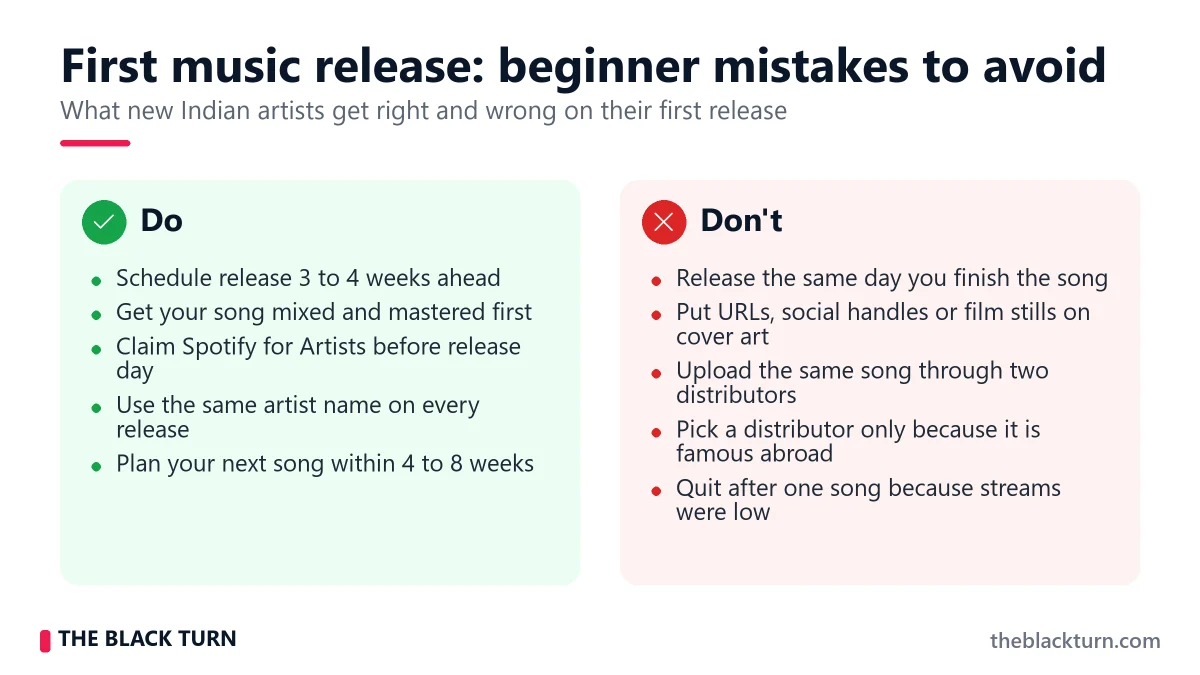
1. Releasing Immediately Without Editorial Pitching Window
Many first-time artists set release dates for the day they finish their song. This removes the chance to pitch to Spotify’s editors, which needs the song delivered and pitched at least 7 days before release. Always schedule a release date 21-28 days ahead, even for your first song.
2. Choosing Distributor Based on Western Recommendations
Most music distribution comparison content online is written for Western artists. DistroKid is famous, so first-time Indian artists default to it. For Hindi, Punjabi, regional or devotional music, that means no caller tunes at all, because global distributors do not deliver to Jio, Airtel, Vi or BSNL. Choose based on your genre and audience, not brand recognition.
3. Not Claiming Spotify for Artists Before Release
Some first-time artists release and forget about Spotify for Artists. This loses editorial pitching, analytics and profile customization. Request access as soon as your release is delivered, ideally before release day.
4. Stopping After One Release
First-time artists often release one song, see modest results, and stop. This prevents the catalog effect from kicking in. Most independent careers take several releases before real traction. Plan for a catalog, not a single.
5. Staying on a Free Plan Forever
Free tier as a starting point is fine. Free tier forever can be a mistake. The 15% a free plan like RouteNote Free keeps grows with your earnings, while a one-time fee stays the same. Do the maths once your songs start earning: when 15% of your yearly royalty is more than the one-time fee, paid distribution nets more. See free vs paid analysis.
6. Not Setting Realistic Earnings Expectations
Expecting your first song to earn lakhs immediately leads to disappointment and quitting. Expect small numbers at first, focus on building catalog and audience, and treat the first release as learning.
7. Poor Quality Production for First Release
Releasing a technically poor first song (bad recording, no mastering, careless cover art) hurts your future releases too, because new listeners find your first song and judge your overall quality. Get the mix and master right before you upload.
8. Uploading the Same Song Twice
Sending the same song through two distributors, or re-uploading it under a new title, creates duplicate releases and Content ID conflicts. Platforms can remove both copies. Use one distributor per song.
9. Skipping the Glossary of Terms
Many first-time artists struggle through the release process without understanding key terms (ISRC, UPC, metadata, royalty pass-through, caller tune, CRBT, etc.). See music distribution glossary for a full A-Z reference. Investing 30 minutes reading the glossary saves hours of confusion later.
Frequently Asked Questions
How do I release my first song in India?
Finish recording, mixing and mastering, prepare 3000×3000 cover art, write down your metadata, choose a distributor, upload the song with all details and a release date 3-4 weeks ahead, get Spotify for Artists access before release day, pitch the song, and promote it. Once approved, songs usually go live on most stores within a few days.
What platforms should I distribute my music on as a new artist?
All major ones: JioSaavn, Spotify, YouTube Music (with Content ID), Instagram/Facebook, Gaana, Apple Music and Amazon Music. For Hindi, Punjabi, regional or devotional songs, add caller tunes on Jio, Airtel, Vi and BSNL. Wynk, Resso and Hungama Music have shut down in India.
How do I become an independent artist in India?
No licence is needed. Own the song you release (lyrics, composition and beat), choose one artist name, release through a music distributor, and keep releasing regularly. You keep ownership of your recordings and most of the royalty.
What is the cheapest way to distribute music as a first-time Indian artist?
Free plans like RouteNote Free cost ₹0 upfront but keep 15% of your earnings. The Black Turn costs ₹599 one-time per single (₹799 with caller tunes) and you keep 95% for life. Yearly plans like DistroKid start at $24.99 a year (as of October 2026). Cheapest upfront and cheapest over several years are not the same thing. See cheapest analysis.
Do I need a record label to release music in India?
No. Independent distribution lets you release directly to JioSaavn, Spotify, Apple Music and YouTube Music without any label. You keep ownership of your music and most of the royalty. Labels matter only if you want their marketing money, advances or industry connections.
How long does it take to release on Spotify in India?
The delivery itself can take just a few days after your distributor approves the release. But schedule the release date 21-28 days after submission, because Spotify needs the song delivered and pitched at least 7 days before release for editorial consideration and Release Radar.
How much can I earn from my first song?
Usually very little at first unless you already have an audience. There is no fixed per-stream rate; it depends on the listener’s country, free vs paid accounts, the platform and your distributor’s cut. Use your first royalty report to work out your real per-stream rate. Treat the first song as learning, not income.
Should first-time Indian artists use free or paid distribution?
Free is fine for a zero-budget test release. Paid makes more sense when you take the song seriously, need caller tunes, or once the songs earn enough that the free plan’s cut is bigger than a one-time fee. See is free worth it.
What is ISRC and do I need it?
ISRC is a 12-character code that identifies each recording. Yes, you need one. Your distributor assigns it when you upload (free at The Black Turn). Keep it noted: it matters for tracking streams and for moving to another distributor later. See full definition in glossary.
How do I get on Spotify for Artists?
Before your first song is live, get your artist link and the release UPC from your distributor and request access through Spotify for Artists. If the song is already live, claim your profile at artists.spotify.com. Access gives you analytics, editorial pitching and profile editing. See full SFA guide.
Conclusion for First-Time Indian Artists
Releasing your first song in India is straightforward once you know the order: mastered WAV, 3000×3000 cover art, correct metadata and KYC, then a distributor that fits your genre, a release date 3-4 weeks out, Spotify for Artists access before release day, and a simple 30-day promotion routine after.
Treat your first release as the start of a career rather than a one-shot attempt. Expect small numbers at first, learn from your data, and release again every 4-8 weeks so the catalog effect can work.
Ready to release your first song? Get started with The Black Turn to distribute to JioSaavn, Spotify, Apple Music, YouTube Music, Instagram and 150+ stores, with caller tunes on Jio, Airtel, Vi and BSNL on the ₹799 plan, free Content ID, free ISRC and UPC, and free mixing and mastering through TrackFix.
 Jyoti Singh – Independent artist (32) who has worked at several music distribution companies and has released music through distributors – so these guides come from both sides of a release.