With most major distributors, your entire catalogue comes off every streaming platform. Not archived, not paused, removed. DistroKid takes releases down unless you buy a per-release “leave a legacy” style add-on, TuneCore’s renewal model means expired releases stop being distributed, and UnitedMasters states plainly that distribution depends on an active subscription. When a release is removed you lose the stream counts attached to it, its playlist placements, its algorithmic history and its URL. Re-uploading later creates a new release, not a restored one. The alternative is a one-time model: pay per song once, and the release stays live permanently with earnings, reports and updates still accessible, whether or not you ever pay again.
That is the short answer, and it is the single most expensive thing most independent artists never check before signing up.
Policies change and add-on options vary. Figures and behaviours below reflect publicly stated terms at the time of writing; confirm your own plan’s cancellation policy before assuming anything.
Why This Question Comes Up So Often
Search any artist forum and you will find the same story on repeat: someone released consistently for two or three years, life happened, a card expired or money got tight, and one morning their catalogue was gone from Spotify.
It is not a bug. It is how subscription distribution is designed to work: you are renting shelf space, not buying it. As long as you keep paying, the shelf is yours. Stop, and the shelf is cleared for the next artist.
The reason this surprises people is that nothing else in a musician’s life works this way. Your recordings are yours. Your masters are yours. Your copyright does not expire because you missed a payment. But your *distribution* does, and distribution is what makes the other three worth anything commercially.
What Actually Gets Lost
This is where artists underestimate the damage. It is not just “the song comes down and I can put it back.”
- Stream counts. The play count attached to that release is tied to its delivery. Re-uploading later starts from zero unless the same ISRC is carried forward correctly, and even then, gaps cause problems.
- Playlist placements. Every editorial and algorithmic playlist your track sat on drops it. Those slots do not come back automatically, and editorial placements are almost impossible to regain.
- Algorithmic momentum. Release Radar, Discover Weekly and autoplay behaviour are built on continuous listener data. A removal breaks that history.
- Your links. Every URL you ever shared, in a bio, an article, a press kit, a YouTube description, becomes dead.
- Saves and library adds. Listeners who saved your song lose it from their library. That relationship does not rebuild on re-upload.
- Your artist profile’s consistency. A discography with holes in it reads as inactive to both listeners and industry.
The financial loss is the smallest part. The loss of accumulated proof, that people listened, saved and returned, is what actually hurts, because that is what labels, playlist curators, sync agents and brands look at.
What Each Model Does When You Stop Paying
| Model | What Happens | Examples |
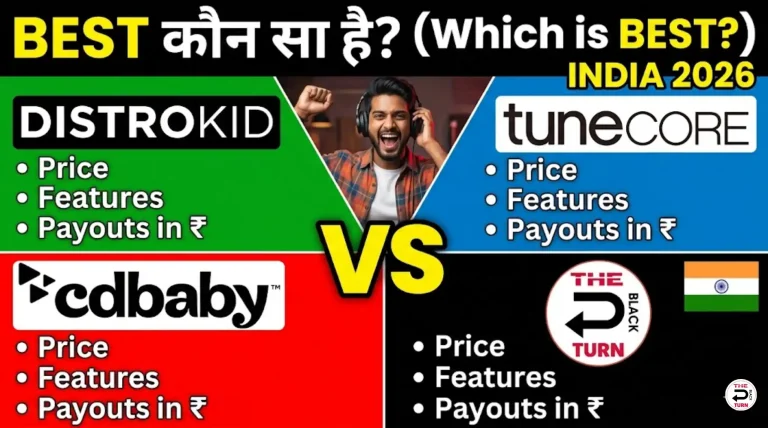
| Annual subscription | Catalogue removed unless a paid legacy/keep-live add-on is purchased per release | DistroKid, TuneCore, UnitedMasters |
| Commission (free) | Music usually stays live, but the percentage keeps applying forever | ONErpm, RouteNote |
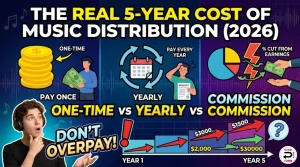
| One-time payment | Nothing happens. Release stays live permanently | The Black Turn |
Read that table carefully, because it contains the whole trade-off in the distribution industry:
- Subscription: low annual cost, permanent dependency
- Commission: no cost, permanent percentage
- One-time: upfront cost, no dependency and no percentage
There is no model where you pay nothing and owe nothing. The only real question is which form of ongoing obligation you prefer, and one-time payment is the only one that ends.
The Add-On Fine Print
Subscription services know this is their weak point, which is why several now sell a way out: pay an extra per-release fee and your music stays up even if you stop subscribing.
Read that carefully. You already paid annually for years, and now you pay again, per release, to keep what you paid for. For a catalogue of 20 releases, that add-on cost can exceed what a one-time distributor would have charged for the entire catalogue in the first place.
It is a legitimate option and better than losing everything. It is also an admission that the underlying model has a problem.
What a Lifetime Model Actually Means
Not all “lifetime” claims are equal, so here is the specific version worth asking any distributor about:
- Releases stay live permanently after a single payment per song, with no renewal required to keep them there
- Earnings continue for as long as the music earns, without further payment
- Reports and dashboard access stay open, so you can see and withdraw what your catalogue earns years later
- Payment is only needed again when you want to upload new music, not to maintain old music
That last point is the one most artists want and rarely get: you pay for new work, not for permission to keep existing work online. The Black Turn operates this way, at ₹599-799 per song (roughly $7-9), with 95% royalty, free Content ID at 0% cut, and no renewal on anything already released. The lifetime-versus-yearly economics are worked through in lifetime vs yearly distribution.
The Five-Year Comparison
An artist with 10 releases, holding them live for five years:
| Annual subscription | One-time | |
| Years 1-5 fees | 5 annual payments, plus forex if billed in USD | Paid once, roughly $70-90 total |
| Add-ons to keep music live after cancelling | Extra per-release fee | Not applicable |
| Risk if payment lapses | Full catalogue removed | None |
| Risk if you take a year off music | Full catalogue removed | None |
| Access to reports and earnings later | Tied to active account | Retained |
The number that matters is not in the fee columns. It is in the risk rows. A one-time model has no failure state, and that is worth more than the price difference for anyone whose life occasionally interrupts their music career, which is everyone.
Before You Cancel Anything: 6 Questions
If you are currently on a subscription and considering leaving, get these answered in writing first:
- On cancellation, are my releases removed, and how quickly?
- Is there a paid option to keep them live, and what does it cost per release?
- Do I keep access to royalty reports and unpaid earnings after cancelling?
- Will I still receive royalties already accrued but not yet paid out?
- Can I take my existing ISRC codes to another distributor?
- How long does a takedown take to fully process across platforms?
Question 5 is the important one for continuity. Carrying the same ISRC forward is what lets stream history stay attached to the recording, explained in what ISRC and UPC codes are and the full migration process in switching distributors without losing streams.
FAQ: Stopping Payment and Music Removal
Does DistroKid remove your music if you stop paying?
Yes. Releases come down unless you purchase their per-release option to keep music live after the subscription ends.
What happens to my streams if my music is removed?
The play count tied to that release is lost. Re-uploading creates a new release unless the same ISRC is carried forward correctly, and playlist placements do not return.
Can I keep my music on Spotify without paying a distributor every year?
Yes, with a one-time distribution model where a single payment per song keeps the release live permanently.
Do I lose unpaid royalties when I cancel?
It depends on the distributor’s terms. Ask specifically whether accrued but unpaid earnings are still released to you after cancellation.
Is a commission-based free service safer than a subscription?
It removes removal risk, but replaces it with a permanent percentage on everything you earn, which typically costs more once your catalogue performs. The maths is in free vs paid distribution.
How do I move my catalogue without losing history?
Time the takedown, carry your ISRCs forward, and re-deliver through the new distributor. The step-by-step is in switching without losing streams, and the wider comparison is in best music distribution companies 2026.
The Bottom Line
Every distributor sells the same thing on the way in: your music, everywhere, easily. They differ enormously on the way out.
Ask any service one question before you pay it: what happens to my catalogue if I never send you another rupee or dollar? If the honest answer is “it disappears,” you are not buying distribution, you are renting visibility, and the rent never stops.
The Black Turn’s distribution service answers that question differently: pay once per song, the release stays live for life, earnings and reports remain accessible, and you only pay again when you want to upload something new. Your catalogue should outlast your worst financial year. Choose a model where it does.