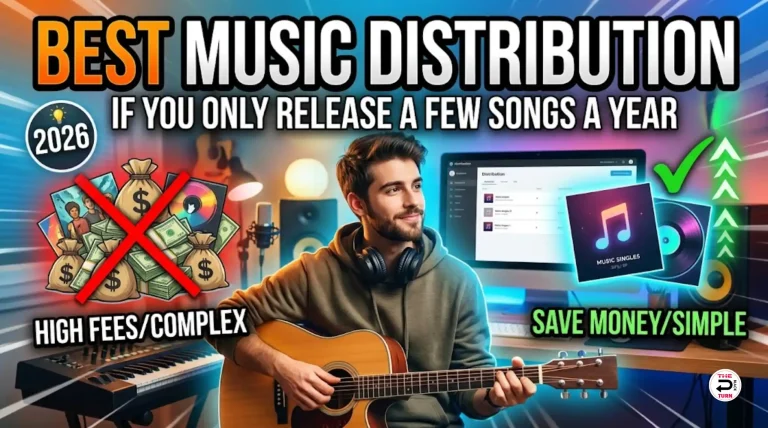
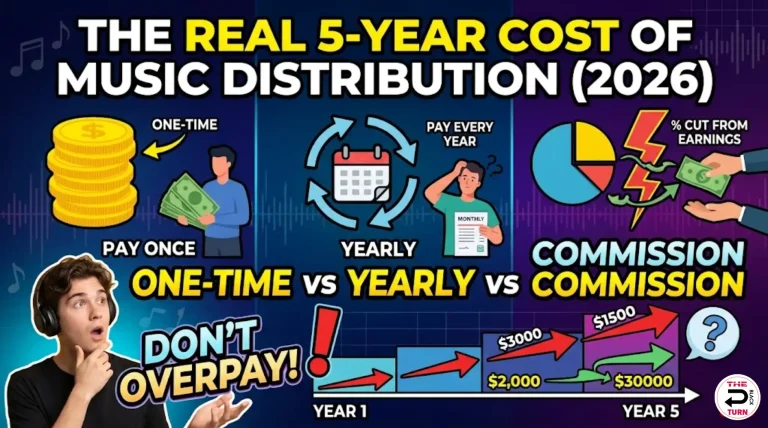
Free music distribution is real, legal and genuinely useful, but it is never actually free. Free services recover their costs in one of three ways: a permanent royalty commission (ONErpm keeps around 15% of streaming and 30% of YouTube; RouteNote’s free tier keeps around 15%), a reduced royalty rate on the free tier (Grootin pays 80% free versus 95% paid), or by limiting reach and features (ForeVision’s free tier, Amuse’s free plan). The honest rule: free costs nothing when your music earns nothing, and costs the most exactly when your music starts working. If you expect your catalogue to earn, a one-time fee of ₹599-799 per song with 95% royalty and caller tune is almost always cheaper over a five-year horizon.
That is the summary. This article compares the free options honestly, shows the exact break-even maths, and tells you when free is the right choice, because sometimes it clearly is.
Pricing and terms change frequently. All figures reflect publicly listed information at the time of writing; confirm current terms before signing up anywhere.
The Three Ways “Free” Gets Paid For
Every free distributor is a business. Understanding which model you are in tells you what it will cost you:
| Model | How It Works | Costs You Most When |
| Commission | No upfront fee, permanent % of your royalties | Your catalogue earns well |
| Reduced free tier | Free tier pays lower royalty than paid tiers | Every stream, forever, unless you upgrade |
| Limited free tier | Fewer platforms, features, or releases | You need reach, speed or caller tune |
None of these is dishonest. They are simply different bets on your future earnings, and you are on the other side of that bet.
The Free Options in India, Compared Honestly
| Service | Free Model | What It Actually Costs |
| ONErpm | Commission | ~15% of streaming, ~30% of YouTube, permanently. No caller tune. Full review |
| RouteNote | Commission | ~15% of royalties on the free tier; paid tier available. No caller tune. Full review |
| Grootin | Reduced free tier | 80% royalty on free (20% cut), one release a year; 95% needs the top paid tier. No caller tune. Full review |
| ForeVision Digital | Limited free tier | Free tier restricted; paid tiers pay 90% streaming and 85% YouTube (15% YouTube cut). Full review |
| Amuse | Limited free tier | Free tier limits release control and features; higher tiers paid. Full review |
| ST Digital / Gallery Vision type services | Revenue share | Share of royalties in exchange for zero upfront. Full review |
| SwaLay | Very low cost, not free | ~₹99 + GST entry, up to 90% royalty. Full review |
| The Black Turn | Paid, one-time | ₹599-799 once per song, 95% royalty, 0% YouTube cut, caller tune all four networks |
Two patterns jump out of that table.
Pattern 1: Almost no free service offers caller tune. CRBT requires telecom integrations that cost money to maintain, so it is the first thing free models drop. For Indian devotional, folk, regional and mass-market artists, that is not a missing feature, it is a missing income stream, as explained in caller tune revenue for artists.
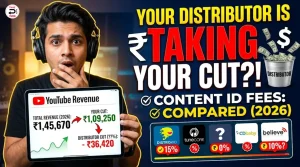
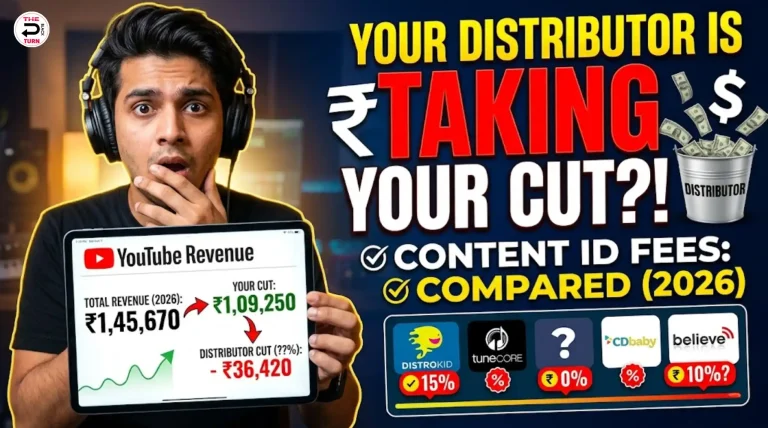
Pattern 2: YouTube is where free gets expensive. Several free and low-cost models take a larger cut of YouTube than of streaming (30% at ONErpm, 15% at ForeVision’s paid tiers). In India, where YouTube is the dominant music platform and Content ID income from other people’s uploads is substantial, that is the most costly line in the whole comparison.
The Break-Even Maths
Take one song that earns ₹20,000 across five years, split across streaming and YouTube. Realistic for a working independent artist, not a hit.
| Free (15% streaming / 30% YouTube commission) | One-time paid (₹799, 95% streaming, 0% YouTube cut) | |
| Upfront | ₹0 | ₹799 |
| Deducted over 5 years | roughly ₹3,000-5,000 | roughly ₹600 (5% of streaming) |
| Caller tune income | none | available |
| Net position | worse the more you earn | better the more you earn |
Break-even arrives fast. On commission models, a one-time ₹799 fee is recovered once the song earns roughly ₹5,000-6,000 in lifetime revenue. Everything after that point is money you keep instead of money you share, forever.
Now multiply by a catalogue. Twenty songs on a commission model, earning modestly, quietly hands over a meaningful annual sum that never stops. Twenty songs on one-time pricing cost ₹15,980 once, and then nothing again for as long as they stay live.
When Free Is Genuinely the Right Choice
This is not a “never use free” article. Free is the correct decision when:
- You have no money. A released song on a free service beats an unreleased song on a better one. Starting matters more than optimising.
- You are testing. First release, unsure whether you will continue, no plan yet. Spend nothing to find out.
- The music is not commercial. Personal projects, archives, demos, tribute tracks you never expect to monetise. If income is near zero, a percentage of near zero is near zero.
- You need to learn the process. Uploading, metadata, artwork standards, dashboards. Learn on a free service, then apply that knowledge where it pays. Our first-time artist guide works on any platform.
When Free Quietly Becomes Expensive
Switch to paid when any of these becomes true:
- Your song starts earning. Once monthly income is consistent, the commission outruns any one-time fee.
- Your genre earns from caller tune. Devotional, folk, Bhojpuri, Haryanvi, Punjabi and regional mass-market artists are giving up a whole revenue stream to save ₹799 once.
- YouTube is your main channel. A 15-30% YouTube cut applies to every Content ID claim, permanently.
- You are building a catalogue. Percentages compound across songs; a one-time fee does not.
- You need speed or reliability. Free tiers often have slower delivery, limited platforms and lower-priority support. When a release has a date attached, that matters, as covered in how long distribution takes.
The transition point is usually much earlier than artists expect. The full switching process, including carrying ISRCs forward so streams stay attached, is in moving from free to paid distribution and switching without losing streams.
Questions That Reveal the Real Cost
Ask any free service these, in writing, before uploading:
- What exact percentage do you keep, on streaming and on YouTube separately?
- Does the free tier deliver to JioSaavn, Gaana, Wynk and Hungama?
- Is caller tune available at all, and on which networks?
- Is YouTube Content ID included, and what cut applies to it?
- How long until my music goes live, and when does royalty reporting start?
- If I upgrade or leave later, do my existing releases and stream counts carry over?
If any answer is vague, that vagueness is the product. The habit of getting terms in writing is covered in the agreement red flags guide, and the fuller evaluation framework is the 12-point distributor checklist.
The Middle Option Most Artists Miss
Free and expensive are not the only choices. India has a third category that global comparison articles usually skip entirely: one-time payment with no recurring cost.
At ₹599 (streaming) or ₹799 (with caller tune), a song is distributed permanently, keeps 95% of its streaming royalty, takes no cut of YouTube Content ID income, reaches 150+ platforms and can be a caller tune on Jio, Airtel, Vi and BSNL. There is no subscription to maintain and no percentage that compounds against you as you grow.
That is why the honest answer to “what is the best free music distribution in India” is often “the cheapest paid one,” provided you can afford it at all. The full field is ranked in best music distribution companies in India 2026.
FAQ: Free vs Paid Music Distribution
Is free music distribution really free?
No service is genuinely free. Costs are recovered through royalty commissions, lower free-tier royalty rates, or restricted platforms and features.
What is the best free music distributor in India?
It depends on your model tolerance: commission-based services like ONErpm and RouteNote cost nothing upfront, while ForeVision and Grootin offer limited free tiers. All of them lack caller tune.
Do free distributors offer caller tune?
Almost none do, because CRBT requires paid telecom integrations. This is the biggest gap for Indian artists in devotional, folk and regional genres.
When should I switch from free to paid?
As soon as your music earns consistently, your genre earns from caller tune, or YouTube becomes your main channel. Break-even on a ₹799 one-time fee arrives at roughly ₹5,000-6,000 of lifetime song revenue.
Will I lose my streams if I switch?
Not if you carry your existing ISRC codes forward and time the takedown correctly, explained in switching without losing streams.
What is the cheapest paid option that includes caller tune?
One-time plans at ₹799 per song include caller tune on all four networks with lifetime validity. See the music distribution India guide for the full process.
The Verdict
Free distribution deserves respect. It has put thousands of Indian artists on Spotify who would otherwise still be sitting on unreleased files, and for a first release with an empty wallet it remains the right call.
But free is a loan against your future earnings, and the interest is paid in percentages that never expire. The moment your music starts working, the cheapest option becomes the one you paid for once. The Black Turn’s music distribution India service is built for exactly that moment: ₹599-799 one-time per song, lifetime validity, 95% streaming royalty, free Content ID with 0% cut on YouTube earnings, 150+ platforms, caller tune on Jio, Airtel, Vi and BSNL, INR payouts with a low threshold and phone support in your language. Start free if you must, but do the maths before your catalogue grows, because the cost of free rises exactly as fast as you do.