Music distribution pricing looks straightforward on most service homepages. ₹999 per release. USD 19.99 per year. Free with revenue share. The headline prices seem clear and competitive. Then you sign up, release a few songs, and start noticing charges that were not obvious upfront. Yearly subscription renewals appearing in your credit card statement. Forex conversion losses on every USD payout. Add-on fees for services you assumed were standard. Revenue share is quietly taken from your streaming earnings month after month. The actual total cost ends up significantly higher than the headline price suggested.
This is not necessarily fraud. Most major distributors disclose their fees somewhere in their terms of service or pricing pages. The issue is that these disclosures are often spread across multiple pages, written in fine print, or only become visible during the signup process or after months of use. Indian artists in particular face additional currency conversion and missing-revenue-stream issues that compound the practical cost beyond what Western-focused pricing pages suggest.
This guide identifies every category of hidden or under-disclosed charge in Indian music distribution in 2026. We name specific distributors and their specific fee structures honestly. We show how to calculate true total cost over 3 to 5 years. And we give you a framework for spotting transparent distribution versus services that hide significant cost behind headline prices. By the end you will be able to evaluate any music distribution offer accurately, regardless of what the marketing pages claim.
The 12 Categories of Hidden Charges in Music Distribution
1. Yearly Renewal Fees on Lifetime-Sounding Marketing
Some distributors market services in language that implies one-time payment when the actual structure is yearly subscription. Phrases like “unlimited uploads” or “one fee” can obscure that the fee renews annually. Always verify whether your distributor charges yearly, one-time, or per-release. The Black Turn at ₹599 to 799 is genuinely one-time lifetime per release. DistroKid yearly subscription, TuneCore yearly per release, and various other services renew annually.
2. Per-Platform Additional Fees
Some distributors charge additional fees to add specific platforms like Beatport, Traxsource, or specialized regional services. While the headline price gets you to Spotify, Apple Music, and major platforms, adding niche platforms may require additional payment. Indian artists planning to use specific Indian regional or genre-specific platforms should verify coverage included in base price.
3. Royalty Commission Below 100 Percent
| Service | Royalty Pass-Through | Distributor Takes |
| The Black Turn | ~95% | ~5% |
| DistroKid | ~100% on streaming | Recouped via yearly fee |
| TuneCore | ~100% on streaming | Recouped via yearly fee |
| CD Baby | ~91% (~9% commission) | ~9% per stream |
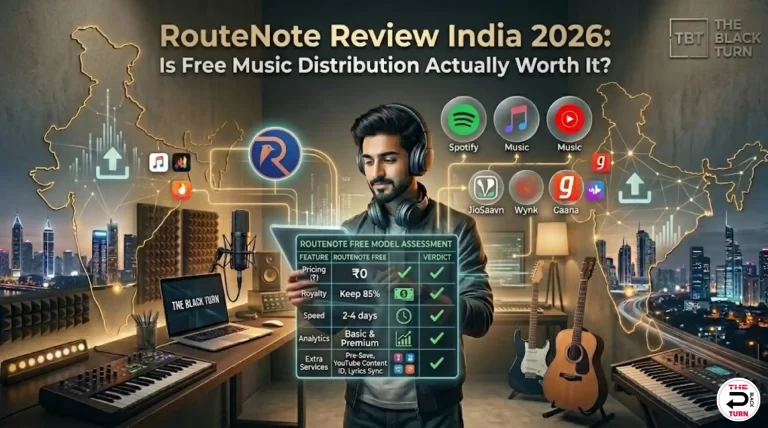
| RouteNote Free | ~85% (~15% revenue share) | ~15% per stream |
| Amuse Free | ~75-85% (~15-25% revenue share) | ~15-25% per stream |
For complete royalty pass-through analysis across distributors, see our best royalty music distributor in India analysis.
4. Forex Conversion Losses on USD Payouts
Every distributor that pays in USD to Indian bank accounts loses approximately 2 to 4 percent of the payment value to forex conversion. Over time this compounds significantly. For an artist receiving USD 1000 per year in royalty over 5 years, forex losses alone total USD 100 to 200 (Rs 8000 to Rs 16000). INR-native distributors that pay directly in INR avoid this loss entirely.
5. Payout Fees and Wire Transfer Charges
USD-based distributors paying via international wire transfer often charge USD 25 to 50 per payout. PayPal payments incur conversion fees of 3 to 4 percent. Even relatively small fees add up over years of payments. An artist receiving monthly USD payouts could lose USD 60 to 100 per year just in payout fees. INR direct bank transfer typically has no such fees.
6. High Minimum Payout Thresholds
Some distributors require minimum royalty balance before processing payout. The DistroKid threshold is approximately USD 50 (Rs 4000+). For artists earning modest royalty, this can mean payments held for months or longer waiting to accumulate to threshold. Not technically a fee but creates effective time-value loss. The Black Turn threshold of Rs 500 to 1000 enables more frequent payouts.
7. Revenue Share on Free Tier Services
Free tier services like RouteNote Free and Amuse Free take 15 to 25 percent revenue share indefinitely on streaming earnings. For songs that start earning meaningfully, this revenue share accumulates to more than paid lifetime alternatives would have cost. See is free music distribution worth it analysis.
8. Premium Add-on Fees for Standard Services
Some distributors charge separately for services that should be included with basic distribution: split sheets and collaborator payment management, YouTube Content ID activation, ISRC codes (though most include automatically), pre-save link setup, music video distribution, audio mastering, lyrics submission, and various other features. Always check what is included in base price vs add-on.
9. Account Inactivity Fees
Some services charge fees if you do not release music for extended periods. Read terms of service to identify any inactivity charges. Most major distributors do not have these but smaller services may.
10. Takedown Fees
A few services charge fees to remove your music from platforms. This is uncommon among major distributors but worth verifying. Lifetime distribution should never charge to take music down since you have already paid for distribution rights.
11. Missing Revenue Stream (Functionally Hidden Cost)
Global distributors (DistroKid, TuneCore, CD Baby, Amuse, RouteNote) do not cover Indian caller tune networks. For Indian artists with caller-tune-relevant music (Hindi, Punjabi, regional, devotional), this represents 20 to 70 percent of potential revenue missed entirely. Not technically a fee but functionally similar in financial impact. See best caller tune distributor.
12. Compound Annual Cost Over Multi-Year Catalog
Yearly subscription distributors compound costs across multi-year catalogs. Over 5 years, yearly fees can total 5x to 15x what one-time lifetime distribution would cost. This is not exactly hidden but is often not calculated by artists before signing up. Always calculate 3-5 year total cost when comparing options.
Calculating True Total Cost (3-5 Year Analysis)
To accurately compare music distribution services, calculate total cost over a realistic 3 to 5 year horizon. Headline prices alone are misleading.
Example Cost Calculation. Indian Artist with 6 Releases Over 3 Years
| Distributor | Cost Breakdown | 3-Year Total |
| The Black Turn | 6 releases x Rs 699 lifetime | ~Rs 4,194 |
| DistroKid | Yearly USD 22.99 x 3 years + forex | ~Rs 6,500-7,500 |
| TuneCore | Yearly per release USD 14.99 x 6 releases x 3 years + forex | ~Rs 21,000-25,000 |
| CD Baby | One-time USD 9.95 x 6 releases + ~9% royalty share + forex | ~Rs 5,000-15,000 (depends on streams) |
| RouteNote Free | Rs 0 upfront + 15% revenue share x stream earnings | ~Rs 0-50,000 (depends on streams) |
The calculation lesson: Headline prices are misleading. The Black Turn at ₹699 per release is genuinely the cheapest paid option for typical multi-release Indian artists. Free tier can be cheapest only if your songs earn very little. Yearly subscription distributors compound dramatically over time. Always calculate full 3-5 year scenarios including all fees and missed revenue.
Honest Distributor Transparency Ranking
Most Transparent: The Black Turn
The Black Turn pricing is genuinely transparent for Indian artists:
- Single lifetime fee at ₹599 to 799 per release
- No yearly renewals or hidden recurring charges
- ~95% royalty pass-through clearly disclosed
- INR direct bank transfer with no forex conversion losses
- All 4 caller tune networks included in base price
- YouTube Content ID included without premium add-on
- ISRC and UPC codes assigned automatically
- No payout fees for Indian bank transfers
Reasonably Transparent: DistroKid
DistroKid base subscription is transparent. Add-on services for splits, pre-save links, vocal tuning are clearly listed as optional paid features. The yearly subscription model means costs compound across years. USD billing creates forex conversion costs. Missing Indian caller tune coverage is a significant practical cost for Indian artists. See DistroKid alternative analysis.
Reasonably Transparent: CD Baby
CD Baby one-time per-release pricing is clearly disclosed. However the ~9 percent royalty commission and USD billing forex losses create cumulative costs beyond upfront fee. Honest about pricing structure but total cost over multi-year usage exceeds INR alternatives. See CD Baby alternative analysis.
Reasonably Transparent: TuneCore
TuneCore yearly per-release model is clearly disclosed. The compounding cost over multi-year catalogs is the practical issue rather than hidden fee. Pricing is transparent but model is unfavorable for typical Indian artist usage patterns. See TuneCore alternative analysis.
Less Transparent: Free Tier Services
RouteNote Free and Amuse Free are technically transparent about revenue share but most artists do not calculate the cumulative cost of 15-25 percent ongoing revenue share. The “free” framing obscures that paid lifetime distribution typically costs less over time once songs earn meaningfully.
How to Spot Transparent Music Distribution
Apply these criteria when evaluating any distributor:
- Pricing page states total cost upfront • No tiers, no “prices starting at,” no hidden upgrades required
- Royalty pass-through clearly disclosed • Specific percentage stated, ideally 95-100 percent
- Payment cycle and threshold stated • You know when and how much before signing up
- Standard features included • ISRC, UPC, YouTube Content ID, caller tune coverage (for Indian artists), basic features
- Refund or cancellation policy clear • What happens if you change your mind
- Customer support responsive • Pre-signup questions answered clearly
- Terms of service readable • Not buried in complex legal language
- Multi-year examples available • Realistic total cost over time shown
Red Flags Indicating Hidden Costs
- Vague language about “additional fees may apply” without specifics
- Unclear royalty pass-through or no specific percentage stated
- Premium tiers required for basic features like Content ID
- Complicated pricing tables that hide true total cost
- “Contact us for pricing” instead of clear public pricing
- Marketing emphasizes “free” without explaining revenue share
- No clear 3-5 year cost examples provided
Common Hidden Cost Mistakes Indian Artists Make
1. Comparing Only Upfront Prices
Comparing Rs 0 (free tier) vs Rs 699 (TBT lifetime) vs USD 22.99/year (DistroKid) only on upfront cost is misleading. Calculate 3-5 year total including revenue share, yearly compounding, forex losses, and missed revenue streams.
2. Not Factoring Missed Caller Tune Revenue
Indian artists using global distributors miss caller tune revenue which for caller-tune-relevant genres is 20-70 percent of total potential income. This is the largest “hidden cost” of choosing the wrong distribution. See caller tune analysis.
3. Ignoring Forex Conversion in USD Payouts
USD payouts to Indian bank accounts lose 2-4 percent in forex per transaction. Over years across multiple payouts, total forex loss is substantial. INR direct deposit avoids this entirely.
4. Choosing Free Tier and Staying on Free Long-Term
Free tier is an acceptable starting point. Staying on free after songs earn meaningfully means giving up 15-25 percent forever which exceeds paid lifetime cost. Migrate when songs start earning.
5. Not Reading Terms of Service
Most hidden fee discoveries come months after signup. Reading TOS before signing up identifies most issues. See music distribution glossary for term definitions to help understand TOS.
6. Not Calculating Add-on Cost Stack
Base subscription + splits add-on + pre-save link tool + vocal tuning + Songfile services can quickly stack up. The total of necessary add-ons may exceed alternative distributors with everything included.
Frequently Asked Questions
What hidden charges to watch for in music distribution?
Yearly renewals on lifetime-sounding marketing. Per-platform fees. Royalty commission below 100%. Forex losses on USD payouts. Payout fees. High minimum thresholds. Free tier revenue share. Premium add-ons for standard services. Account inactivity fees. Takedown fees. Missing revenue stream (Indian caller tune). Compound multi-year cost.
Does DistroKid have hidden fees?
Base subscription transparent but charges add-ons for splits, Mastered Mixer, pre-save links, vocal tuning, lyrics. Yearly subscription model compounds across years. USD billing creates 2-4% forex losses for Indian artists. No caller tune coverage = missed Indian revenue. See DistroKid alternative.
Does TuneCore have hidden fees?
Base pricing transparent. Yearly per-release model compounds dramatically over multi-year catalogs. USD billing creates forex losses. No caller tune coverage. Pricing transparent but the model creates the highest Indian artist total cost. See TuneCore alternative.
Does CD Baby have hidden fees?
Pricing structure clear. ~9% royalty commission (91% pass-through). USD billing forex losses. No caller tune coverage. Pricing transparent but cumulative cost over multi-year exceeds INR alternatives covering caller tune. See CD Baby alternative.
What is the true cost of free music distribution?
₹0 upfront but 15-25% revenue share forever on streaming earnings. For songs earning ₹5,000/month, that’s ₹750-1,250/month given up. Over a year ₹9,000-15,000 exceeds paid lifetime cost. No caller tune coverage = additional 25-50% revenue missed. See free vs paid.
How to spot transparent music distributors?
Pricing clear upfront. Royalty pass-through stated (95-100% ideal). Payment cycle stated. Standard features included (ISRC/Content ID/caller tune). Refund policy clear. Support responsive. TOS readable. Multi-year cost examples available.
Are payout fees normal for music distributors?
Vary by distributor and method. INR direct bank transfer typically has no fees. USD wire transfer USD 25-50 per payout. PayPal 3-4% conversion. For Indian artists, INR direct is most efficient. Receiving USD 100 royalty can become USD 95 or less after all fees and conversion.
Does The Black Turn have hidden charges?
No known hidden charges. ₹599-799 lifetime per release. No yearly renewals. ~95% royalty pass-through clearly stated. INR direct bank transfer no forex. All 4 caller tune networks included. Content ID included. ISRC/UPC automatic. No payout fees. See pricing.
Conclusion
Hidden charges in music distribution are real but mostly identifiable if you know what to look for. The 12 categories covered (yearly renewals, per-platform fees, royalty commissions, forex losses, payout fees, thresholds, revenue share, premium add-ons, inactivity fees, takedown fees, missing revenue streams, multi-year compounding) cover the typical patterns. Apply the calculation framework of 3-5 year total cost rather than upfront price comparison.
For Indian artists in 2026, the most transparent option is INR-native lifetime distribution at clear upfront price with full feature inclusion and no forex losses. The Black Turn at ₹599-799 lifetime per release with ~95 percent royalty pass-through, all 4 caller tune networks included, YouTube Content ID standard, ISRC automatic, and INR direct bank transfer represents this transparent model. Global distributors (DistroKid, TuneCore, CD Baby) have transparent pricing within their model but the model itself (yearly fees, USD billing, no caller tune) creates higher Indian artist total cost.
Ready to choose music distribution with no hidden charges? Get started with The Black Turn for transparent INR pricing at ₹599-799 lifetime per release.
Transparent pricing is the foundation of trust between artist and distributor. Choose services that disclose total cost clearly, include standard features without surcharges, and pay royalty efficiently without conversion losses. For most Indian artists in 2026, this means INR-native lifetime distribution covering all revenue streams without hidden upcharges.