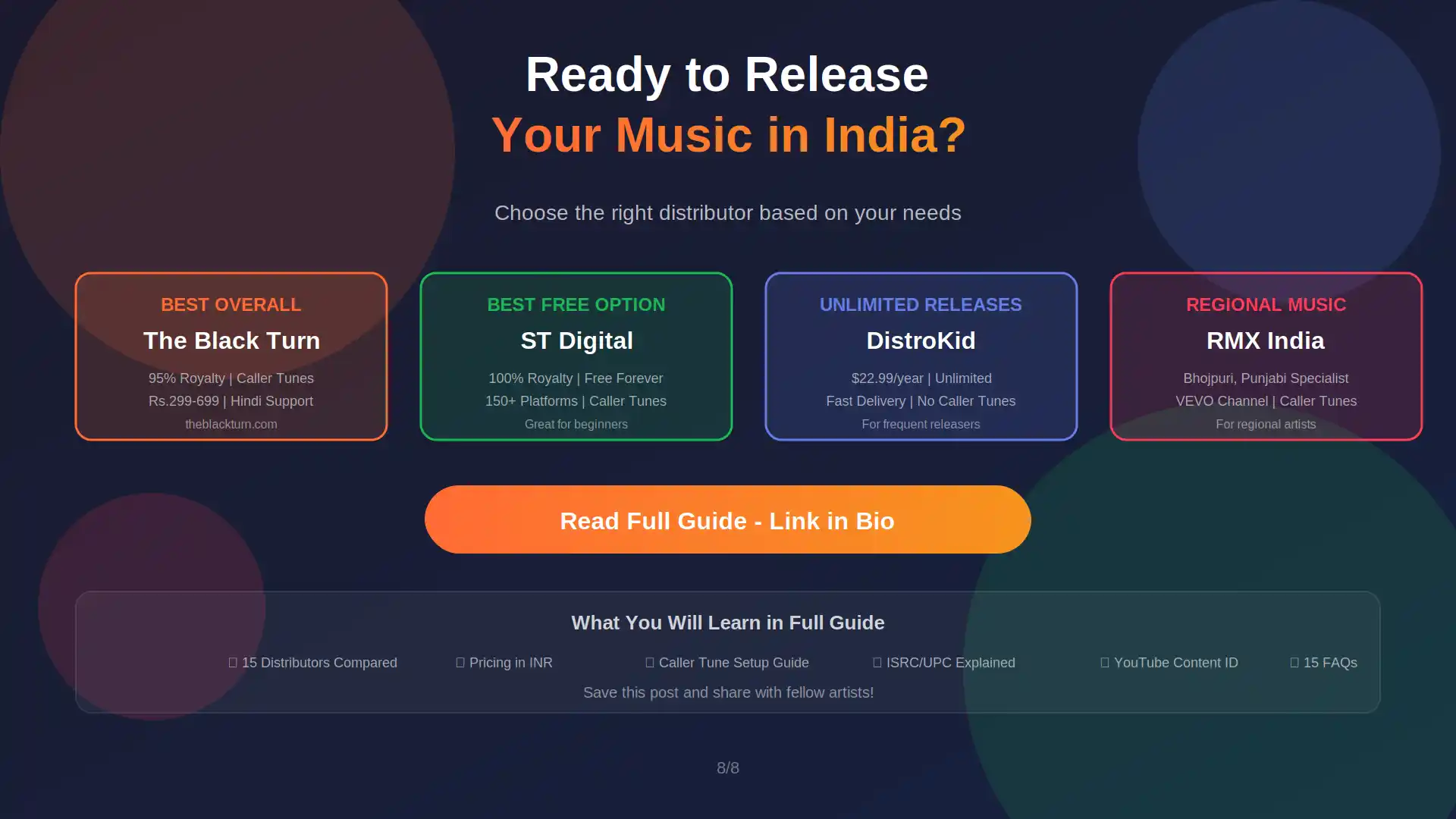
Are you an independent artist looking to release your music on Spotify, Apple Music, JioSaavn, and other streaming platforms? Finding the right music distribution company in India can make or break your music career.
In this comprehensive guide, we’ll cover everything you need to know about music distribution in India, from free options to premium services, caller tune distribution, YouTube Content ID, and much more. Whether you’re a bedroom producer, rapper, singer, or established artist, this guide will help you choose the best music distributor for your needs.
What is Music Distribution?
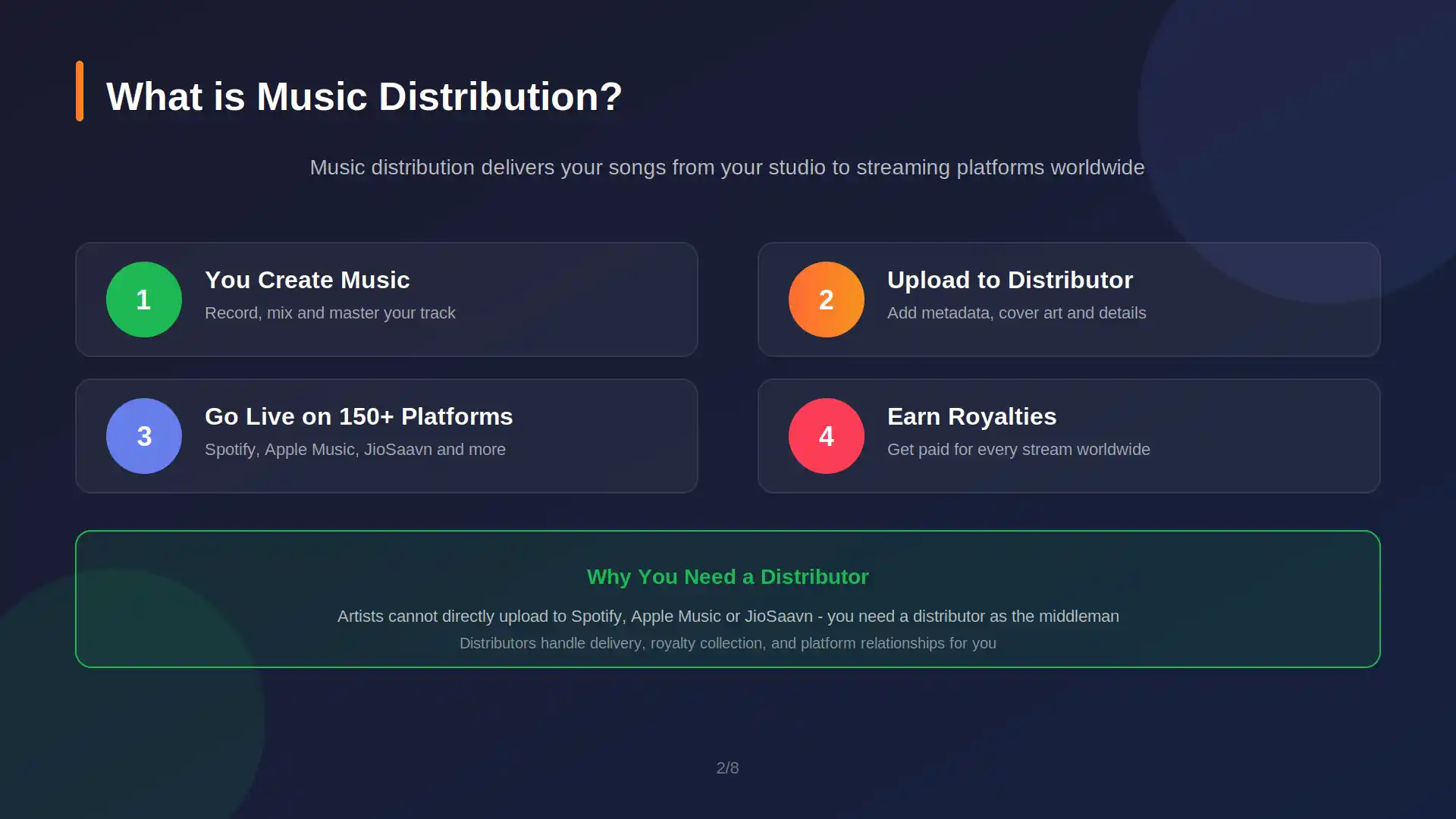
Music distribution is the process of delivering your music from your studio to streaming platforms and online stores where listeners can access it. Think of music distributors as the bridge between artists and platforms like Spotify, Apple Music, Amazon Music, JioSaavn, Gaana, and YouTube Music.
Traditional vs Digital Music Distribution
In the past, music distribution meant pressing CDs, vinyl records, and distributing them to physical stores. Today, digital music distribution has revolutionized the industry. With just a few clicks, your music can reach millions of listeners across 150+ platforms worldwide.
Why Do Independent Artists Need Distribution?
Here’s the thing, you cannot directly upload your music to Spotify, Apple Music, or JioSaavn. These platforms only accept music through authorized distributors. This is where music distribution companies come in.
Benefits of using a music distributor:
- Release music on 150+ streaming platforms globally
- Earn royalties from streams and downloads
- Get ISRC and UPC codes for your releases
- Access analytics and insights
- Distribute caller tunes in India
- Monetize your music on YouTube through Content ID
- Build your artist profile on major platforms
Indian Streaming Platforms in 2026: What Changed
Before choosing a distributor, you should know which platforms actually exist today. Three Indian streaming services have shut down in the last two years, and many older guides still list them.
Platforms That Have Closed:
- Resso shut down in India on 31 January 2024
- Wynk Music shut down in December 2024 after Airtel partnered with Apple Music
- Hungama Music shut down on 15 April 2025
Platforms Active Today:
- Spotify with free and paid tiers, largest reach in India
- YouTube Music with free and paid tiers
- JioSaavn with free and paid tiers, the biggest remaining Indian platform
- Apple Music paid only, grew after Wynk users moved over
- Amazon Music paid and Prime bundled
- Gaana paid only since 2022, so stream volumes are much lower now
- Instagram and Facebook for Reels monetization
- Caller tunes on Jio, Airtel, Vi and BSNL
Important note: Wynk Music the streaming app is gone, but Airtel Hello Tune is a separate telecom service and is still running. You can still get your song on Airtel caller tunes in 2026.
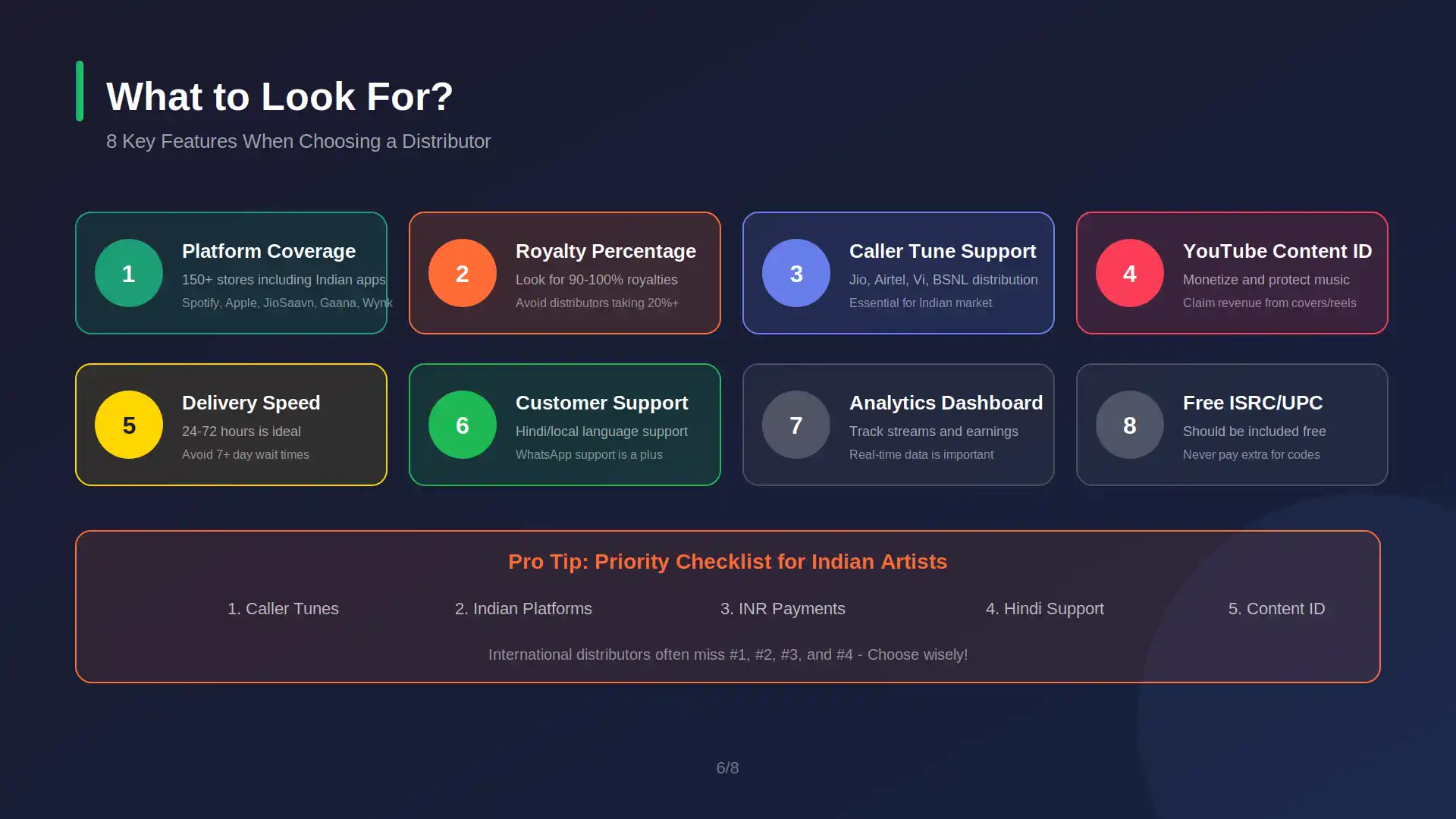
How to Choose the Best Music Distribution Company in India
Before jumping into our list, let’s understand what factors you should consider when choosing a music distributor:
1. Platform Coverage
The more platforms your distributor supports, the wider your reach. Look for distributors that cover:
- International platforms: Spotify, Apple Music, Amazon Music, YouTube Music, Tidal, Deezer
- Indian platforms: JioSaavn and Gaana
- Social media: Instagram/Facebook, Snapchat
- Caller tunes: Jio, Airtel, Vi, BSNL
If a distributor still advertises Wynk, Resso or Hungama delivery, their store list has not been updated in two years.
2. Royalty Percentage
Different distributors offer different royalty splits. Some keep 100% with you, while others take a small percentage (5-20%). Always check:
- What percentage of streaming royalties do you keep?
- What about YouTube Content ID revenue, which is often a separate cut?
- What about Reels and short video revenue, where some distributors take up to 20%?
- Are there any hidden deductions?
3. Pricing Model
Music distributors typically offer:
- Per-release pricing: Pay per single or album
- Annual subscription: Unlimited releases for a yearly fee
- Free with commission: No upfront cost, but they take a percentage of royalties
4. What Happens If You Stop Paying
This is the most expensive detail artists miss. With most annual subscription distributors, if your subscription lapses, your music is removed from every platform along with your stream counts and playlist placements.
Some distributors charge a separate one time fee to keep releases live permanently. Indian per release distributors and one time fee services usually keep your music live by default. Ask this question before you upload, not after.
5. Indian Platform Support
For Indian artists, support for local platforms is crucial:
- Gaana and JioSaavn distribution
- Caller tune distribution (Jio, Airtel, Vi, BSNL)
- Regional language metadata handling
- INR payouts to an Indian bank account
6. Customer Support
Look for distributors with:
- Hindi/English support
- Quick response times
- Phone or WhatsApp support
- Local presence in India
7. Additional Features
Consider extra features like:
- YouTube Content ID
- Playlist pitching
- Analytics dashboard
- Royalty splits for collaborators
- Pre-save campaigns
- Artist verification assistance
- AI disclosure support through DDEX, which became important in 2026
Top 15 Best Music Distribution Companies in India 2026
After extensive research and analysis, here are the best music distribution companies for Indian independent artists. All international pricing was verified in August 2026.
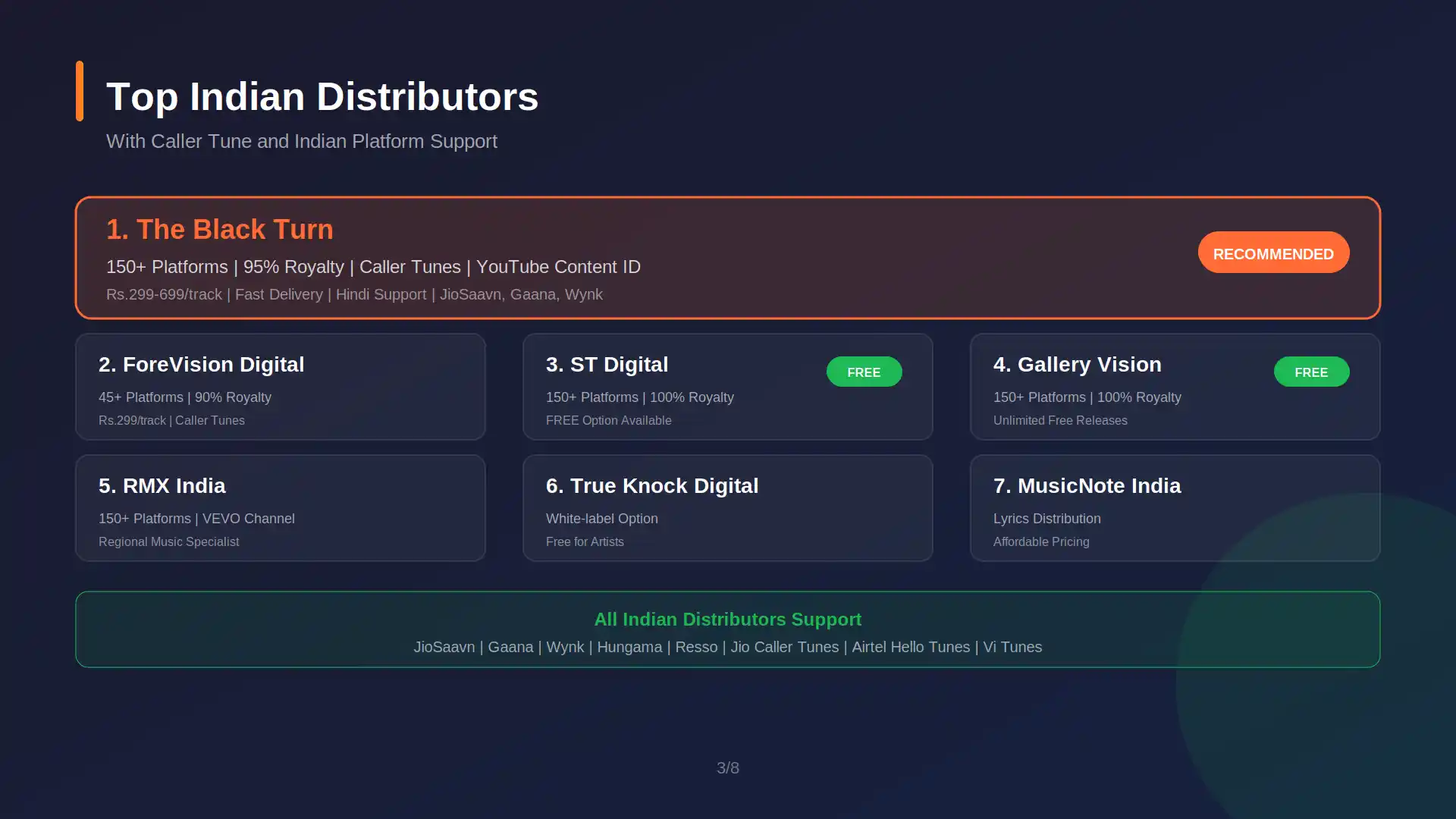
1. The Black Turn: Best Overall for Indian Artists
The Black Turn has emerged as one of India’s most trusted music distribution platforms, offering a perfect blend of affordability, features, and customer support.
Key Features:
- Distribution to 150+ platforms including Spotify, Apple Music, JioSaavn, Gaana, YouTube Music and Amazon Music
- Caller tune distribution on Jio, Airtel, Vi, and BSNL
- 95% royalty share, one of the highest in the industry
- Fast delivery: 3-5 days standard, 24-48 hours express
- Custom label name and C/P line
- Unlimited ISRC and UPC codes
- Monthly transparent reports
- YouTube Content ID support
- Music stays live with no annual renewal needed
- INR payouts to Indian bank accounts
- Hindi and English customer support
Pricing:
- Single track: ₹299 to ₹699
- Unlimited releases available with premium plans
- No hidden charges
Best For: Independent artists who want affordable, comprehensive distribution with excellent Indian platform support and caller tune features.
Pros:
- Best caller tune distribution in India
- Transparent pricing with no hidden fees
- Excellent customer support in Hindi
- Fast delivery times
- 95% royalty, industry leading
- No takedown risk from a lapsed subscription
Cons:
- No free plan available
- Newer compared to international giants
- Not the cheapest if you release 20+ tracks a year
2. ForeVision Digital: Budget-Friendly Indian Distributor
ForeVision Digital is another excellent Indian music distribution company known for its affordable pricing and quick service.
Key Features:
- Distribution to 45+ major platforms
- Caller tune support for all Indian networks
- 90% streaming royalties, 85% YouTube
- Quick release: 1-3 working days
- Lifetime availability
- Hindi, English, and Bengali support
Pricing:
- Starting from ₹299 per track
- Various plans up to ₹699
Best For: Artists looking for affordable distribution with caller tune support.
Pros:
- Very affordable pricing
- Excellent caller tune distribution
- Local language support
- Quick turnaround
Cons:
- Fewer platforms compared to competitors
- Lower YouTube royalty percentage
3. ST Digital: Best Free Option
ST Digital offers genuinely free music distribution in India, making it an excellent choice for beginners and budget-conscious artists.
Key Features:
- Free music distribution
- 150+ platforms worldwide
- 100% royalty retention
- Video distribution available
- Presence in India, Nepal, Bangladesh
Pricing:
- Free basic distribution
- Premium plans available for additional features
Best For: New artists who want to release music without any upfront investment.
Pros:
- Completely free distribution
- Wide platform coverage
- Keep 100% royalties
- Good for beginners
Cons:
- Limited features in free plan
- Customer support can be slow
4. Gallery Vision: Free with Full Features
Gallery Vision has gained popularity for offering free music distribution with impressive features.
Key Features:
- 100% free distribution
- 150+ platforms including Indian stores
- Unlimited releases
- Full ownership retained
- 24-hour delivery
- Caller tune support
Pricing:
- Completely free
Best For: Artists who want feature-rich free distribution.
Pros:
- No charges whatsoever
- Fast 24-hour delivery
- Full feature access
- Indian platform support
Cons:
- Relatively new platform
- Limited track record
5. RMX India: Best for Regional Music
RMX India specializes in regional Indian music distribution, making it perfect for artists creating content in various Indian languages.
Key Features:
- Specialization in regional music (Hindi, Tamil, Telugu, Punjabi, Bengali, Marathi, etc.)
- 150+ platforms
- VEVO channel services
- Content ID protection
- Caller tune distribution
- Artist verification assistance
Pricing:
- Custom pricing based on requirements
Best For: Regional artists and Bollywood music creators.
Pros:
- Excellent for non-English content
- VEVO channel support
- Comprehensive rights management
- Strong regional presence
Cons:
- Custom pricing can be unclear
- Not ideal for English-only content
6. True Knock Digital: Best for Labels
True Knock Digital offers both artist and label services, with a unique white-label infrastructure option.
Key Features:
- Free distribution for artists
- B2B label and distributor memberships
- 90+ platforms
- White-label platform available
- Regional language support
- 100% copyright control
Pricing:
- Free for individual artists
- Custom pricing for labels and distributors
Best For: Music labels wanting their own distribution infrastructure.
Pros:
- White-label option unique in India
- Good for scaling businesses
- Free artist distribution
- Regional focus
Cons:
- Complex for solo artists
- B2B focus may not suit everyone
7. MusicNote India: Affordable & Reliable
MusicNote India offers market-beating prices with reliable distribution services.
Key Features:
- Distribution to major platforms
- YouTube Content ID
- Caller tune distribution
- Publishing administration
- Lyrics distribution
- Transparent analytics
Pricing:
- Affordable plans (specific pricing on inquiry)
Best For: Artists wanting a balance of price and features.
Pros:
- Competitive pricing
- Lyrics distribution feature
- Good analytics
- Content ID support
Cons:
- Less platform coverage than leaders
- Newer in the market
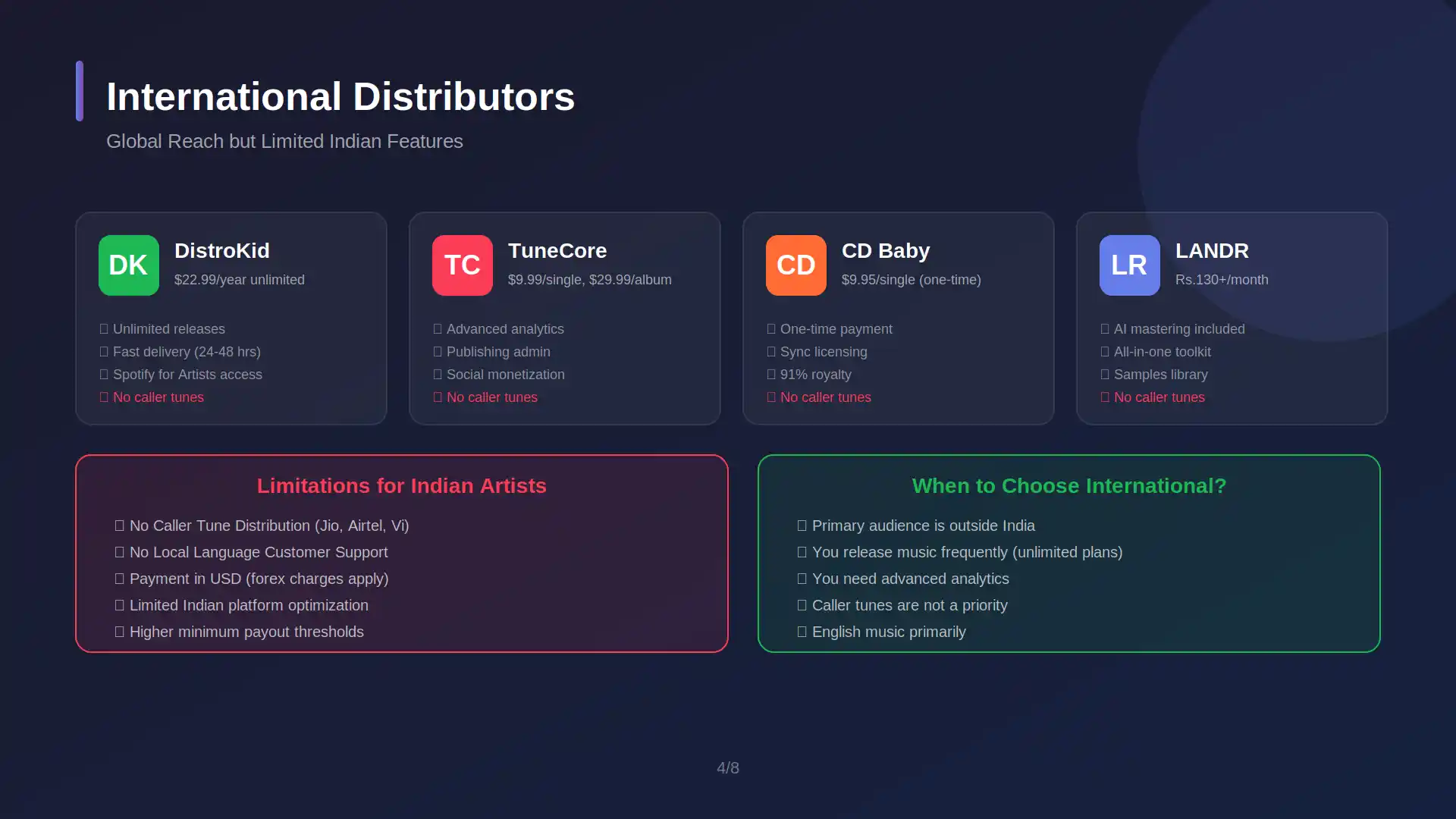
8. DistroKid: Best for Unlimited Releases
DistroKid is a global favorite known for its unlimited releases model and speed. Prices went up in 2026.
Key Features:
- Unlimited song uploads
- Distribution to 150+ platforms
- Fast delivery (often within 24 hours)
- 100% streaming royalty retention
- YouTube monetization as a paid add-on
- Spotify verification
- AI disclosure checkbox added in April 2026
Pricing:
- Musician: $24.99/year, raised from $22.99
- Musician Plus: $44.99/year, raised from $39.99
- Ultimate: $89.99/year
Add-on costs to watch:
- Leave a Legacy: one time $29 per single or $49 per album, without which your music comes down if you stop paying
- YouTube Content ID: around $4.95 per single per year, plus DistroKid keeps 20% of Content ID revenue
- Store Maximizer: around $7.95 per release per year
- Scheduled release dates are not available on the base Musician plan
Best For: Artists who release music frequently and want unlimited uploads.
Pros:
- Unlimited releases for one annual fee
- Very fast delivery
- User-friendly interface
- 100% streaming royalties
Cons:
- No caller tune distribution
- No Indian platform focus
- Music is removed if you stop paying unless you buy Leave a Legacy
- Add-ons push the real cost well above the advertised price
- Payouts in USD
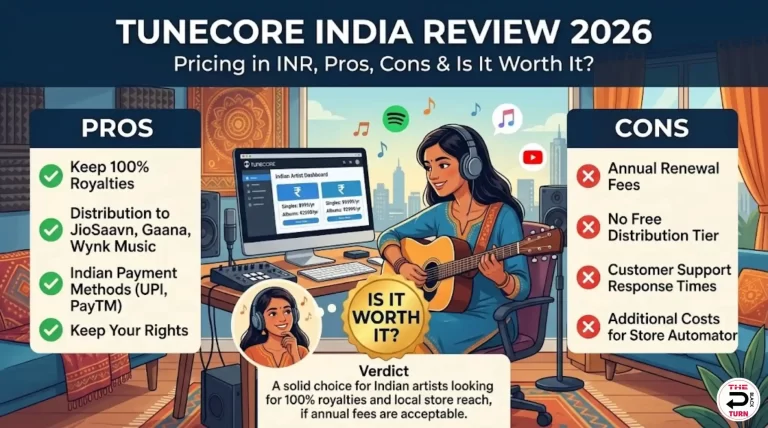
9. TuneCore: Best for Professional Artists
TuneCore is designed for serious artists who want professional-grade tools and analytics. It has moved from per release pricing to annual subscription tiers, and it is owned by Believe.
Key Features:
- Distribution to 150+ platforms
- Advanced analytics and daily trend reports
- Publishing administration
- Sync licensing opportunities
- YouTube Content ID included
- 100% streaming royalty retention
Pricing:
- Rising Artist: $24.99/year
- Breakout Artist: $44.99/year
- Professional: $54.99/year plus around $14.99 per extra artist
The old $9.99 per single and $29.99 per album pricing no longer applies. TuneCore also takes around 20% of social and Reels revenue, which matters a lot for Indian artists.
Best For: Professional artists and indie labels wanting data-driven insights.
Pros:
- Excellent analytics
- Publishing services
- Content ID included in the plan
- Professional reputation
- Sync opportunities
Cons:
- 20% cut on social and Reels revenue
- No caller tune support
- No Indian focus
- Scheduled releases blocked on the entry tier
10. CD Baby: The Veteran Distributor
CD Baby has been in the industry for over two decades and remains a trusted name. As of February 2026 it sits under Universal Music Group, following UMG’s acquisition of Downtown Music Holdings.
Key Features:
- Distribution to 150+ platforms
- One-time fee model
- Physical distribution (CDs, vinyl)
- Sync licensing
- Publishing administration
- 91% royalty share
Pricing:
- Single: $9.99 (one-time)
- Album: $14.99 (one-time)
Best For: Artists who prefer one-time payments and want physical distribution.
Pros:
- One-time fee, lifetime distribution
- Music never comes down for non-payment
- Physical distribution option
- Long industry reputation
- Sync licensing
Cons:
- Takes 9% commission permanently
- No caller tunes
- No Indian platform focus
- Now owned by a major label group
- Rejects fully AI generated tracks
11. LANDR: Best for All-in-One Solution
LANDR combines distribution with AI-powered mastering and other creation tools.
Key Features:
- Music distribution
- AI mastering
- Samples and plugins
- Collaboration tools
- Cover art creation
Pricing:
- Starting from approximately ₹130/month (billed annually)
Best For: Artists who want mastering and distribution in one place.
Pros:
- AI mastering included
- Comprehensive toolkit
- Creative resources
- Good for beginners
Cons:
- Expensive for just distribution
- No Indian platform focus
- No caller tunes
12. Horus Music India: International with Indian Office
Horus Music is an international distributor with a dedicated India office since 2016.
Key Features:
- 150+ platforms
- India editorial playlist pitching
- 100% royalty retention
- UK registered company
- Local India support
- Phone and email support
Pricing:
- Unlimited Distribution PRO: around £40/year
Best For: Artists wanting international reach with local support.
Pros:
- First international aggregator in India
- Local team presence
- Playlist pitching
- Professional service
Cons:
- Pricing in GBP
- Limited caller tune info
- May be pricey for beginners
13. Ditto Music: Artist-Friendly Global Distributor
Ditto Music offers artist-friendly services with flexible plans. It remains founder owned with no major label stake, which is rare in 2026.
Key Features:
- Distribution to 160+ stores
- 0% commission on streaming royalties at every tier
- Record label creation tools
- Promotion opportunities
- Publishing services on higher tiers
Pricing:
- Starter: around £19/year
- Pro: around £59/year, which adds Release Protection, Content ID, publishing and sync admin
- Label tiers above that for multi artist rosters
Release Protection is available on Pro only. On the Starter plan, a lapsed subscription can take your catalogue down.
Best For: Artists wanting label-like services.
Pros:
- Label creation tools
- Flexible options
- 0% streaming commission
- Publishing support
Cons:
- Western audience focus
- Limited India features
- No caller tunes
- Users report slow support and automated fraud flags freezing payouts
14. Amuse: Paid Plans Only Now
Amuse used to offer a free tier, but it was discontinued in March 2024. Any guide still listing Amuse as free is out of date.
Key Features:
- Unlimited releases on all plans
- Distribution to around 53 outlets
- Automated advance offers based on your streaming data
- Good mobile app
- Artist-friendly terms
Pricing:
- Artist: around $23.99 to $24.99/year
- Artist Plus: around $39.99/year
- Professional: around $59.99/year and above
Best For: Artists wanting a mobile-first experience with advance funding options.
Pros:
- Automated advances are genuinely useful
- Fast distribution
- Good mobile app
- Independently owned
Cons:
- No free plan anymore
- Content ID revenue carries a fee on the entry tier
- No lyrics distribution
- Fewer stores than competitors
- No caller tunes
15. RouteNote: Free with Revenue Split
RouteNote offers free distribution with a revenue split model.
Key Features:
- Free distribution option
- 150+ platforms
- YouTube Content ID
- Premium paid option (100% royalties)
Pricing:
- Free (15% commission) or Premium ($10/single)
Best For: Artists who prefer commission-based free distribution.
Pros:
- Genuinely free option
- Good platform coverage
- Premium upgrade available
- Content ID support
Cons:
- 15% commission on free tier
- No caller tunes
- Limited Indian focus
Music Distribution Companies Comparison Table
| Distributor | Pricing | Platforms | Royalty | Caller Tune | Indian Support | Free Plan |
|---|---|---|---|---|---|---|
| The Black Turn | ₹299-699/track | 150+ | 95% | ✅ All networks | ✅ Hindi, English | ❌ |
| ForeVision Digital | ₹299-699/track | 45+ | 90% | ✅ All networks | ✅ Hindi, Bengali | ❌ |
| ST Digital | Free / Premium | 150+ | 100% | ✅ | ✅ | ✅ |
| Gallery Vision | Free | 150+ | 100% | ✅ | ✅ | ✅ |
| RMX India | Custom | 150+ | 90-100% | ✅ | ✅ | ❌ |
| True Knock Digital | Free / Custom | 90+ | 100% | ✅ | ✅ | ✅ |
| MusicNote India | Affordable | Major | 90%+ | ✅ | ✅ | ❌ |
| DistroKid | $24.99/year | 150+ | 100% | ❌ | ❌ | ❌ |
| TuneCore | $24.99/year | 150+ | 100% streaming, 20% social | ❌ | ❌ | ❌ |
| CD Baby | $9.99/single | 150+ | 91% | ❌ | ❌ | ❌ |
| LANDR | ₹130+/month | 100+ | 100% | ❌ | ❌ | ❌ |
| Horus Music India | £40/year | 150+ | 100% | Limited | ✅ | ❌ |
| Ditto Music | £19-£59/year | 160+ | 100% | ❌ | ❌ | ❌ |
| Amuse | $23.99-$59.99/year | 53 | 100% | ❌ | ❌ | ❌ |
| RouteNote | Free (15% cut) | 150+ | 85-100% | ❌ | ❌ | ✅ |
All international pricing verified in August 2026. Distributor pricing changes often, so confirm on the official website before purchasing.
Free Music Distribution in India: Best Options
If you’re just starting out or have a limited budget, here are the best free music distribution options in India:
Top Free Music Distributors:
- ST Digital, completely free, 150+ platforms
- Gallery Vision, free unlimited releases
- True Knock Digital, free for individual artists
- RouteNote, free with 15% commission
Amuse has been removed from this list because its free plan was discontinued in March 2024.
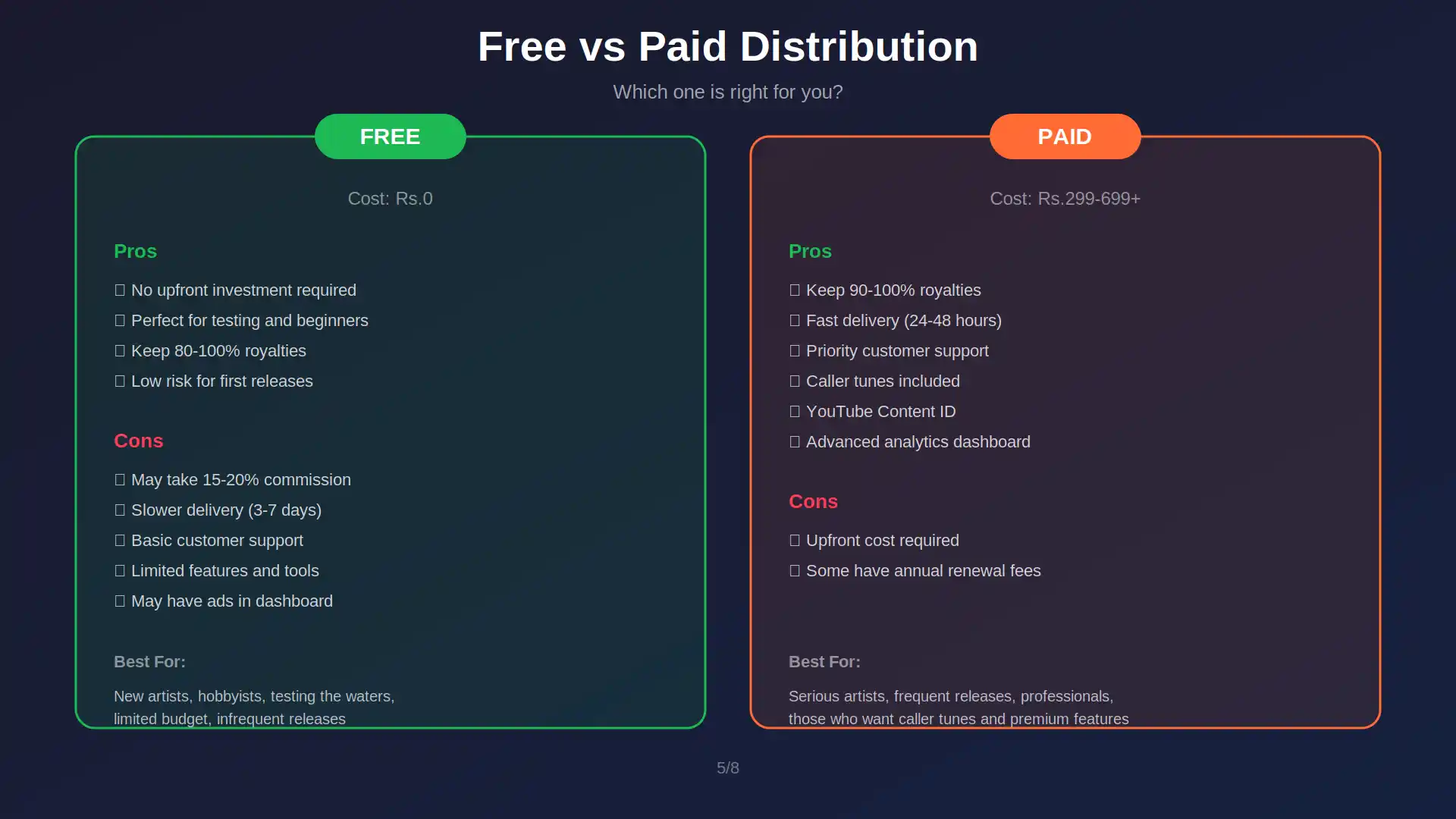
Free vs Paid Distribution: What’s the Difference?
| Feature | Free Distribution | Paid Distribution |
|---|---|---|
| Upfront Cost | ₹0 | ₹299 to ₹5000+ |
| Royalty Commission | 0-20% taken | 0-10% taken |
| Delivery Speed | 3-7 days | 24-48 hours |
| Customer Support | Basic | Priority |
| Additional Features | Limited | Full access |
| Caller Tunes | Sometimes | Usually included |
| Analytics | Basic | Advanced |
Pros of Free Distribution:
- No financial risk
- Good for testing the waters
- Suitable for beginners
- Can earn royalties immediately
Cons of Free Distribution:
- May have commission cuts
- Slower delivery times
- Limited customer support
- Fewer features
A 15% commission costs you almost nothing on a track that never takes off. On a track that reaches 10 million streams, it costs far more than ₹699 ever would have.
AI Music Rules in 2026: What Changed
This is the biggest change in distribution since 2024, and it affects any Indian artist using AI tools.
What Spotify Changed
In September 2025 Spotify announced three changes, and confirmed it had removed more than 75 million tracks it classified as spammy over the previous 12 months:
- Impersonation policy: unauthorized AI voice clones and deepfakes are banned. Vocal impersonation is only allowed if the impersonated artist has authorized it.
- Spam filter: targets mass uploads, duplicates, keyword stuffing in metadata, artificially short tracks and stream manipulation.
- DDEX AI disclosure: a standard way to declare where AI was used, whether in vocals, instrumentation or post production.
The AI Credits beta went live on 16 April 2026. When your distributor supports it, the disclosure travels in the DDEX file and Spotify shows an AI tag in the song credits.
Which Distributors Accept AI Music:
| Distributor | AI Policy in 2026 |
|---|---|
| TuneCore | Rejects fully AI generated submissions |
| CD Baby | Rejects fully AI tracks at intake |
| DistroKid | Accepts with disclosure, runs detection scans |
| Amuse | Runs active AI detection, bans can be permanent |
| Indian distributors | Policies vary, ask before uploading |
How to Stay Safe:
- Disclose AI usage honestly. Spotify has said the tag is meant to inform listeners, not to filter or rank tracks.
- Never clone a real artist’s voice without written permission.
- Do not mass upload. Dumping 30 tracks in a week is exactly the pattern the spam filter looks for.
- Never buy streams. Artificial streaming is the fastest route to takedown.
- Appeals go through your distributor, not directly to Spotify.
Read our detailed guide: AI Music Ke Liye Best Distributor 2026
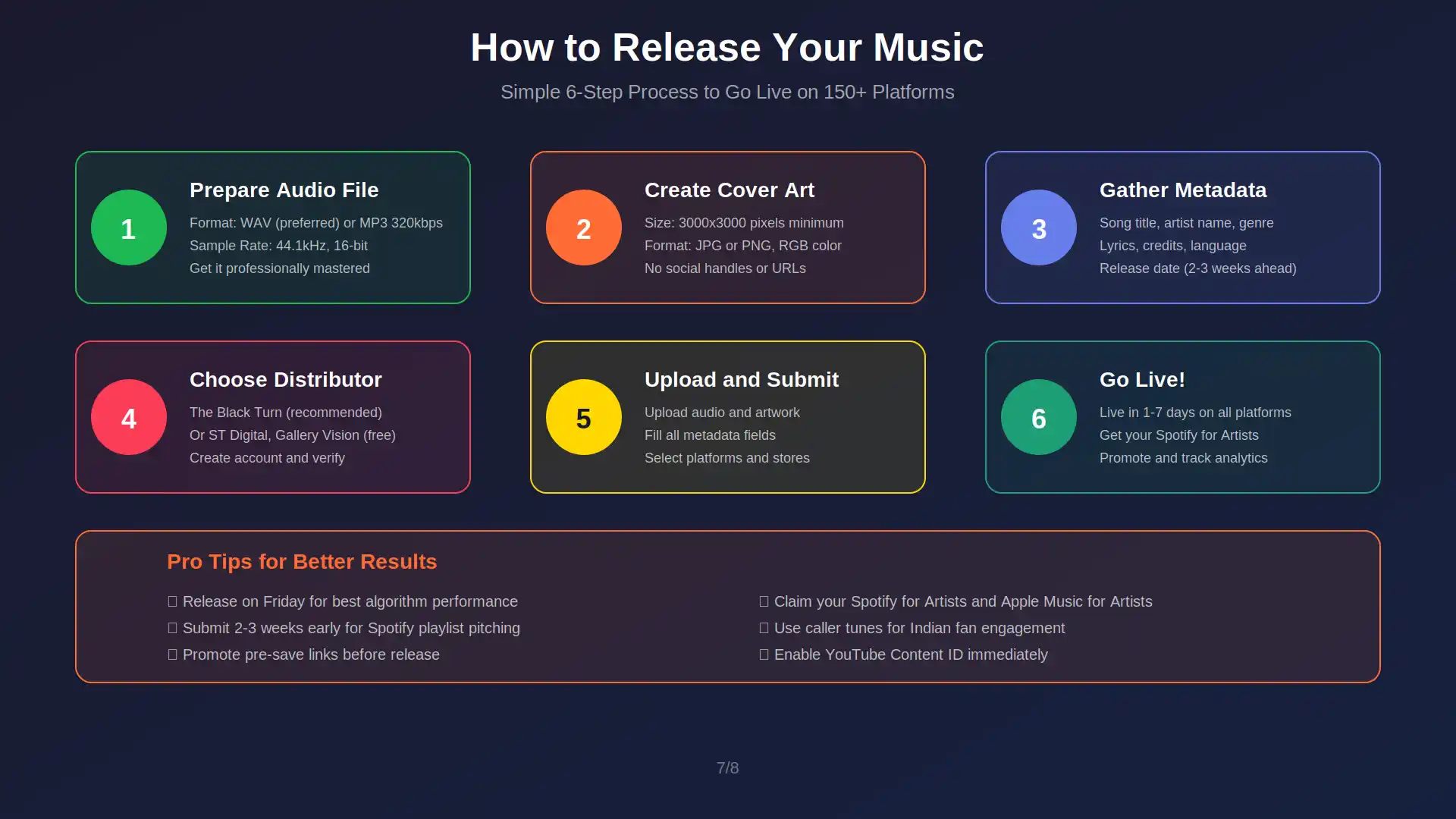
How to Release Music on Spotify & JioSaavn: Step-by-Step Guide
Ready to release your first song? Here’s a complete step-by-step guide:
Step 1: Prepare Your Audio File
Requirements:
- Format: WAV (preferred) or high-quality MP3 (320kbps)
- Sample rate: 44.1 kHz
- Bit depth: 16-bit or 24-bit
- Stereo or mono
Tips:
- Get your track professionally mastered
- Ensure proper loudness levels (-14 LUFS for streaming)
- Check for clipping or distortion
Step 2: Create Cover Art
Specifications:
- Size: 3000 x 3000 pixels (minimum)
- Format: JPG or PNG
- File size: Under 10MB
- Resolution: 300 DPI
Rules:
- No blurry or pixelated images
- No social media handles or URLs
- No explicit content without parental advisory
- Original artwork only (no copyright infringement)
Step 3: Gather Metadata
Prepare the following information:
- Song title (exact spelling, no keyword stuffing)
- Artist name(s) (primary and featured)
- Album/Single name
- Genre (primary and secondary)
- Release date (plan 2-3 weeks ahead)
- Language
- Lyrics (if available)
- Credits (writers, producers, composers)
- AI usage declaration if applicable
Step 4: Choose Your Distributor
Select a distributor based on:
- Your budget
- Platform requirements
- Caller tune needs
- Feature requirements
For Indian artists, we recommend The Black Turn for its comprehensive features and caller tune support.
Step 5: Create Account & Upload
- Sign up on your chosen distributor’s website
- Complete KYC/verification if required
- Click “New Release” or “Upload Music”
- Upload your audio file
- Upload cover art
- Fill in all metadata
- Select platforms for distribution
- Choose your release date
Step 6: Submit & Wait for Approval
After submission:
- Quality check takes 24-72 hours
- You’ll receive confirmation email
- Song goes live on the release date
- Check all platforms for proper listing
Step 7: Claim Your Artist Profiles
- Claim Spotify for Artists as soon as your first release is delivered, you need it for playlist pitching
- Claim Apple Music for Artists
- Apply for a YouTube Official Artist Channel once eligible
- Register with IPRS if you wrote the song
Caller Tune Distribution in India: Complete Guide
Caller tunes (CRBT, or Caller Ring Back Tone) are a significant revenue source for Indian artists. Here’s everything you need to know:
What are Caller Tunes?
Caller tunes are the songs that callers hear instead of the traditional “ring” sound when they call someone. In India, millions of users have active caller tune subscriptions.
Supported Telecom Operators:
- Jio Tune (JioCRBT)
- Airtel Hello Tune
- Vi (Vodafone Idea) Caller Tune
- BSNL Caller Tune
Airtel shut down the Wynk Music streaming app in December 2024, but Airtel Hello Tune is a separate service and is still active.
How to Get Your Song as Caller Tune:
- Choose a distributor that supports caller tune distribution (The Black Turn, ForeVision, etc.)
- Select caller tune option during upload
- Distributor creates 30-45 second cuts
- Songs are submitted to telecom operators
- Approval takes 3-8 days
- Users can then set your song as their caller tune
Caller Tune Revenue:
- Artists earn a percentage of subscription revenue
- Revenue varies by operator and plan
- Can be significant for popular songs
- Monthly royalty payments
The 2026 Calcutta High Court Ruling on Caller Tune Royalties
On 8 May 2026, a Division Bench of the Calcutta High Court ruled against Vodafone Idea in its long running dispute with IPRS. The court held that telecom operators cannot offer caller tunes and ringtones on the basis of a music label licence alone. They must also obtain an IPRS licence and pay royalties to lyricists and composers.
The reasoning goes back to the Copyright Amendment Act of 2012, which was designed to give composers and lyricists an independent right to royalties.
What this means for you:
- If you wrote and composed your own song, you have a royalty claim on caller tune usage that is separate from what your distributor pays you
- To receive it, you need to be registered with IPRS as a composer or lyricist member
- Your distributor pays the recording side, IPRS pays the composition side, and these are two different payments
Music Royalties in India: What You’re Not Collecting
Your distributor only pays you one type of royalty. Most Indian independent artists never collect the rest.
The Four Bodies You Should Know:
| Organization | Who It Pays | What It Collects |
|---|---|---|
| Your Distributor | The master owner, usually you | Streaming and download royalties from Spotify, Apple Music, JioSaavn, YouTube |
| IPRS | Composers, lyricists, publishers | Performance and mechanical royalties for the underlying song, including radio, TV and caller tunes |
| PPL India | Labels and master recording owners | Public performance of recordings in restaurants, gyms, events and venues |
| ISAMRA | Singers and session musicians | Performers’ share when a recording is commercially used |
As of mid 2024, only around 14,450 music creators were registered with IPRS out of a potential pool of roughly 40,000. Low awareness is the main reason.
Your song has two copyrights. The sound recording, which your distributor handles, and the composition, which nobody handles unless you register. If you wrote your own song and only signed up with a distributor, you are collecting roughly half of what you’re owed.
What To Do:
- If you write your own songs, register with IPRS as an author member
- If you sing on recordings, look into ISAMRA membership
- If you own the master recordings, PPL India covers public performance income
- Keep your credits accurate at upload time, because that’s the data these societies match against
YouTube Content ID & Monetization
YouTube Content ID is a crucial feature for monetizing your music on the world’s largest video platform.
What is YouTube Content ID?
Content ID is YouTube’s digital fingerprinting system that:
- Identifies your music when used in any video
- Automatically claims revenue on your behalf
- Protects your music from unauthorized use
- Tracks usage across YouTube
How It Works:
- Your distributor registers your music with Content ID
- YouTube scans all uploaded videos
- When your music is found, you can choose to:
- Monetize: Earn ad revenue from the video
- Track: Monitor where your music is used
- Block: Remove the video (not recommended)
Watch the Content ID Commission
Content ID is where distributors take their biggest cuts, and it rarely appears on the pricing page. DistroKid charges around $4.95 per single per year and keeps 20% of the Content ID revenue it collects. TuneCore includes Content ID but takes around 20% of social revenue. Ditto puts Content ID behind its Pro tier. Compare this line specifically.
YouTube OAC (Official Artist Channel):
An Official Artist Channel consolidates your music on YouTube:
- Topic channel merged with personal channel
- “Music” tab on your channel
- Official checkmark
- Better discoverability
Most distributors help you apply for OAC once you meet YouTube’s requirements.
Understanding ISRC & UPC Codes
These codes are essential for tracking and identifying your music globally.
ISRC Code (International Standard Recording Code)
- What: A unique 12-character code for each recording
- Format: CC-XXX-YY-NNNNN (Country-Registrant-Year-Number)
- Purpose: Tracks your song across all platforms
- Example: INS012512345
Why It Matters:
- Required for streaming platforms
- Ensures accurate royalty tracking
- Proves ownership of recording
- Essential for chart tracking
- Keep a record of it, because you will need it if you ever change distributors
UPC Code (Universal Product Code)
- What: A 12-digit barcode for your release (album/single)
- Purpose: Identifies the product in stores
- Used for: Sales tracking, inventory management
Good News: Most distributors provide both ISRC and UPC codes for free!
How to Switch Distributors Without Losing Your Streams
With pricing changing across the board in 2026, a lot of artists are moving. Do it in the right order or you will lose your play counts.
- Export your ISRC codes, UPC codes, release dates, credits and artwork from your old distributor
- Confirm your new distributor lets you supply your existing ISRC, because a new ISRC means Spotify treats it as a brand new track and your streams reset to zero
- Upload to the new distributor first with the same ISRC and original release date, and do not take anything down yet
- Once delivery is confirmed, request the takedown from your old distributor
- Check that Spotify for Artists shows the release under the same artist page, not a duplicate
- Never run both distributors long term, because duplicate delivery causes takedowns on both
- Plan the switch during a quiet period, not two weeks before a release
Frequently Asked Questions (FAQs)
Q1: Which is the best music distribution company in India?
The Black Turn, ForeVision Digital, ST Digital, and Gallery Vision are among the top music distributors in India. The Black Turn stands out for its 95% royalty share and comprehensive caller tune distribution.
Q2: Can I distribute music for free in India?
Yes! ST Digital, Gallery Vision, True Knock Digital and RouteNote (with 15% commission) offer free music distribution services where you can release music without paying upfront. Amuse discontinued its free plan in March 2024.
Q3: Is Wynk Music still available for distribution?
No. Airtel shut down the Wynk Music streaming app in December 2024 and moved users to Apple Music. However, Airtel Hello Tune caller tunes are a separate service and are still active in 2026.
Q4: What happened to Resso and Hungama?
Resso shut down in India on 31 January 2024 and Hungama Music closed on 15 April 2025. JioSaavn and Gaana are the two remaining Indian platforms, and Gaana has been subscription only since 2022.
Q5: How much money can I earn from music distribution?
Earnings depend on streams. On average:
- Spotify: ₹3-5 per 1000 streams
- Apple Music: ₹7-10 per 1000 streams
- JioSaavn: ₹1-3 per 1000 streams
These are indicative ranges, not guarantees. Your royalty percentage (80-100%) also affects final earnings. Caller tunes and YouTube Content ID often earn more than streaming for regional artists.
Q6: How do I release my song on Spotify?
You cannot upload directly to Spotify. Use a music distributor like The Black Turn, DistroKid, or TuneCore to submit your music. They deliver it to Spotify within 24-72 hours.
Q7: How do I upload music on JioSaavn?
Similar to Spotify, JioSaavn only accepts music through authorized distributors. Choose an Indian distributor that supports JioSaavn distribution.
Q8: What is an ISRC code?
ISRC (International Standard Recording Code) is a unique 12-character code assigned to each recording. It helps track your song across all platforms and ensures proper royalty collection.
Q9: How do I set my song as a caller tune?
Use a distributor that offers caller tune distribution (The Black Turn, ForeVision Digital). They’ll create cuts of your song and submit to Jio, Airtel, Vi, and BSNL.
Q10: How long does music distribution take?
Most distributors deliver within 1-7 days. Premium services offer 24-48 hour delivery. Plan your release date 2-3 weeks ahead for proper playlist pitching.
Q11: What is YouTube Content ID?
Content ID is YouTube’s system that identifies your music when used in videos and automatically earns you revenue from those videos. Check what commission your distributor takes on it.
Q12: Do I need a record label to distribute music?
No! Independent artists can distribute music without a label. Distributors can even provide a custom label name for your releases.
Q13: DistroKid vs TuneCore, which is better for India?
Both start at $24.99/year in 2026 and both pay 100% of streaming royalties. TuneCore includes Content ID but takes 20% of social revenue. DistroKid charges extra for Content ID and removes your music if you stop paying unless you buy Leave a Legacy. Neither offers caller tune distribution, so Indian distributors may be more suitable.
Q14: Can I release AI generated music in India?
It depends on your distributor. TuneCore rejects fully AI submissions and CD Baby rejects fully AI tracks at intake. DistroKid and Amuse accept AI assisted music but run detection scans and require disclosure. Spotify bans unauthorized AI voice clones outright.
Q15: Will disclosing AI usage hurt my streams?
Spotify has stated the AI credits tag is meant to inform listeners, not to filter or rank tracks. What does hurt you is undisclosed mass uploaded AI content, which the spam filter catches.
Q16: What’s the difference between free and paid distribution?
Free distribution may have royalty commission (10-20%), slower delivery, and limited features. Paid distribution offers full royalties, faster delivery, priority support, and advanced features.
Q17: What are the cover art requirements?
Cover art must be 3000×3000 pixels minimum, JPG or PNG format, no blurry images, no social media handles, and original artwork only.
Q18: When and how do I receive royalty payments?
Most distributors pay monthly or quarterly via bank transfer or PayPal. Minimum threshold is typically ₹500-1000. Indian distributors usually pay in INR directly, which avoids currency conversion loss.
Q19: Can I distribute the same song through multiple distributors?
No. Each song should only be distributed through one distributor. Multiple distribution causes conflicts and potential takedowns.
Q20: Do I get royalties if I wrote the song, separate from streaming?
Yes, and most Indian artists never claim it. Your distributor pays you for the sound recording. The composition, meaning melody and lyrics, earns separately through IPRS. After the May 2026 Calcutta High Court ruling this clearly extends to caller tunes.
Q21: What happens to my music if I stop paying my distributor?
It depends on the distributor. Indian per release distributors and one time fee services like CD Baby keep your music live permanently. Most annual subscription services remove your catalogue unless you have bought a permanent availability add-on.
Conclusion: Which Music Distributor Should You Choose?
Choosing the right music distribution company depends on your specific needs:
For comprehensive Indian distribution with caller tunes: Choose The Black Turn, which offers 95% royalties, all Indian platforms, and excellent caller tune support.
For free distribution: Try ST Digital or Gallery Vision if budget is a concern.
For unlimited releases: DistroKid is ideal if you release music frequently, just budget for the add-ons.
For music you want live forever: CD Baby has a one time fee, if you can accept the permanent 9% commission.
For professional analytics: TuneCore offers the best data insights.
For regional Indian music: RMX India specializes in regional content.
Three things to do this week:
- Check whether your current distributor still lists Wynk, Resso or Hungama, because that means their data is two years old
- If you wrote your own songs, start your IPRS registration
- Work out your real annual cost including Content ID fees and commission on social revenue
Remember, your music deserves to be heard by the world. The right distributor is your partner in this journey. Choose wisely, release consistently, and keep creating!
Ready to release your music? Get started with The Black Turn and reach millions of listeners on 150+ platforms including Spotify, Apple Music, JioSaavn, and more, with caller tune distribution included!
Disclaimer: Pricing and features mentioned in this article may change. International pricing was verified in August 2026. Please verify current details on the respective distributor’s website.