If you are an independent artist in India and want your music to reach listeners across the country and around the world, you need to understand how music distribution works. This guide covers everything you need to know about distributing music in India, from choosing the right distributor to getting your songs live on Spotify, JioSaavn, Apple Music, Gaana, YouTube Music, Amazon Music and 150+ other stores, plus caller tunes on Jio, Airtel, Vi and BSNL.
Whether you are releasing your first single or managing a full catalogue for a label, this step-by-step guide walks you through the entire process: audio files, cover art, metadata, ISRC and UPC codes, choosing a distributor, caller tunes, YouTube Content ID, claiming your artist profiles, and how royalty payouts work.
What Is Music Distribution?
Music distribution is the process of delivering your recorded songs to streaming platforms and digital stores where listeners can find and play them. Think of it as the bridge between your finished track and millions of potential listeners.
Here is the key thing most new artists do not realise: you cannot upload your music directly to platforms like Spotify, Apple Music, or JioSaavn. These platforms only accept music through authorised distribution companies. This applies to every artist, whether you are a bedroom producer in Mumbai or a professional studio in Delhi.
A music distribution company acts as the middleman. You upload your song to the distributor, they deliver it to all streaming platforms, and when listeners play your music, royalties flow back through the distributor to your bank account.
How Does Music Distribution Work in India?
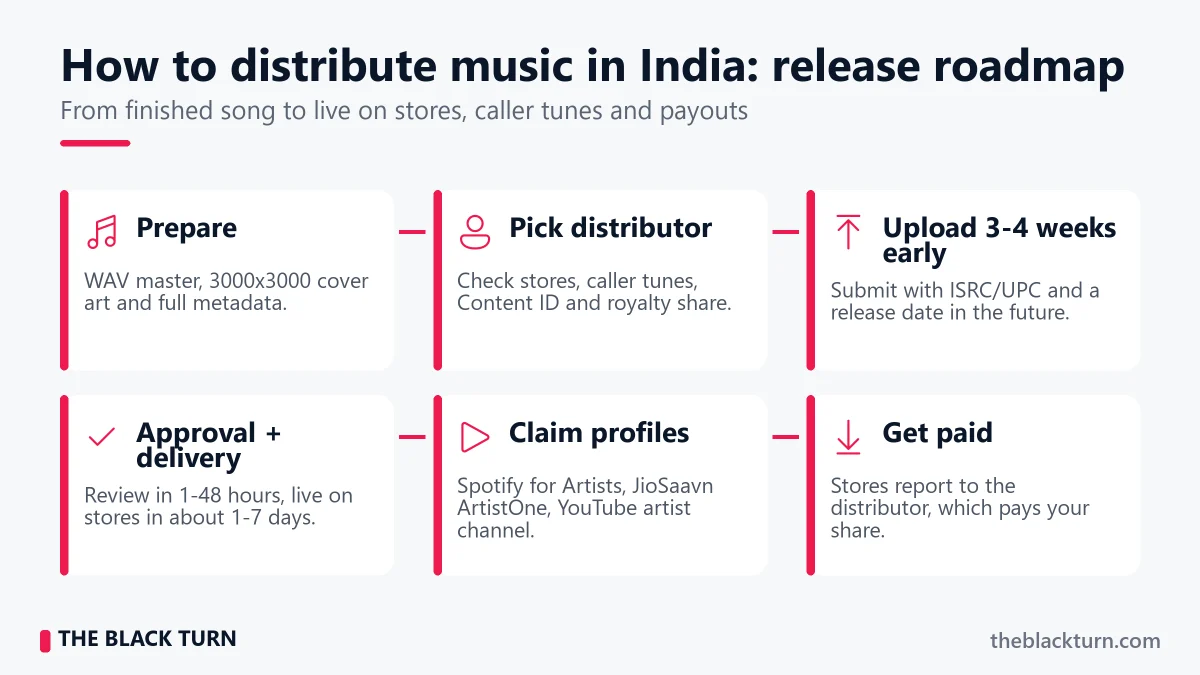
The music distribution process in India follows the same global framework, with one big India-specific extra: caller tunes. Here is how it works:
- You prepare your song : A properly mixed and mastered audio file (WAV format recommended), cover artwork (3000×3000 pixels, JPG), and complete metadata (song title, artist name, genre, language, credits).
- You choose a distributor : Select a distribution company that supports Indian platforms, caller tunes, and offers fair pricing. More on this below.
- You upload and submit : Log into your distributor’s dashboard, upload your audio file, artwork, and fill in all song details. Select which platforms you want your music on.
- Distributor reviews your submission : Quality checks on audio, artwork, and metadata. This typically takes 1–48 hours.
- Your song goes live : After approval, your song is delivered to all selected platforms. Most platforms take 1–7 days to make it available to listeners.
- You earn royalties : Every time someone streams your song, you earn money. The distributor collects royalties from all platforms and pays you, usually monthly or quarterly.
Pro Tip: Submit your song at least 3–4 weeks before your desired release date. Spotify only adds a song to your followers’ Release Radar if you pitch it at least 7 days before release, and the extra time also lets you run a pre-save campaign.
Where Can You Distribute Music in India?
India’s streaming market has changed a lot in the last two years. Resso shut down in early 2024, Airtel closed Wynk Music by the end of 2024, and Hungama shut its music streaming service in April 2025. If a distributor or an old blog still lists these as live stores, the information is out of date. Here is where your music can actually be heard today:
Indian Streaming Platforms
| Platform | Best For | Artist Tools |
| JioSaavn | Hindi, Punjabi, regional, Jio users | JioSaavn ArtistOne (profile + stats) |
| Gaana | Bollywood, Hindi pop, regional | Delivered through your distributor |
Searching “how to distribute music to Saavn”? There is no direct upload; JioSaavn takes music only from distributors. Our step-by-step guide on how to get your song on JioSaavn covers it in detail, and if you prefer Hindi, read Spotify pe gaana kaise upload kare.
International Streaming Platforms
| Platform | Best For | Artist Tools |
| Spotify | All genres, playlist discovery | Spotify for Artists (pitching, stats) |
| Apple Music | Paying listeners, iPhone users | Apple Music for Artists |
| YouTube Music | Video + audio, India’s biggest music audience | Official Artist Channel, Content ID |
| Amazon Music | Prime and Alexa users | Amazon Music for Artists |
Social Media Music Platforms
Social media is where most Indian listeners first hear a new song. Your distributor should get your music on:
- Instagram & Facebook : Your song is added to the Meta music library, so anyone can search it and use it in Reels and Stories. One viral Reel can drive thousands of Spotify streams.
- YouTube Shorts : Songs delivered to YouTube can be used in Shorts, and Content ID tracks those uses.
- Snapchat : Reaches younger listeners through Snapchat Sounds, where your distributor delivers there.
TikTok has been banned in India since 2020, so it only matters if you are targeting listeners outside India.
How to Choose the Right Music Distributor in India
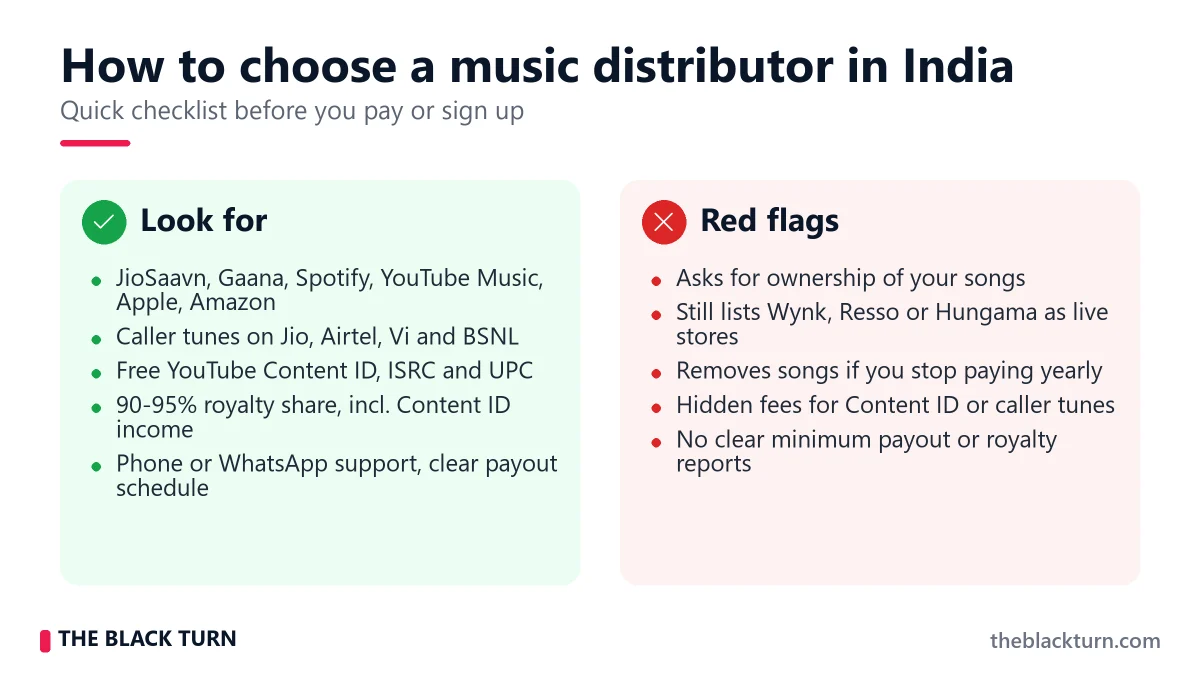
This is arguably the most important decision you will make in your music career. The wrong distributor can delay your releases, eat into your royalties, or lock your music in unfavourable contracts. People search for the “best music distribution company in India”, but the right answer depends on how often you release, your budget and whether caller tunes matter to you. Here is what to look for:
1. Royalty Share
How much of your streaming revenue do you actually keep? Industry standard ranges from 80% to 100%. In the Indian market, 90–95% royalty share is a strong deal. Also check whether the same share applies to YouTube Content ID income, which some distributors cut separately.
2. Platform Coverage
Ensure your distributor covers both Indian platforms (JioSaavn, Gaana) and international platforms (Spotify, Apple Music, YouTube Music, Amazon Music), plus Instagram/Facebook. A store count of 150+ is common in 2026, but the big names above matter far more than the total number.
3. Caller Tune (CRBT) Distribution
This is India-specific and massively underrated. Caller tune distribution gets your song on JioTunes, Airtel Hellotunes, Vi Callertunes and BSNL Tunes. Almost every Indian listener has a phone on one of these four networks, which makes caller tunes a real extra stream of income and exposure. Not all distributors offer this, especially international ones, so check before you sign up.
4. Pricing Model
Indian distributors typically offer three models:
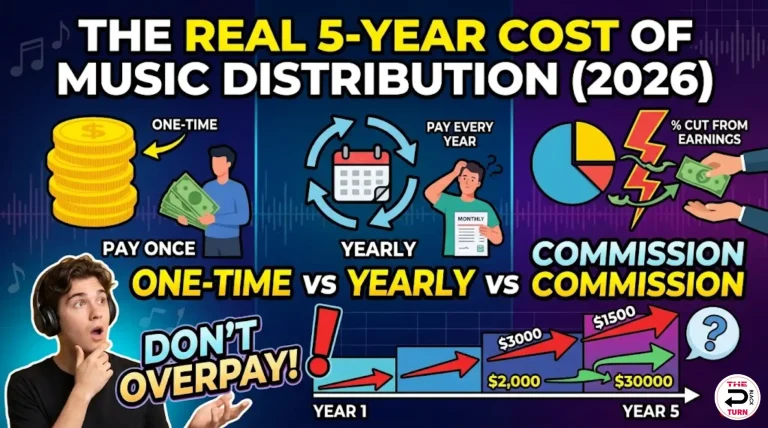
| Model | How It Works | Best For |
| Per Song | One-time fee per release | Beginners, occasional releases |
| Yearly Plan | Annual subscription, unlimited uploads | Artists and labels releasing many songs a year |
| Commission | Free upload, distributor takes % of royalties | Budget-conscious artists |
With yearly plans, always ask what happens if you stop paying. Some services remove your songs, and some (TuneCore, for example) renew every plan and every per-release purchase yearly.
5. Delivery Speed
How fast does your music go live after submission? Good distributors approve within a day and get you live on most stores in 1–3 days. Anything over two weeks is too slow in 2026.
6. YouTube Content ID
Content ID is YouTube’s digital fingerprinting system. When someone uses your song in their video or Short, Content ID automatically detects it and lets you monetise that video. This is a critical revenue stream, especially in India where YouTube usage is massive. Ensure your distributor includes Content ID at no extra charge, and only send a song to Content ID if you own it fully (no leased beats or uncleared samples).
7. Customer Support
When something goes wrong and it will eventually you need responsive support. Indian distributors often have an advantage here with phone support and WhatsApp communication. International distributors typically offer only email support in English.
Important: Read the terms of service carefully. No legitimate distributor should ever ask for ownership of your music. You should retain 100% of your rights at all times.
Is Free Music Distribution in India Worth It?
Free plans do exist. They usually make money by keeping a share of your royalties, delivering to fewer stores, or charging extra for things like Content ID, caller tunes or faster delivery. Free can be fine for a first test release. If you plan to release regularly, compare the total cost over a few years: a small one-time fee with a 95% royalty share often works out better than a free upload that keeps 15–20% of your earnings forever.
How Do Indian Record Labels Distribute Music to Spotify, JioSaavn and Gaana?
Labels use exactly the same route as artists, just at a bigger scale. A label signs up with a distributor on a label plan, adds its label name (which shows as the “℗” line on every store), and uploads releases for all its artists from one dashboard. The distributor delivers to Spotify, JioSaavn, Gaana, Apple Music, YouTube and the caller tune operators, and pays the label, which then pays its artists as per their contracts.
Most small labels use ISRC codes issued by the distributor. Bigger labels can apply for their own ISRC registrant code from the Indian Music Industry (IMI), which runs ISRC registration in India. When choosing a platform as a label, check for unlimited artists, bulk upload, label-name display, and clear per-artist royalty reports.
Step-by-Step: How to Distribute Your Music in India
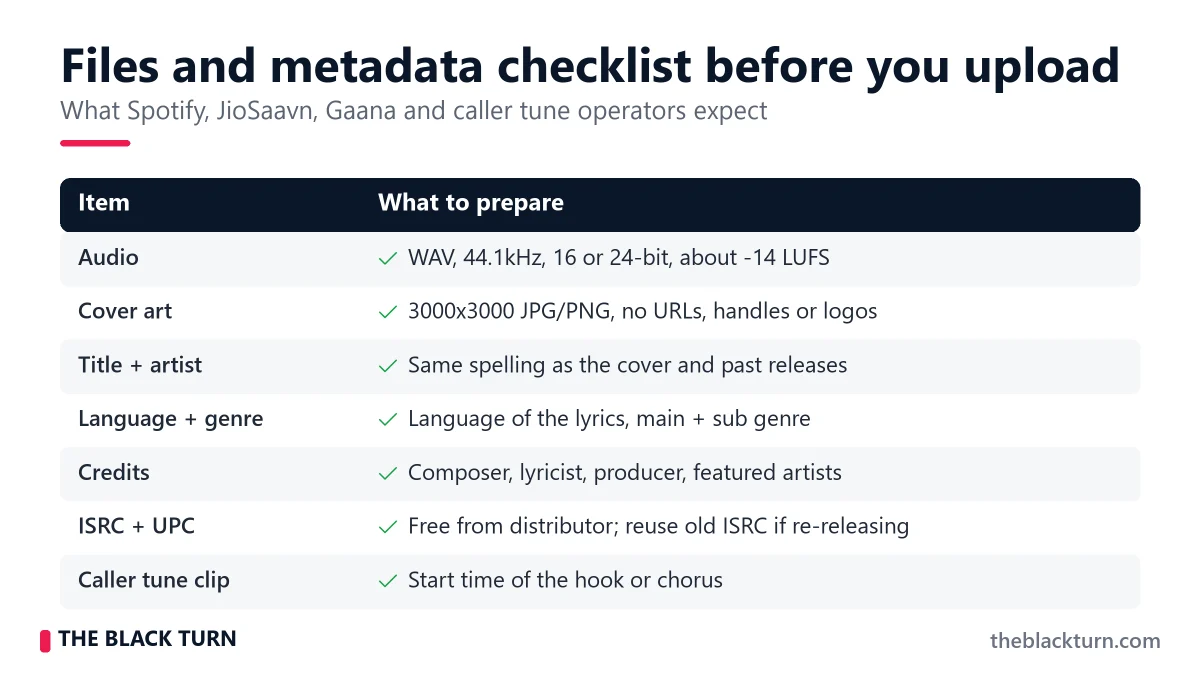
Now let us get practical. Here is exactly how to go from a finished song to being live on all platforms.
Step 1: Prepare Your Audio File
Your song needs to meet technical specifications that streaming platforms require:
- Format: WAV is strongly recommended. Most professional distributors do not accept MP3. If you only have MP3, some accept 320kbps, but WAV is always preferred.
- Sample Rate: 44.1kHz minimum. Some distributors also accept up to 96kHz for high-resolution audio.
- Bit Depth: 16-bit minimum, 24-bit preferred for better dynamic range.
- Loudness: Spotify normalises tracks to -14 LUFS, so a master pushed much louder just gets turned down and loses punch. Aim for around -14 LUFS integrated with peaks below -1 dBTP.
If your mix is not ready yet, The Black Turn artists get free unlimited mix and mastering with TrackFix.
Step 2: Create Your Cover Artwork
Your cover art is the first thing listeners see. It needs to be professional and follow platform guidelines:
- Dimensions: 3000×3000 pixels (square format).
- Format: JPG or PNG, RGB colour, high resolution with no visible compression artifacts.
- Rules: Do not include website URLs, social media handles, pricing information, store logos, or text that is hard to read at small sizes. The artist name and title on the cover must match your metadata. Streaming platforms will reject artwork that violates these rules.
- Design tools: Canva (free) works for basic designs. Adobe Photoshop or Illustrator for professional results. Only use photos and fonts you have the rights to.
Step 3: Prepare Your Metadata
Metadata is the information attached to your song. Getting this right is critical because changing it after release is difficult and can cause issues. Prepare the following:
- Song Title : Exact spelling you want displayed. Double-check for typos.
- Primary Artist Name : Your stage name or real name, spelled the same way on every release so all songs land on one artist profile.
- Featured Artists : If anyone is featured, their name goes here.
- Album/Single Name : Even singles need a release name.
- Genre : Primary and secondary genre (e.g., Hip Hop / Indian Hip Hop).
- Language : Hindi, Punjabi, Haryanvi, Bhojpuri, Tamil, etc. Pick the language of the lyrics, not the language of the title.
- Release Date : Set it at least 7–14 days in the future for playlist pitching.
- Composer, Lyricist, Producer : Full credits for everyone involved.
- Explicit Content : Mark it if your song contains profanity.
- Caller tune start time : The point in the song (usually the hook) where your caller tune clip should begin.
Step 4: Get Your ISRC and UPC Codes
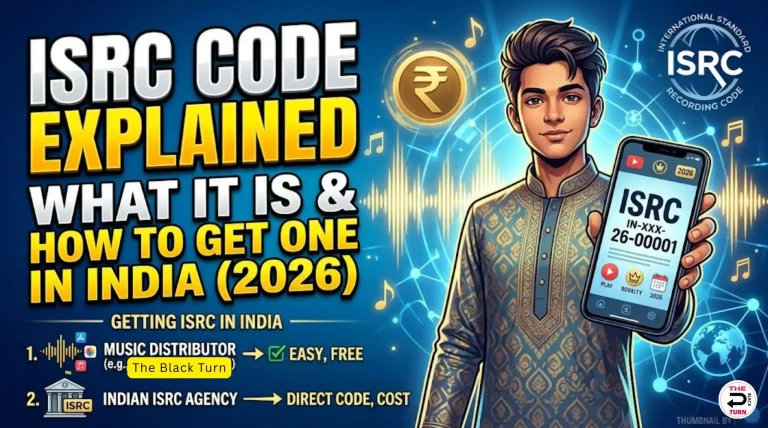
Every song needs an ISRC (International Standard Recording Code), a 12-character code that identifies that exact recording. Indian ISRCs start with “IN”. Stores use it to track streams and pay royalties, so one recording keeps one ISRC forever, even if you change distributors. Every release (single, EP or album) also needs a UPC, the barcode for the release as a whole.
You do not need to buy these separately. Most distributors, including The Black Turn, generate ISRC and UPC codes free when you upload. If the song was released before, reuse its old ISRC instead of taking a new one, otherwise stores treat it as a different recording.
Step 5: Choose Your Distributor and Create an Account
Based on the factors we discussed above, select a distributor that fits your needs. For Indian artists, The Black Turn is a strong option: 150+ stores, caller tunes on Jio, Airtel, Vi and BSNL, free ISRC, UPC and YouTube Content ID, a one-time fee per single, and a 95% lifetime royalty that keeps paying even if you never renew. You can compare all plans on the pricing page.
During registration, you will need:
- Email ID and phone number
- Bank account details (for royalty payments)
- PAN Card (required for Indian artists)
- KYC documentation if required
Step 6: Upload Your Song
Log into your distributor’s CMS (content management system) and start a new release:
- Click “New Release” or “Upload”.
- Upload your WAV audio file. Wait for it to finish completely.
- Upload your cover artwork.
- Fill in all metadata fields accurately.
- Select platforms choose “All Platforms” for maximum reach.
- If caller tune distribution is available, choose the part of the song to use as your caller tune clip.
- Review everything one final time.
- Complete payment and submit.
Step 7: Wait for Approval
Your distributor will review your submission. This usually takes 1–48 hours. Common rejection reasons include:
- Incorrect or incomplete metadata
- Audio quality issues (clipping, distortion, silence at start/end)
- Artwork that violates platform guidelines
- Copyright concerns (uncleared samples, unlicensed beats)
After approval, platforms take 1–7 additional days to make your song available. Caller tunes take longer because each telecom operator reviews the clip separately.
Step 8: Post-Release Actions
Your song is live. Now what? The work does not stop here:
- Claim your Spotify for Artists profile : This gives you access to analytics, the ability to customise your profile, and submit to editorial playlists.
- Claim JioSaavn ArtistOne : Once you have at least one song live on JioSaavn, sign up at artists.jiosaavn.com, search your artist name and submit your details for verification. You can then update your photo and bio and see streams and listeners.
- Get your YouTube Official Artist Channel : Ask your distributor to merge your “Topic” channel with your own YouTube channel so all your music sits in one place.
- Link your Instagram and Facebook : Make sure your song shows up in the Reels music library under your artist profile.
- Share pre-save and streaming links : Use tools like ToneDen or feature.fm to create smart links.
- Submit to playlists : Both Spotify editorial playlists (via Spotify for Artists) and independent curators.
- Promote on social media : Post consistently on Instagram, YouTube Shorts, and WhatsApp Status.
Caller Tune Distribution: India’s Hidden Revenue Stream
Caller tune (CRBT) distribution is one of the biggest advantages Indian artists have over international artists. When someone sets your song as their caller tune, every person who calls them hears your music, which is free, repeated exposure every day.
Here is how caller tune distribution works:
- Your song gets distributed to streaming platforms normally.
- Your distributor cuts a short clip from your song (usually the hook or chorus) and creates caller tune codes for it.
- These clips are submitted to all major Indian telecom operators: Jio, Airtel, Vi, and BSNL.
- Users can find and set your song as their caller tune through their network’s app.
- You earn royalties when people set your song as their caller tune.
| Network | Service Name | How Fans Set Your Tune |
| Jio | JioTunes | MyJio app or JioSaavn app |
| Airtel | Airtel Hellotunes | Airtel Thanks app, or SMS the song code to 543211 |
| Vi | Vi Callertunes | Vi app |
| BSNL | BSNL Tunes | BSNL’s own tune service |
Airtel users no longer use Wynk for this, since Wynk has shut down. Share our fan guide on how to set an Airtel Hello Tune with your listeners so they know the current steps. Already released a song without caller tunes? With The Black Turn you can add a caller tune to an old song for ₹499, live in 1–3 weeks.
How Much Does Music Distribution Cost in India?
One of the most common questions artists ask. Prices across distributors change often, so always check each company’s own pricing page before you pay. For reference, here is what The Black Turn charges (as of October 2026):
| Service | Price | Includes | Payment Type |
| Single Song | ₹599 | 150+ stores, ISRC, UPC, Content ID | One-time |
| Song + Caller Tune | ₹799 | All of the above + Jio, Airtel, Vi, BSNL caller tunes | One-time |
| Album / EP (up to 7 songs) | ₹1,999 | 150+ stores, ISRC, UPC, Content ID | One-time |
| Custom Label Plan | ₹4,999/year | Unlimited releases, unlimited artists | Annual |
The one-time payment model is popular among Indian distributors because there is no yearly fee per song. On every Black Turn plan you keep 95% of royalties for life, and earnings continue even if you do not renew. Free, commission-based distributors cost ₹0 upfront but keep a share of every rupee you earn, so compare them over several years, not just on day one.
How Much Can You Earn from Music Distribution in India?
Let us be honest about earnings. Streaming royalties alone are unlikely to make you rich overnight. But with consistent releases and smart strategy, they build into meaningful income.
There is no fixed “per stream” rate. Stores share a part of their subscription and ad revenue with rights holders, so what one stream pays changes with the listener’s country, whether they are on a free or paid plan, the platform, and the month. Any table promising a fixed amount per 1,000 streams should be taken with a pinch of salt. A better way is to calculate from your own numbers:
- Step 1: After your first payout, divide what a store paid by the streams it reported. That is your real per-stream rate on that store.
- Step 2: Multiply that rate by expected streams to estimate future income.
- Step 3: Apply your distributor’s share. At 95%, ₹10,000 of store revenue means ₹9,500 for you; at 80%, it is ₹8,000.
The key to building real income is diversifying your revenue streams. Streaming royalties are just one piece. Add caller tune revenue, YouTube Content ID earnings, sync licensing, live performances, and merchandise, and the picture changes significantly.
How Royalty Payouts Work
Stores report streams to your distributor a month or two after they happen, so your first earnings show up some weeks after release, not the next day. Your distributor then pays you on its schedule: some pay monthly, others quarterly. Most have a minimum payout amount and need your PAN and bank details on file. The Black Turn pays royalties quarterly, with 95% of all income (including YouTube Content ID) going to the artist.
7 Common Mistakes to Avoid When Distributing Music in India
1. Incorrect Metadata
Misspelling your artist name, choosing the wrong genre, or setting an incorrect release date causes problems that are hard to fix after your song is live. Triple-check everything before submitting.
2. Uploading Low-Quality Audio
Uploading an MP3 instead of WAV, or a track with clipping and distortion, will either get rejected or sound worse than your competition. Invest in proper mastering before distribution.
3. Skipping Caller Tune Distribution
Many Indian artists distribute to streaming platforms but completely ignore CRBT. This is leaving free money and exposure on the table. Always opt for caller tune distribution if your distributor offers it.
4. Releasing Without a Promotion Plan
Uploading your song and hoping for the best is not a strategy. Plan your promotion before the release date. Tease on social media, prepare content, reach out to playlist curators, and coordinate your launch across all channels.
5. Not Claiming Your Artist Profiles
After your first release, immediately claim your Spotify for Artists, JioSaavn ArtistOne, Apple Music for Artists, and YouTube Official Artist Channel. These give you analytics, customisation options, and legitimacy.
6. Choosing the Wrong Distributor
Going with the cheapest option without checking platform coverage, support quality, or contract terms can hurt you long-term. Some free distributors take high commission cuts that eat into your earnings over time.
7. Ignoring Copyright
Using unlicensed samples, beats you found online without permission, or releasing cover songs without mechanical licenses will result in takedowns and potentially legal issues. Only distribute music you have full rights to.
Frequently Asked Questions
Below are the most commonly asked questions about music distribution in India.
Can I upload my song directly to Spotify or JioSaavn?
No. Major streaming platforms do not accept direct uploads from individual artists. You need an authorised music distribution service to deliver your music to these platforms.
How long does it take for my song to go live?
After your distributor approves your submission (usually within 24–48 hours), platforms take an additional 1–7 days to make your song available. Caller tunes take longer. Plan for at least 2–3 weeks from submission to release day so you can pitch to Spotify and run a pre-save.
Is Wynk Music still available for new releases?
No. Airtel shut down Wynk Music in 2024. Your song can still be an Airtel Hellotune; fans now set it through the Airtel Thanks app. Hungama Music and Resso have also closed, so for Indian streaming focus on JioSaavn and Gaana, plus Spotify, YouTube Music, Apple Music and Amazon Music.
What is the difference between a music distributor and a record label?
A distributor delivers your music to platforms and you retain 100% of your rights. A record label typically signs you to a contract, may fund your production and marketing, but takes ownership or a large share of your music rights and revenue. Most independent artists in 2026 use distributors rather than labels.
Can I distribute a cover song?
Yes, but you need a mechanical license from the original copyright holder. Without this license, platforms may take down your cover song and you could face legal action. Some distributors help facilitate cover song licensing.
What happens to my music if I switch distributors?
Upload the songs through your new distributor using the same ISRC codes, the same audio and the same title and artist spelling. Once the new release is live, ask your old distributor to take the old one down. When everything matches, Spotify and other stores can usually keep your stream counts, though playlist placements may be affected for a short time. Taking songs down first and re-uploading with new ISRCs resets everything.
Do I need a record label to distribute music in India?
Absolutely not. One of the biggest advantages of modern music distribution is that any independent artist can release music worldwide without a label. You keep full ownership and control of your music.
How do I get paid my royalties?
Royalties are collected by your distributor from all streaming platforms and paid to your registered bank account. Payment schedules vary: some distributors pay monthly, others quarterly. There is usually a minimum payout amount, so check it before you sign up.
Is music distribution a one-time payment or recurring?
This depends on your distributor. Some charge a one-time fee per release (common among Indian distributors). Others charge annual subscriptions (like DistroKid). Commission-based models charge nothing upfront but take a percentage of your royalties.
Start Distributing Your Music Today
Music distribution in India has never been more accessible or affordable. Whether you are a hip-hop artist in Delhi, a folk singer in Rajasthan, or a producer in Chennai, you can get your music on every major streaming platform worldwide and start building your audience and income.
The key steps are straightforward: prepare your audio and artwork properly, choose a reliable distributor with strong Indian platform coverage and caller tune support, upload your music with accurate metadata, and promote actively after release.
Ready to release your first song? Get started with The Black Turn and distribute your music to 150+ platforms including Spotify, JioSaavn, Apple Music, Gaana, YouTube Music, and all Indian caller tune networks. One-time payment per release, 95% lifetime royalty, approval within 24 hours.
 Jyoti Singh – Independent artist (32) who has worked at several music distribution companies and has released music through distributors – so these guides come from both sides of a release.