You wrote a song. You recorded it. You distributed it. People are streaming it. But do you actually understand how the money reaches your bank account? And more importantly, are you collecting all the money you are owed?
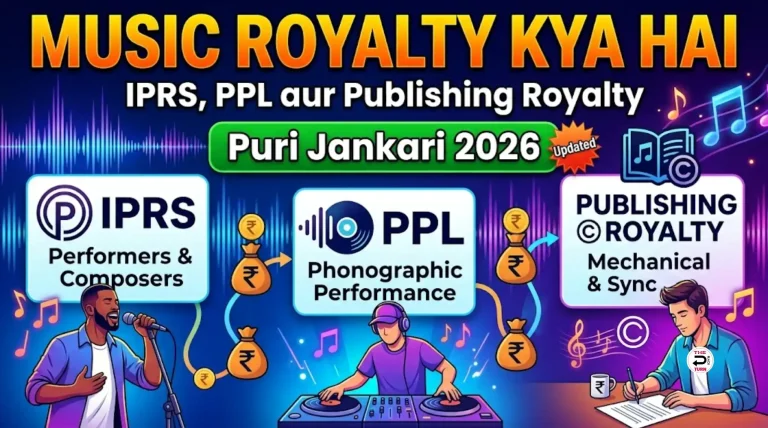
Most Indian artists know about streaming royalties. That is the money you get when someone plays your song on Spotify or JioSaavn. But streaming royalties are just one of five types of music royalties you can earn in India. The other four are quietly accumulating somewhere and if you are not registered with the right organisations, nobody is sending you that money.
This guide breaks down every type of royalty, who pays it, who collects it, and exactly what you need to do to make sure you are not leaving money on the table.
One Song, Multiple Rights, Multiple Payments
Before we get into royalty types, you need to understand something fundamental: one song is actually two separate copyrights.
Copyright 1: The composition : the melody and lyrics. This belongs to the songwriter (composer + lyricist). Even if the song is never recorded, the composition exists as soon as it is written down or documented.
Copyright 2: The sound recording : the specific recorded version of that composition. This belongs to whoever paid for the recording, which is typically the artist, the producer, or the record label.
Why does this matter? Because different royalty types are tied to different copyrights. Performance royalties go to the composition owner. Sound recording royalties go to the recording owner. If you wrote and recorded your own song (which most independent artists do), you own both and you are entitled to both sets of royalties.
If you are an independent artist who writes, records, and owns your own music: You are the composer, lyricist, performer, AND sound recording owner. This means you are eligible for ALL five types of royalties. Most signed artists only get a fraction because the label owns the recording.
The 5 Types of Music Royalties in India
| Royalty Type | Who Gets Paid | When Triggered | Who Collects | Passive? | Action Needed |
| Streaming | Recording owner | Every stream on any platform | Your distributor | Yes | Distribute your music |
| Performance | Composer + lyricist | Public play: radio, TV, events, cafes, streaming | IPRS | Yes | Register with IPRS |
| Mechanical | Composer + lyricist | Reproduction: downloads, physical sales, streams | IPRS / distributor | Yes | Register with IPRS |
| Neighbouring / Performer | Singer + musicians | Commercial use of the recording | ISAMRA + PPL | Yes | Register with ISAMRA |
| Sync | All rights holders | Music used in film, ad, web series, game | Direct / agent | No | Make music discoverable |
Now let us break down each one with real-world examples.
1. Streaming Royalties : The One Everyone Knows
Every time someone plays your song on Spotify, Apple Music, JioSaavn, Gaana, Wynk, YouTube Music, or any streaming platform, you earn a per-stream royalty. This is the most visible income source for modern artists.
How it flows: Listener streams your song → Platform (Spotify etc.) calculates royalty → Platform pays your distributor → Distributor pays you (minus their commission).
We covered exact per-stream rates in detail in our Spotify pay per stream India guide. Quick summary:
| Platform | Per 1,000 Indian Streams | Per 1 Lakh Streams |
| Spotify | ₹120–250 | ₹12K–25K |
| Apple Music | ₹500–700 | ₹50K–70K |
| JioSaavn | ₹50–100 | ₹5K–10K |
| YouTube Music | ₹100–200 | ₹10K–20K |
What you need to do: Distribute your music through a distributor. That is it, streaming royalties flow automatically once your song is live on platforms.
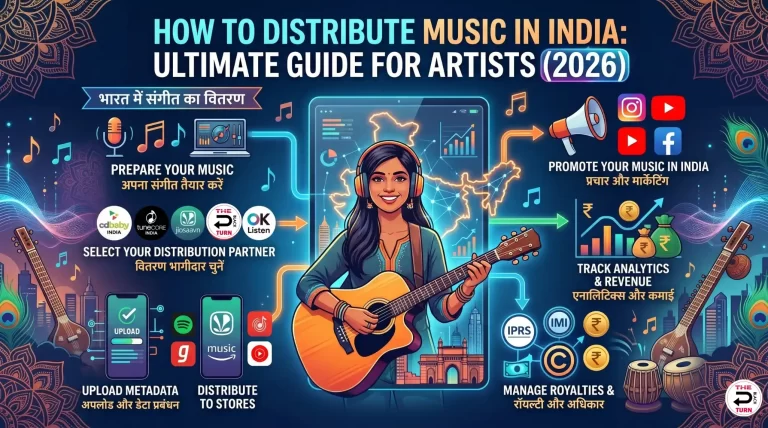
If you have not distributed your music yet, read our step-by-step distribution guide.
2. Performance Royalties : The Money Most Indian Artists Miss
This is where things get interesting and where most Indian artists lose money. Performance royalties are earned whenever your composition (melody + lyrics) is performed or played publicly:
- Your song plays on FM radio (Radio Mirchi, Red FM, etc.)
- A TV channel uses your song in a show or as background music
- A cafe, restaurant, hotel, or mall plays your song over their speakers
- Your song is performed at a live event, wedding, or concert
- A streaming platform plays your song (yes, streaming generates performance royalties too, separate from streaming royalties)
Who collects this: In India, performance royalties are collected by IPRS (Indian Performing Right Society). IPRS issues licences to businesses, radio stations, TV channels, and streaming platforms. The licence fees are pooled and distributed to IPRS members based on usage data.
Critical: If you are not registered with IPRS, your performance royalties are not being collected. They do not accumulate and wait for you. They get distributed to other registered members or remain uncollected. Register NOW at iprs.org.
How to Register with IPRS
- Visit iprs.org and click on Membership.
- Select your category: Author (lyricist), Composer, or Publisher.
- Fill out the online application with your personal details, PAN card, Aadhaar, and bank details.
- Submit proof of your musical works (links to your songs on streaming platforms, distribution agreements).
- Pay the one-time membership fee (nominal).
- Once approved, register each of your songs (called “work registration”) through the IPRS portal with complete credits.
Earning potential: Varies based on how widely your music is played publicly. Active radio play + streaming + public venues can generate ₹5,000–50,000+/year in performance royalties on top of your streaming income.
3. Mechanical Royalties : Every Download and Stream Generates These
Mechanical royalties are paid to the songwriter every time a composition is reproduced that includes physical copies (CDs/vinyl), digital downloads, and even streaming. Yes, every stream generates a tiny mechanical royalty in addition to the streaming royalty.
In Western countries (US, UK), mechanical royalties are a significant income stream with dedicated collection organisations. In India, the structure is less developed, but IPRS handles mechanical rights as well.
For most Indian independent artists, mechanical royalties from streaming are automatically included in what your distributor pays you. The separate collection through IPRS becomes relevant for public performances and broadcast.
What you need to do: Register with IPRS (same registration covers both performance and mechanical royalties). Ensure all your song details are accurately registered.
4. Neighbouring / Performer Royalties : For Singers and Musicians
Here is a royalty type that almost no independent Indian artist knows about. Neighbouring rights (also called performer royalties or “R3 rights”) are paid to performers such as the singer who sang the song and the musicians who played on the recording, when the sound recording is used commercially.
This is separate from the composer’s royalties. The composer gets paid for writing the song. The performer gets paid for performing it. If you are both the writer and performer (as most independent artists are), you are owed both.
Who collects this in India:
- ISAMRA (Indian Singers’ and Musicians’ Rights Association) : collects royalties for singers and session musicians when their performances are used commercially.
- PPL (Phonographic Performance Limited India) : collects royalties for the owners of sound recordings (labels/producers) when recordings are played publicly.
If you are an independent artist who sings and owns your recordings, you should register with both ISAMRA (as performer) and PPL (as recording owner).
Think of it this way: IPRS = you wrote the song. ISAMRA = you sang the song. PPL = you own the recording. If you did all three (which independent artists typically do), register with all three to collect every rupee owed.
5. Sync Licensing Fees : The Big Ticket
Sync (synchronisation) licensing is when your music is placed alongside visual content : films, advertisements, web series, video games, brand content. Unlike other royalties which are per-play micropayments, sync fees are lump-sum payments that can be substantial.
India’s booming OTT market such as Netflix India, Amazon Prime, Disney+ Hotstar, JioCinema has massively increased demand for independent music in sync placements. Music supervisors actively seek out fresh, unsigned tracks.
| Placement Type | Typical Fee Range |
| YouTube brand collaboration | ₹10,000–50,000 |
| Web series / OTT background | ₹25,000–2,00,000 |
| TV ad (regional) | ₹50,000–5,00,000 |
| TV ad (national brand) | ₹2,00,000–10,00,000+ |
| Bollywood film placement | ₹5,00,000–50,00,000+ |
What you need to do: Keep your music well-organised with clean metadata. Register on sync platforms like Musicbed, Artlist, or Epidemic Sound. Keep instrumental versions available because many sync placements want music without vocals.
Bonus: Caller Tune Royalties : India’s Unique Revenue Stream
This does not fit neatly into the traditional five categories because it is uniquely Indian. Caller tune (CRBT) royalties are earned when Jio, Airtel, Vi, or BSNL subscribers set your song as their caller tune. You earn ₹2–5 per download plus ongoing subscription revenue. With 800+ million mobile subscribers, this is serious money. We covered this in detail in our caller tune distribution guide.
Caller tune royalties are collected through your distributor but only if your distributor supports CRBT distribution. International distributors like DistroKid, TuneCore, CD Baby, and RouteNote do not offer this. Only Indian distributors provide it.
The Complete Registration Checklist for Indian Artists
Here is everything you need to do to collect every rupee owed to you. Most artists do step 1 and stop. Do all five.
| # | Action | What It Collects | Where to Register | Time Required |
| 1 | Distribute your music | Streaming royalties + Content ID + caller tune | The Black Turn / distributor | 30 minutes |
| 2 | Register with IPRS | Performance + mechanical royalties | iprs.org | 1–2 hours (one-time) |
| 3 | Register with ISAMRA | Performer / singer royalties | isamra.in | 1 hour (one-time) |
| 4 | Register with PPL | Sound recording public performance royalties | pplindia.org | 1 hour (one-time) |
| 5 | Claim artist profiles | Analytics + playlist pitching | Spotify for Artists, Apple Music for Artists | 30 minutes |
Total time: approximately 4-5 hours of one-time setup. After that, all five royalty streams flow automatically for the rest of your career. That is possibly the highest-ROI 5 hours you will ever invest.
The cost of NOT registering: If you have 10 songs on streaming platforms but are not registered with IPRS, ISAMRA, and PPL, you are potentially losing ₹10,000–50,000+ per year in uncollected royalties. This money does not wait for you it gets redistributed or lost. Register today.
How Royalty Money Actually Flows to Your Bank Account
Understanding the payment timeline helps set realistic expectations. Nothing in the music industry pays instantly.
Streaming Royalties Timeline
Listener streams your song (Month 1) → Platform calculates royalty (end of Month 1) → Platform pays distributor (Month 2) → Distributor pays you (Month 2–3). Total delay: 2–3 months.
IPRS Performance Royalties Timeline
Your song is played publicly (ongoing) → IPRS collects licence fees from venues/platforms (quarterly) → IPRS matches usage data to registered works → IPRS distributes to members (quarterly/semi-annually). Total delay: 3–6 months. Can be longer for first payments.
YouTube Content ID Timeline
Someone uses your song in a YouTube video → Content ID detects it (within days) → Ad revenue accumulates (monthly) → YouTube pays distributor (monthly) → Distributor pays you. Total delay: 2–3 months. See our Content ID complete guide for details.
Caller Tune Royalties Timeline
User sets your caller tune (ongoing) → Telecom operator tracks subscriptions (monthly) → Operator pays distributor (monthly/quarterly) → Distributor pays you. Total delay: 2–4 months.
How Your Distributor’s Commission Affects Total Royalties
Your distributor’s commission applies to streaming royalties, Content ID revenue, and caller tune royalties (everything that flows through them). This is why the commission percentage matters so much:
| Annual Gross Royalties | RouteNote Free (15%) | CD Baby (9%) | The Black Turn (5%) |
| ₹50,000 | You lose ₹7,500 | You lose ₹4,500 | You lose ₹2,500 |
| ₹2,00,000 | You lose ₹30,000 | You lose ₹18,000 | You lose ₹10,000 |
| ₹5,00,000 | You lose ₹75,000 | You lose ₹45,000 | You lose ₹25,000 |
At ₹5 lakh annual earnings, the difference between a 15% distributor and a 5% distributor is ₹50,000 per year. Choose wisely. For a detailed comparison, read our free vs paid distribution analysis.
How Long Do Music Royalties Last in India?
Under the Indian Copyright Act, 1957:
- Musical and literary works (compositions): Copyright lasts for the lifetime of the author + 60 years after death. Your grandchildren can collect royalties from your songs.
- Sound recordings: Copyright lasts for 60 years from the year of publication. A song released in 2026 is protected until 2086.
This is why proper registration and rights management matters so much. A well-distributed, properly registered catalogue is not just current income it is a 60+ year asset that generates revenue long after you stop actively promoting it.
Frequently Asked Questions
What are the different types of music royalties in India?
Five main types: streaming royalties (per play on platforms), performance royalties (public play – collected by IPRS), mechanical royalties (reproduction of composition), neighbouring/performer royalties (for singers – ISAMRA and PPL), and sync licensing fees (music in films, ads, web series).
What is IPRS and should I register?
IPRS is India’s government-authorised copyright society for composers, lyricists, and publishers. If you write your own songs, absolutely register at iprs.org. They collect performance royalties from radio, TV, streaming platforms, live events, and public venues. Without registration, these royalties go uncollected.
How do streaming royalties work in India?
Platform pays per stream → distributor collects → distributor pays you minus commission. Per-stream rates vary: Spotify ₹0.12–0.25, Apple Music ₹0.50–0.70, JioSaavn ₹0.05–0.10 per Indian stream. For detailed rates: Spotify pay per stream India.
What is the difference between IPRS, PPL, and ISAMRA?
IPRS = you wrote the song (composer/lyricist royalties). PPL = you own the recording (sound recording royalties). ISAMRA = you sang/performed the song (performer royalties). Independent artists who do all three should register with all three organisations.
Do independent artists get royalties without a label?
Yes. All five royalty types are accessible without a label. Streaming royalties come through your distributor, performance royalties through IPRS, performer royalties through ISAMRA, recording royalties through PPL. Distribute independently with The Black Turn and keep all your rights.
How long do music royalties last in India?
Compositions: lifetime of the author + 60 years. Sound recordings: 60 years from publication. A song released in 2026 generates royalties until at least 2086.
What are caller tune royalties?
You earn when someone sets your song as their Jio/Airtel/Vi/BSNL caller tune. ₹2–5 per download + ongoing subscription. Only available through Indian distributors with CRBT distribution support.
Start Collecting Every Royalty You Are Owed
Music royalties in India are not complicated once you understand the structure. The problem is not complexity it is inaction. Most Indian artists only collect streaming royalties (one type out of five) and leave the other four uncollected.
Today’s action plan: (1) Distribute your music to all platforms including caller tune. (2) Register with IPRS. (3) Register with ISAMRA. (4) Register with PPL. (5) Claim your artist profiles. Five steps, 5 hours, and every royalty rupee starts flowing to your bank account.
Distribute your music with The Black Turn one upload covers streaming royalties, YouTube Content ID, caller tune royalties, and 150+ platforms. One-time payment, 95% royalties, lifetime distribution. Then register with IPRS, ISAMRA, and PPL to complete the picture.