In 2014, becoming a music artist in India meant one path. Get signed by a label. Sing playback for films. I hope someone notices. Most people who tried failed. The few who succeeded had to give away their masters, their publishing, and most of their creative control.
In 2026, that has completely changed. Independent artists in India can release music to Spotify, JioSaavn, Apple Music, and 150+ platforms within 7 days. They can earn from caller tunes, YouTube Content ID, sync licensing, and live performances. They keep 95 percent of their royalties. They own their masters. They build direct relationships with fans through Instagram Reels and WhatsApp.
This is the most accessible time in history to become an independent music artist in India. But access is not the same as ease. There is still a clear path, real costs, and predictable timelines. This guide is your complete roadmap from “I want to make music” to “I am earning from my music.” Practical, honest, and grounded in real Indian numbers.
The Mindset Shift. From Aspiring Artist to Music Entrepreneur
Before equipment, before software, before strategy, you need a mindset shift. Most aspiring artists in India fail not because of talent or budget but because they think like employees waiting to be picked. Successful independent artists think like entrepreneurs building a business.
Employee Mindset (What to Avoid)
- “I will release my song and hope someone discovers me”
- “I just need one big break”
- “I will start once I am perfect”
- “My music speaks for itself, I do not need to promote”
- “I cannot do social media, I am just an artist”
Entrepreneur Mindset (What Actually Works)
- “I will release consistently and build audience over time”
- “I am building a catalogue, not chasing one viral moment”
- “I will start before I am ready and improve as I go”
- “My music plus my marketing equals my career”
- “Social media is part of being a modern artist”
Reality check: Being an independent artist in India in 2026 is 50 percent making music and 50 percent everything else. Promotion, distribution, branding, fan communication, financial management. If you only want to make music and avoid everything else, you need to either get signed (and sacrifice control and royalties) or hire a team (which requires income to pay them). For most starting artists, you do everything yourself for the first 1 to 3 years.
Step 1. Define Your Artistic Identity (Before Anything Else)
The biggest mistake new artists make is starting to record before they know who they are as an artist. They produce a Lo-Fi track, then a Bollywood cover, then a hip-hop song, then folk. Their Spotify profile becomes a confused mix that does not appeal to any specific audience.
Define your artistic identity first. Three questions to answer:
Question 1. What Genre and Sub-Genre?
Pick a primary genre and sub-genre. “Pop” is too broad. “Hindi acoustic singer-songwriter” is specific. The Indian indie market in 2026 has strong demand in these specific genres:
| Genre | Indian Demand Level | Notable Sub-niches |
| Hindi Singer-Songwriter | Very High | Acoustic, romantic, sad-pop |
| Lo-Fi / Chill | Very High | Study beats, Hindi lo-fi, lofi remixes |
| Indie Hip-Hop | High | Hindi rap, Punjabi rap, regional rap |
| Punjabi (non-film) | Very High | Punjabi pop, devotional, folk-fusion |
| Tamil/Telugu Indie | High | Singer-songwriter, indie pop |
| Devotional | Very High | Bhajans, mantras, kirtan, sufi |
| Indie Pop / Indi-Pop | Medium-High | Hindi pop, Hindi-English fusion |
| Acoustic Covers | High (with licensing) | Bollywood covers, classic covers |
| Bollywood Production | Hard to break in independently | Mostly label-controlled |
Question 2. What Language(s)?
Language affects everything. Reach, audience, royalty rates, distribution strategy, marketing channels.
- Hindi: Largest single-language audience in India. Most competitive but also the biggest opportunity
- English: Smaller domestic audience but international reach. Lower per-stream rates from Indian listeners but higher from US/UK listeners
- Punjabi: Massive consumption base in India and diaspora. Punjabi independent artists often outperform Hindi artists in stream counts
- Tamil/Telugu/Kannada/Malayalam: Strong regional audiences. Less competition than Hindi
- Marathi/Bengali/Gujarati/Bhojpuri: Growing markets with passionate listeners and less crowded competition
- Multi-lingual: Some artists succeed with mixed-language tracks (Hindi-English, Punjabi-English). Works for younger audiences
Question 3. Who Is Your Specific Listener?
“Everyone in India” is not a target audience. Be specific. Picture one real person:
- Age range: 18-22 college student? 25-32 working professional? 35-50 nostalgic listener?
- Lifestyle: Hostel kid? Big-city corporate? Tier-2 city college student? NRI?
- Listening context: Study music? Workout? Romantic moments? Long drives? Wedding playlist?
- Emotional connection: What do they need from your music? Comfort? Energy? Validation? Inspiration?
Example specific listener profile: “22-year-old engineering student in Bangalore who studies late at night, feels homesick for hometown, listens to Hindi acoustic music for comfort, follows artists like Anuv Jain and Prateek Kuhad on Instagram, uses Spotify free tier.”
This level of specificity changes how you write songs, what your visuals look like, where you promote, and what playlists you target.
Step 2. Build the Skills You Need (Or Find Who Has Them)
Becoming an artist requires multiple skills. You either learn them yourself or pay someone who has them. Most independent artists are a mix of both: master 1 or 2 skills deeply, hire others as needed.
Core Skills Required
| Skill | Difficulty to Learn | Cost to Hire | Recommendation |
| Songwriting/Composition | Medium | ₹5K-50K per song | Learn yourself |
| Vocal Performance | High | ₹2K-15K per song (session vocalist) | Learn yourself if you sing |
| Production/Beat Making | High | ₹5K-50K per beat | Learn or partner with a producer |
| Mixing | Very High | ₹3K-15K per song | Hire (until you are advanced) |
| Mastering | Very High | ₹1K-5K per song | Hire (or use AI tools) |
| Photography | Medium | ₹5K-25K per session | Hire for quality assets |
| Video / Reels | Medium | ₹5K-50K per video | Learn yourself (basic) |
| Graphic Design | Medium | ₹1K-10K per design | Use Canva or hire freelancer |
| Marketing/Social Media | Medium | ₹5K-25K monthly | Learn yourself |
Free Learning Resources for Indian Artists
- YouTube channels: Andrew Huang (production), Rick Beato (music theory), Adam Neely (theory), Cymatics (production), and Indian channels like Ankur Kalita, Indian Raga
- DAW tutorials: Free for FL Studio, Ableton, Logic, GarageBand, BandLab on YouTube
- Online courses: Coursera (Berklee), Udemy production courses (often ₹499 in sales), Skillshare, Lynda
- Free DAWs to start: GarageBand (Mac), BandLab (free, web-based), Cakewalk (free for Windows), LMMS (free, open-source)
Step 3. Build a Basic Home Recording Setup
You do not need a professional studio to release music in 2026. You need a quiet room and basic equipment. Here is what to budget at different levels:
Budget Tier 1. Smartphone Setup (₹5,000 to ₹15,000)
- Smartphone with decent built-in mic (most modern phones work)
- Wired earphones for monitoring (₹500 to ₹2,000)
- Free DAW: GarageBand (iOS), BandLab Mobile (Android/iOS)
- Acoustic treatment: blankets, pillows, soft surfaces in recording space (₹1,000)
- Optional: Smartphone-compatible mic like Shure MV88 (₹10,000) or RODE Wireless Go
What you can produce: Vocal-led acoustic tracks, Lo-Fi music with samples, basic singer-songwriter content. Not ideal for full-band productions or beat-heavy tracks but completely viable for a starting artist.
Budget Tier 2. Entry-Level Home Studio (₹20,000 to ₹50,000)
| Equipment | Recommended Models | Approximate Price |
| Audio Interface | Behringer UMC22, Focusrite Scarlett Solo | ₹6,000 to ₹15,000 |
| Condenser Microphone | Audio Technica AT2020, Behringer C-1 | ₹5,000 to ₹12,000 |
| Studio Headphones | Audio Technica ATH-M30x, Sennheiser HD-280 | ₹3,000 to ₹8,000 |
| Mic Stand and Pop Filter | Generic Indian brands work | ₹1,500 to ₹3,000 |
| Acoustic Treatment | Foam panels, bass traps for vocal booth | ₹5,000 to ₹10,000 |
| Cables and Stand | XLR cables, basic accessories | ₹1,500 to ₹3,000 |
| DAW License (optional) | FL Studio, Ableton Lite, Logic (one-time fee) | ₹5,000 to ₹15,000 |
Budget Tier 3. Serious Home Studio (₹70,000 to ₹2 lakh)
Includes upgraded interface (Focusrite Scarlett 2i2, PreSonus Studio 24c), professional condenser mic (Rode NT1, AKG C214), monitor speakers (Yamaha HS5, Adam T5V), advanced acoustic treatment, full DAW (Ableton Suite, Logic Pro), and professional plugins. At this tier you can produce commercially competitive tracks entirely from home.
Budget reality: Tier 1 can launch your career. Tier 2 is the sweet spot for serious starters. Tier 3 is overkill until you are earning consistently from music. Most artists who quit blame lack of expensive equipment when actually their content output was the real problem. Equipment is a tool, not a solution.
Step 4. The First 5 Songs Strategy
Your first 5 songs are not your masterpieces. They are your training. They build your skills, your catalogue, your release rhythm, and your understanding of what works. Most artists wait too long for their “perfect first song” and never build momentum.
The 5-Song Training Plan
- Song 1: Just complete a song from start to finish. Quality is secondary. The goal is to learn the entire workflow
- Song 2: Apply lessons from Song 1. Improve recording technique. Test the distribution process
- Song 3: Focus on the hook and chorus quality. Test promotion strategy. First serious Spotify pitch
- Song 4: Experiment with collaboration or new sub-genre. Find what excites your specific listeners
- Song 5: Use everything learned. This is your first “public-facing” song you actively promote
Realistic timeline: First 5 songs over 6 to 12 months while building skills. Then move to monthly releases.
All 5 songs should be distributed through a proper service. Distribute through The Black Turn gets each song on Spotify, Apple Music, JioSaavn, 150+ platforms, plus caller tune distribution. One-time payment per release, no annual fees, 95% royalties. The same model works for your first song or your hundredth.
Step 5. Build Your Online Presence Before First Release
Most artists release their first song into a void. No social media presence. No followers. No one ready to listen. Then they wonder why streams are zero. Build presence before you have music to promote.
Pre-Release Content Strategy (3 months before first song)
- Month 1: Set up Instagram, YouTube, Spotify-prepared bio across all platforms. Start posting behind-the-scenes content
- Month 2: Cover videos, vocal takes, songwriting moments. Show your craft. Connect with similar artists
- Month 3: Tease your upcoming song. Build anticipation. Get pre-saves activated
What to Post Before You Have Original Music
- Cover videos (your own performances of existing songs)
- Songwriting moments (you on a piano figuring out a melody)
- Reactions to other artists’ new releases
- Music recommendations from your favourite Indian indie artists
- Singing along to popular songs (lip-syncs)
- Studio setup tour and equipment reviews
- Music theory or production breakdowns
- Stories about your music journey
For the complete content strategy, read our music marketing guide for Indian artists.
Step 6. Distribute Your Music Properly
Distribution is the technical step of getting your music onto streaming platforms. This is where many artists make critical mistakes that affect their entire career.
What Distribution Should Cover
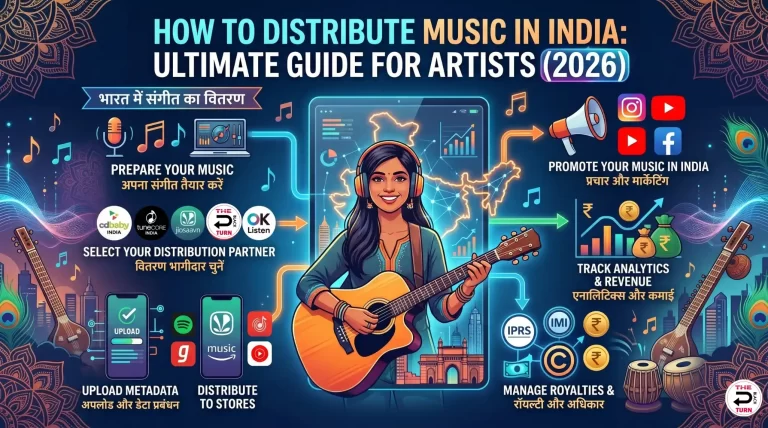
- All major streaming platforms: Spotify, Apple Music, JioSaavn, Amazon Music, YouTube Music, Wynk, Gaana
- Caller tune networks: Jio, Airtel, Vi, BSNL (uniquely Indian opportunity)
- Social media platforms: Instagram, Facebook (for Reels usage)
- YouTube Content ID: Automatic monetization of fan videos using your music
- International platforms: Tidal, Deezer, Pandora, Beatport
What to Look For in a Distributor
Most international distributors (DistroKid, TuneCore, CD Baby) miss caller tune distribution entirely. Indian distributors handle this. Compare options in our distributor analysis.
- One-time fee rather than annual subscription (much better for long-term)
- 95 percent royalties or higher (avoid services that take more than 10 percent)
- Caller tune included (specifically for Indian market)
- YouTube Content ID free (some distributors charge extra)
- Spotify for Artists fast verification (saves you 5-7 days)
- Lifetime distribution (your songs stay live forever, not just one year)
The Black Turn covers all of these in their standard package. One-time payment, 95% royalties, caller tune included, Content ID free, lifetime distribution. The structure is purpose-built for Indian indie artists.
Step 7. The Audience Building Phase (Months 6 to 18)
With your first few songs out and basic skills built, your focus shifts to audience building. This is the longest and hardest phase. Most artists quit during this period because growth feels slow.
Realistic Growth Numbers for Indian Indie Artists
| Month | Songs Released | Monthly Spotify Listeners | Monthly Income from Music |
| Month 3 | 1-2 | 0-200 | ₹0 to ₹100 |
| Month 6 | 3-5 | 100-1,000 | ₹100 to ₹1,000 |
| Month 12 | 8-12 | 1,000-10,000 | ₹1,000 to ₹5,000 |
| Month 18 | 15-20 | 5,000-25,000 | ₹5,000 to ₹15,000 |
| Month 24 | 20-30 | 15,000-75,000 | ₹15,000 to ₹40,000 |
| Month 36 | 30+ | 50,000-2,00,000 | ₹40,000 to ₹1,50,000 |
Growth is non-linear: These numbers are averages. Your actual growth might happen in jumps. One viral Reel can take you from 1,000 monthly listeners to 50,000 in a month. One Spotify editorial placement can change your trajectory. Stay consistent through the slow months. The compounding happens later.
Step 8. The Monetization Phase
By month 18-24, you should be earning some income from music. The mix of revenue sources for Indian indie artists looks like this:
| Revenue Source | Typical Share | Time to Activate |
| Streaming royalties (Spotify, Apple Music etc.) | 30-40 percent | Day 1 |
| Caller tune (CRBT) | 10-20 percent | Week 1 |
| YouTube Content ID | 10-20 percent | Week 1 |
| YouTube channel ad revenue | 5-15 percent | After 1,000 subscribers |
| Live performances | 20-40 percent (when they happen) | After audience built |
| Sync licensing | Variable but high per deal | Opportunistic |
| Merchandise | 5-10 percent | After dedicated fan base |
| Brand deals | Variable | After audience built |
For the complete revenue breakdown with INR estimates, read our 12 revenue streams guide for Indian artists.
The 5 Career Phases of an Indian Independent Artist
Phase 1: Beginner (Months 0 to 6)
- Build basic skills (DAW, mixing fundamentals)
- Set up home recording
- Release first 1-3 songs
- Active social media presence on Instagram and YouTube
- Income: ₹0 to ₹500/month
- Goal: Develop your sound and learn the workflow
Phase 2: Building (Months 6 to 18)
- Monthly releases
- First 1,000 followers across platforms
- First Spotify editorial pitch attempts
- Beginning Instagram Reels strategy
- Income: ₹500 to ₹5,000/month
- Goal: Find your audience and consistent content rhythm
Phase 3: Growing (Months 18 to 36)
- Consistent monthly releases
- First viral moment or playlist placement
- First live performances
- First brand collaborations
- Income: ₹5,000 to ₹40,000/month
- Goal: Reach sustainable income levels
Phase 4: Sustaining (Months 36 to 60)
- Established audience
- Multiple revenue streams active
- Possibly hire help (manager, PR, video team)
- Regular live shows
- Income: ₹40,000 to ₹2,00,000/month
- Goal: Treat it as a full business
Phase 5: Scaling (Year 5+)
- Major editorial placements regularly
- Tours and bigger shows
- Sync placements in films/ads
- Possible label partnership (negotiated as established artist)
- Income: ₹2,00,000+/month
- Goal: Sustained growth and creative freedom
When to Quit Your Day Job (Honest Advice)
This question kills more music careers than any other decision. Quit too early, you create financial stress that forces creative compromises. Quit too late, you miss the right moment to scale.
The 6-Month Rule
Do not quit your day job until your music income consistently covers your monthly expenses for 6 consecutive months. Not one good month. Not three months. Six straight months. This proves the income is sustainable, not a temporary spike.
The Calculation
Calculate your true monthly minimum:
- Rent and utilities
- Groceries and basic food
- Transportation
- Mobile, internet, basic subscriptions
- Equipment maintenance and replacement
- Music distribution fees and tools
- Healthcare basics
- Some personal spending allowance
Add 30 percent buffer for unpredictable expenses. This is your monthly minimum. Music income should cover this for 6 months before quitting.
Indian context warning: For most Indian artists, a monthly minimum is ₹25,000 to ₹70,000 depending on city. This means you need 6 months of ₹25,000+ music income from STREAMS+CALLER TUNE+CONTENT ID combined. Live performance income is variable so do not count it as monthly base. Most artists reach this point in years 3 to 5, not year 1 to 2.
7 Myths About Becoming an Indian Indie Artist (Debunked)
Myth 1: “You need expensive equipment to start”
Many successful Indian indie artists started with smartphones. Equipment helps but is not the bottleneck. Content and consistency are.
Myth 2: “Bollywood is the only path to success”
Independent Indian artists in 2026 reach larger audiences than many Bollywood playback singers. Spotify monthly listeners for top indie artists exceed millions.
Myth 3: “You need to be in Mumbai or Delhi”
Successful Indian indie artists exist in Bangalore, Pune, Hyderabad, Kolkata, Chennai, Chandigarh, and smaller cities. Online distribution erased geographic barriers.
Myth 4: “You need a music degree”
Most successful Indian indie artists are self-taught through YouTube, online courses, and practice. Formal training is helpful but not required.
Myth 5: “You need to be young”
Plenty of Indian indie artists started in their late 20s, 30s, and 40s. Maturity often helps with songwriting depth. Age is not the barrier most people think it is.
Myth 6: “You need a label to promote your music”
Independent artists in India access Spotify editorial pitching, Content ID, caller tune distribution, and major platforms through distributors for one-time fees. Labels are not gatekeepers anymore.
Myth 7: “It takes 10 years to become successful”
Realistic timeline for sustainable indie career in India is 2-5 years. Some artists succeed faster through viral moments. Some take longer. 10 years is the worst-case timeline if you are inconsistent.
9 Pitfalls That Kill Most Indian Indie Music Careers
1. Releasing inconsistently
One song every 6 months never builds momentum. Aim for monthly releases.
2. Spreading thin across platforms
Trying Instagram + YouTube + Twitter + TikTok + Threads simultaneously means depth on none. Pick 2-3 and master them.
3. Comparing yourself to overnight successes
Social media shows highlight reels, not the 5 years of struggle before. Compare yourself to your past self, not other artists.
4. Quitting too early
Most artists quit at month 12-18 when growth feels slow. The compounding happens months 18-36. Stay consistent.
5. Spending too much on equipment before content
₹1 lakh studio with 0 songs out is worse than ₹20,000 setup with 10 songs out. Content first.
6. Avoiding social media
“I am just an artist” is not a strategy in 2026. Social media is part of being a modern musician. Make peace with it or pay someone to handle it.
7. Buying fake streams or followers
Spotify and Instagram detect bots. Bought engagement looks suspicious to real fans, kills algorithmic visibility, and can result in account bans.
8. Ignoring the business side
Not registering with IPRS for performance royalties, not tracking ISRC codes, not understanding distribution deals. Read our music royalties guide to set up the business basics.
9. Quitting day job too early
Financial stress kills creativity faster than anything. Keep job income until music income is genuinely stable for 6+ months.
Total Budget Summary for Year One
Minimum Viable Year One Budget
| Item | Cost |
| Basic recording setup (Tier 1) | ₹10,000 |
| Distribution for first 8-12 songs | ₹5,000 to ₹8,000 |
| Mixing/mastering for select songs | ₹10,000 to ₹20,000 |
| Basic promotional content (smartphone shooting) | ₹2,000 |
| Online courses and learning resources | ₹2,000 to ₹5,000 |
| **Total Minimum Year One Budget** | **₹29,000 to ₹45,000** |
Comfortable Year One Budget
| Item | Cost |
| Recording setup (Tier 2) | ₹35,000 |
| Distribution for 10-12 songs | ₹6,000 to ₹8,000 |
| Mixing/mastering for all releases | ₹25,000 to ₹40,000 |
| Music videos (basic, 3-4 songs) | ₹15,000 to ₹30,000 |
| Photography and visual content | ₹5,000 to ₹10,000 |
| Meta ads (small budget testing) | ₹10,000 to ₹15,000 |
| Online courses and tools | ₹5,000 |
| **Total Comfortable Year One Budget** | **₹1,01,000 to ₹1,43,000** |
Budget reality: Year one is investment year. Most artists do not earn back their year one budget in year one. They earn it back over years 2-3 when audience compounds. Budget what you can lose without financial stress. Do not borrow money to fund music in year one.
Frequently Asked Questions
How do I become an independent music artist in India?
Define your artistic identity. Build basic recording setup. Release your first song through a music distributor. Build presence on Instagram Reels and YouTube. Distribute consistently. Most successful indie artists take 18 to 36 months to build sustainable income.
How much does it cost to become an independent artist?
Minimum ₹29,000 to ₹45,000 for year one. Comfortable ₹1,01,000 to ₹1,43,000. You can start cheaper with smartphone setup but quality matters above a minimum threshold.
Do I need a record label?
No. Independent artists access every tool a label provides. Distribute through The Black Turn for one-time payment, 95% royalties, lifetime distribution. Independence means keeping royalties and creative control.
How long does it take to become successful?
Realistic timeline. 6-12 months for first 5 songs and basic skills. 12-24 months to build initial audience. 24-48 months to reach sustainable income. Quitting day job too early is the most common mistake.
Should I quit my job?
Not until music income covers monthly expenses for 6 consecutive months. Most artists reach this in years 3-5. Premature quitting creates financial stress that forces creative compromises.
Can I become an artist without formal music training?
Yes. Most successful Indian indie artists are self-taught through YouTube, online courses, and practice. Consistency and creative output matter more than degrees.
How do I find my niche?
Intersection of three things. Your genuine interests. What you can authentically create. What audience demand exists. Test 5-10 releases and double down on what gets traction.
How many songs should I release in year one?
8 to 15 songs. Roughly one every 5-6 weeks. Consistency matters more than perfection. Each release teaches you something.
The Path Is Clear. Now Walk It
Becoming an independent music artist in India is not impossible. It is not even particularly hard. It is just slow, it requires consistent execution, and it punishes shortcuts. Define your identity. Build basic skills. Release your first songs. Build presence. Distribute properly. Promote consistently. Wait through the slow months. Trust the compounding.
Most aspiring artists never start. Of those who start, most quit before month 18. The few who stay consistent reach sustainable careers. The math is simple. Show up monthly for 24 to 36 months. That alone puts you ahead of 95 percent of “aspiring artists” in India.
Your music journey needs to begin somewhere. Distribute your first song with The Black Turn and get on Spotify, Apple Music, JioSaavn, 150+ platforms, plus caller tune distribution. One-time payment, 95% royalties, lifetime distribution. Day one of your indie artist career starts when your first song goes live.