You just released your song. It is on Spotify, JioSaavn, Apple Music. Then one day you find someone has uploaded your song under their name. Or a brand has used your music in an ad without permission. Or worse someone claims they wrote your song and threatens to sue you.
Without copyright registration, your only proof is “I made it first”, and you have to prove that from your own files, drafts and dates. With registration, you have an official government certificate that a court treats as prima facie evidence that you are the owner. The other side then has to prove otherwise.
The good news: copyrighting your song in India is fully online, costs as little as ₹500 per work, and you can do it yourself without a lawyer. Here is the complete process, checked against the official Copyright Office pages in October 2026.
Do You Actually Need to Register Copyright?
Let us clear up the biggest confusion first. Under the Indian Copyright Act, 1957, your song is automatically protected by copyright the moment you create it. You do not need to register it for copyright to exist. The Copyright Office’s own FAQ says acquisition of copyright is automatic and does not require any formality.
So why bother registering? Because registration gives you evidence, and evidence is what matters when there is a fight over who owns a song:
| Situation | Without Registration | With Registration |
| Someone steals your song | You must prove you created it first (difficult, expensive) | Certificate is prima facie evidence of ownership |
| Filing a court case | You can still go to court, but must build proof of authorship from your own records | Entries in the Register of Copyrights are accepted as prima facie evidence under Section 48 |
| Dispute with a collaborator | Your word against theirs, plus whatever chats and files survive | Register shows who was named as author and owner, and on what date |
| Public record | No official record exists | Your work is entered in the Register of Copyrights, which is public |
| Licensing your song | Potential licensee may question ownership | Certificate proves you can legally license the work |
One honest caveat: a certificate is strong evidence, not a final verdict. A registration can be challenged, and the Copyright Office publishes rectification and cancellation petitions on its site. If you registered someone else’s work, the certificate will not save you.
Bottom line: automatic copyright protects you in theory. Registration protects you in practice. For ₹500, it is worth doing.
One Song = Three Separate Copyrights
We covered this in our music royalties guide, but it is essential context here. A song is legally made up of three distinct copyrightable elements:
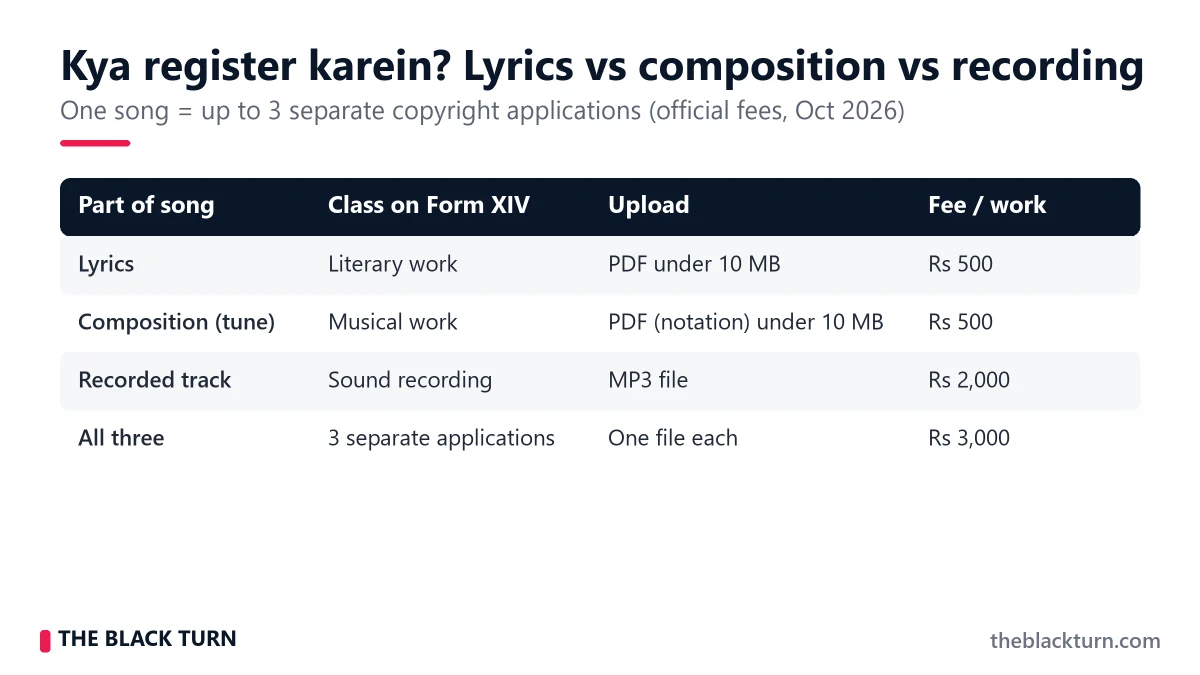
| Element | Category | Owner | Registration Fee |
| Lyrics | Literary Work | Lyricist | ₹500 per work |
| Music / Melody | Musical Work | Composer | ₹500 per work |
| Sound Recording | Sound Recording | Producer / artist who paid for recording | ₹2,000 per work |
Why are lyrics separate from the music? The Copyright Act defines a “musical work” as the music itself (including any written notation) and specifically excludes the words sung with it. So lyrics are registered as a literary work, and the tune as a musical work. The Copyright Office also requires one application per work, so a song with all three elements means three applications.
If you are an independent artist who writes the lyrics, composes the music, AND records the song, you own all three. You can register each separately. The most practically important for streaming and distribution is the sound recording copyright.
Practical advice: If budget is tight, register the sound recording first (₹2,000). This protects the actual audio file i.e. the version on Spotify and JioSaavn. But remember what it does not cover: if someone re-sings your song with a new recording, that copies your lyrics and tune, not your audio. Only the literary and musical work registrations (₹500 each) document those. Add them when budget allows.
How to Copyright Lyrics in India
Lyrics are the cheapest and simplest registration, so many writers start here. On Form XIV choose the class Literary/Dramatic, type the song title exactly as it appears on the lyrics, name the lyricist as author, and upload the lyrics as a PDF under 10 MB. The fee is ₹500 per work. If the lyricist is not the person applying (for example, a label or a producer files), you need an NOC from the lyricist. Each song’s lyrics are a separate application, so a 5-song EP means five lyric applications.
Step-by-Step: How to Register Copyright for Your Song
Step 1: Gather Your Documents
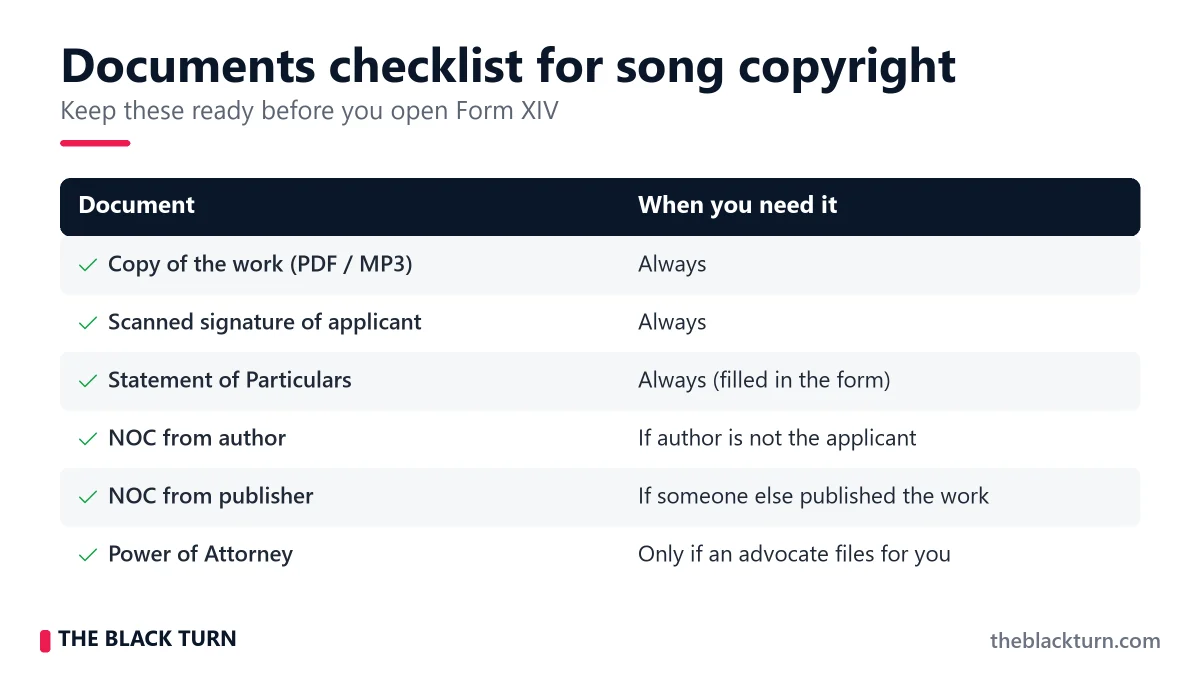
Before touching the copyright portal, have everything ready. Missing documents are the most common reason for a discrepancy letter, which delays your registration. This list follows the official Copyright Office checklist and filing process.
| Document | For What | Format |
| Lyrics (written out) | Literary work registration | PDF, under 10 MB |
| Musical work (notation / lead sheet) | Musical work registration | PDF, under 10 MB |
| Audio file of the song | Sound recording registration | MP3 |
| NOC from the author (if the author is not the applicant) | All types. For a sound recording, from the lyricist, composer and others who contributed | Signed letter, scanned |
| NOC from the publisher (if someone else published the work) | Published works, e.g. a song first released by a label | Signed letter, scanned |
| Scanned signature of the applicant | Signing Form XIV online | Image |
| Power of Attorney | Only if an advocate/agent files for you | Signed, scanned |
| Publication details (if released) | Year and country of first publication, publisher’s name and address | Entered in the form |
The NOC is critical: If your song has a separate lyricist, composer, producer, or featured artist, get a No Objection Certificate from each person whose rights are involved before you file. A sound recording is built on other people’s contributions (lyrics, composition, performances), so an NOC or a written agreement from them in your favour is what the examiner looks for. A simple signed letter stating “I, [name], have no objection to [applicant] registering the copyright for [song name]” is the usual format.
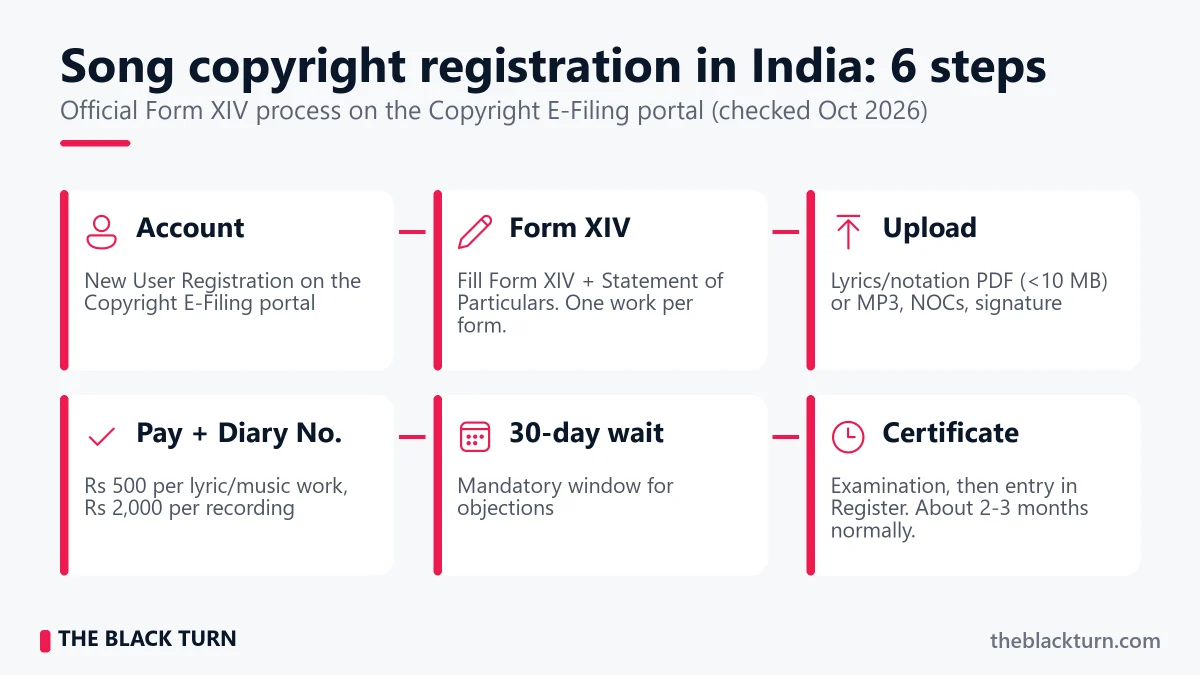
Step 2: Create Account on copyright.gov.in
The Copyright Office moved to a new e-filing module. The information pages now sit on ipindia.gov.in, while filing happens at copyright.gov.in/CopyrightEFiling. If you had an account on the old system, the official e-filing page asks you to use “Forgot password” to set a new password before logging in.
- Go to the Copyright E-Filing login page linked above — the official Copyright Office portal
- Click “New User Registration”
- Fill in your name, email, phone number, and create a password
- Note down your User ID and password — you will need these to track your application later
- Verify your email and log in
Step 3: Start a New Application (Form XIV)
After logging in, click “Click for Online Copyright Registration.” You will fill out Form XIV in four steps:
Form XIV – Part 1: Basic Details
- Category of Work: Select “Musical Work” for melody, “Literary Work” for lyrics, or “Sound Recording” for the recorded track
- Title of Work: Your exact song title
- Language: Hindi, English, Punjabi, etc. (list every language used in the work)
- Date of Creation: When the song was created (not when it was released)
- Is it Published? Select Yes if already on streaming platforms, No if unreleased
- Date of First Publication: The release date on platforms (if published)
- Country of First Publication: India
Form XIV – Part 2: Author and Applicant Details
- Author’s Name: The person who created the work. For lyrics = lyricist. For music = composer. For recording = producer. A firm cannot be named as author, only the actual individual(s).
- Author’s Address, Nationality: Your details
- Is Author Alive? Yes (hopefully)
- Applicant’s Name: Usually the same as author for independent artists
- Nature of Applicant’s Interest: Select “Author” if you created the work
Form XIV – Part 3: Upload Documents
- Upload your scanned signature
- Upload the copy of the work i.e. lyrics PDF, musical work PDF, or the MP3 of the sound recording
- Upload NOC from co-creators if applicable
- Upload Power of Attorney only if an advocate is filing for you
- Fill the Statement of Particulars (who owns the work, publication details, any assignments or licences) and, for literary and musical works, the Statement of Further Particulars
Form XIV – Part 4: Payment
These are the official registration fees from the Copyright Office’s Forms & Official Fees page (checked October 2026). The fee is per work and the official schedule does not have a separate “company” rate for songs.
| Work Type | Official Fee (per work) |
| Literary Work (lyrics) | ₹500 |
| Musical Work (melody/composition) | ₹500 |
| Sound Recording (the recorded song) | ₹2,000 |
You may see “₹2,000 for literary work” on other sites. On the official schedule, that ₹2,000 rate applies to a literary or artistic work used in relation to goods or services (think labels and logos), not to song lyrics.
Pay online through the payment gateway. (For offline filing at the counter, the fee goes by demand draft or postal order in favour of “Registrar of Copyrights”, payable at New Delhi.) After successful submission, you receive a Diary Number : this is your application tracking number. Save it.
Step 4: 30-Day Waiting Period
After filing, there is a mandatory 30-day waiting period so that anyone who believes they have rights over the work can file an objection. The Copyright Rules also expect you to send copies of your Form XIV and Statement of Particulars by registered post to any person who claims an interest in the work or disputes your rights, for example a former collaborator.
If you are the sole creator and your NOCs are in order, there is usually nothing for anyone to object to. The waiting period is a formality : but it is mandatory.
If someone does object, both sides are heard by the Registrar (the Copyright Office lists objected applications and hearing notices on copyright.gov.in). You will need evidence of your ownership: creation files, drafts, emails, contracts. If you face an objection or any real dispute, talk to a copyright lawyer. This guide only covers the standard filing process.
Step 5: Examination and Registration
After the 30-day waiting period (assuming no objections), an examiner checks your application. If something is missing or unclear, you get a discrepancy letter, and the official FAQ says the applicant is ordinarily given 45 days to fix it. Answer on time, or the application can stall.
If everything is in order, the Registrar enters your work in the Register of Copyrights and issues your Registration Certificate. This certificate is your legal proof of ownership.
Total timeline: the Copyright Office FAQ says registration may take around 2–3 months in the normal course. A discrepancy letter or an objection adds to that. Track your diary number on the official application status page.
Total Cost to Copyright a Song in India (2026)
DIY (Do It Yourself)
| What You Register | Government Fee | Total DIY Cost |
| Lyrics only | ₹500 | ₹500 |
| Music/melody only | ₹500 | ₹500 |
| Sound recording only (most common) | ₹2,000 | ₹2,000 |
| All three (lyrics + music + recording) | ₹3,000 | ₹3,000 |
Through a Professional/Service
Copyright agents, online legal services and individual copyright attorneys charge a professional fee on top of the government fee. Their charges vary a lot, so ask for a written quote that shows the government fee and the professional fee separately. Useful if you find the process confusing or want someone to handle the paperwork. If an advocate files for you, they will need a Power of Attorney.
For most independent artists, DIY is perfectly doable. The form is straightforward, and there is no legal requirement to use an attorney.
Copyright Registration vs Music Distribution vs IPRS : What’s the Difference?
Indian artists often confuse these three. They are related but do completely different things:
| Copyright Registration | Music Distribution | IPRS Registration | |
| What it does | Legally proves you own the song | Gets your song on streaming platforms | Collects performance royalties for lyricists, composers and publishers |
| Where | copyright.gov.in | Through a distributor (e.g. The Black Turn) | iprs.org |
| Cost | ₹500–3,000 | ₹599–799 | Check current terms on iprs.org |
| Protects against | Theft, unauthorised use | N/A this is for access, not protection | Uncollected royalties |
| Makes you money? | No. protection only | Yes. streaming + caller tune + Content ID | Yes. performance royalties |
| Mandatory? | No (but recommended) | Required to get on platforms | No (but you lose royalties without it) |
All three are important. Here is the ideal order:
Step 1: Distribute your song get it on platforms and start earning (this also creates a timestamped record of your song).
Step 2: Register copyright at copyright.gov.in legal protection.
Step 3: Register with IPRS collect performance royalties.
Where Distribution, ISRC and YouTube Content ID Fit In
These three get mixed up with copyright all the time. They help protect and track your music, but none of them is a copyright registration:
| Tool | What it actually is | What it does for your rights |
| Distribution | You give the distributor the right to deliver your recording to stores | Creates a dated release with your name as artist and label. Ownership only moves if you sign a written assignment. |
| ISRC | A unique ID code for one specific recording | Lets stores and royalty systems identify your track. It does not prove who owns it. |
| YouTube Content ID | YouTube’s matching system for audio and video | Finds uploads that use your recording and lets you block, monetise or track them |
Content ID only works if you actually hold the rights. YouTube’s Content ID rules require exclusive rights to the material you submit. That is why a song built on a non-exclusive beat lease often runs into Content ID disputes. And when someone disputes your claim, a copyright certificate is the cleanest proof you can show.
With The Black Turn, ISRC and UPC codes and YouTube Content ID are free on every plan (see pricing). Use them for protection on YouTube, and use copyright.gov.in for legal registration.
Other Ways to Establish Proof of Ownership (Without Formal Registration)
While formal copyright registration is the strongest proof, these methods also help establish ownership if a dispute arises:
- Music distribution timestamp : When you distribute through a service, your upload is timestamped with your name, ISRC code, and metadata. This serves as evidence of first publication.
- YouTube Content ID reference : When your distributor delivers your audio to Content ID, there is a dated record of when it became a reference file. It is YouTube’s internal system, not a legal registration, but it supports your timeline.
- Email yourself the files : The “poor man’s copyright.” Email your lyrics, audio file, and project files to yourself. The email timestamp serves as evidence of when you had the work. Not as strong as formal registration but better than nothing.
- Keep original project files : Your DAW project files (Ableton, FL Studio, Logic) with creation dates, individual stems, and revision history prove you actually created the music, not just possess a copy.
- Social media posts : Behind-the-scenes videos, studio session clips, and work-in-progress posts on Instagram create a public timeline of your creation process.
Even with all of these, formal registration at copyright.gov.in is the gold standard. And at ₹500–2,000, there is no good reason not to do it. Your ISRC code is one piece of the puzzle, but copyright registration completes the picture.
6 Copyright Mistakes Indian Musicians Make
1. Not getting NOC from collaborators
If your song has a separate lyricist, composer, producer, or featured artist, you NEED their No Objection Certificate. The official checklist asks for an NOC from the author whenever the author is not the applicant, and a missing NOC is a classic reason for a discrepancy letter. Get NOCs before you even start the application.
2. Registering only the lyrics, not the recording
Many artists register lyrics (Literary Work) and think they are done. But the sound recording is what exists on Spotify and JioSaavn that is what someone is most likely to steal or misuse. Register the sound recording too.
3. Assuming distribution = copyright
Distributing your song through The Black Turn or any distributor gets it on platforms, but does not register copyright. Distribution and copyright registration are separate processes that serve different purposes. Do both.
4. Hiding AI involvement
Form XIV asks you to name the real author(s) of the work. If you used AI tools in your lyrics, composition or production, describe your own human contribution honestly and do not present AI output as something you wrote. The law on AI-generated works is still unsettled, so if a large part of the song was AI-generated, get advice from a copyright lawyer before you file.
5. Not registering before release
You can register unpublished work, so ideally start the copyright registration process BEFORE your song goes live on streaming platforms. This way, if someone copies your song immediately after release (which happens), your registration is already in progress.
6. Paying inflated fees to third-party services
Some websites present copyright registration as a complex legal process and charge accordingly. The government fee is fixed at ₹500 (lyrics or music) or ₹2,000 (sound recording) per work, and the form is straightforward. DIY is perfectly fine for most artists. If you do hire help, insist on a quote that shows the government fee separately.
After Copyright Registration: What to Do Next
Getting the certificate is not the end. Here is what to do with your registered copyright:
- Keep the certificate safe digital and physical copies. You will need it if you ever file a copyright infringement case.
- Use the © symbol : Add “© [Year] [Your Name]” to your song descriptions, YouTube descriptions, and website. This is a public notice that your work is copyrighted.
- Register with IPRS : Provide your copyright registration details when registering with IPRS for performance royalty collection.
- Set up Content ID : Your YouTube Content ID registration through your distributor adds another layer of automated protection and monetisation.
- Monitor for infringement : Periodically search your song title on YouTube, SoundCloud, and social media. If you find unauthorised use, your copyright certificate gives you legal standing to take action. For anything beyond a takedown request, speak to a copyright lawyer.
Frequently Asked Questions
Is copyright registration mandatory for songs in India?
No. Copyright exists automatically upon creation. But registration provides strong legal evidence of ownership i.e. the certificate and Register entries are prima facie evidence in court under Section 48 of the Copyright Act. For ₹500-2,000, it is worth doing.
How much does it cost to copyright a song?
Official government fee: ₹500 per work for lyrics (literary work) or music (musical work), and ₹2,000 per work for a sound recording. Total for all three: ₹3,000. There is no separate company rate for these works. Professional services charge extra if you want someone to handle the paperwork.
How long does it take?
The Copyright Office says around 2–3 months in the normal course. That includes the mandatory 30-day waiting period for objections, then examination. If you get a discrepancy letter, you ordinarily have 45 days to reply, and that adds time.
What documents are needed?
Form XIV with the Statement of Particulars (and Statement of Further Particulars for lyrics and music), a copy of the work (lyrics or notation as PDF, sound recording as MP3), NOC from the author if you are not the author, NOC from the publisher if someone else published it, your scanned signature, and a Power of Attorney only if an advocate files for you.
How do I copyright song lyrics in India?
File Form XIV on the Copyright E-Filing portal under the literary work category, upload the lyrics as a PDF under 10 MB, and pay ₹500. Each song’s lyrics need a separate application. If the lyricist is not the applicant, attach the lyricist’s NOC.
Should I copyright lyrics, music, or the recording?
All three are separate copyrights. For practical purposes, register the sound recording first (₹2,000) since that is what exists on streaming platforms. Add lyrics and musical work registrations later.
Is distributing the same as copyrighting?
No. Distribution gets your song on platforms and creates a timestamped record, but it is not formal copyright registration. Distribute through The Black Turn AND register copyright at copyright.gov.in for complete protection.
Does a distributor take ownership of my master or copyright?
Under the Copyright Act, an assignment of copyright has to be in writing. So ownership only moves if your agreement assigns it. Read the distribution agreement before you sign: words like “assign” or “transfer of ownership” mean something very different from “licence to distribute”. If the contract is unclear, ask a lawyer to review it.
Does an ISRC code or YouTube Content ID copyright my song?
No. An ISRC is an identification code for a recording, and Content ID is YouTube’s system for finding and managing uploads that use your audio. Both help with protection and income, but neither is a copyright registration.
How long does song copyright last?
Lyrics and composition: lifetime of the author + 60 years. Sound recording: 60 years from publication. A 2026 release is protected until at least 2086.
Can I copyright a song with a purchased beat?
With an exclusive license: yes, you can copyright the complete recording. With a non-exclusive lease: you can copyright your lyrics and vocals but not the underlying beat. Always clarify rights with the beat producer.
Protect Your Music : It Takes 30 Minutes
Copyright registration is one of those things that feels complicated until you actually sit down and do it. Once your files and NOCs are ready, the form itself is short. The fee is ₹500–2,000 per work. And the protection for your lyrics and composition lasts for your entire lifetime plus 60 years.
Think about it this way: every song you create is an asset that can earn royalties for decades. Spending ₹500 and an evening to legally protect that asset is one of the best investments you can make as an artist.
Register at copyright.gov.in. Then distribute your music through The Black Turn to start earning. Then register with IPRS to collect every royalty you are owed. Three steps: protection, distribution, royalties.
 Jyoti Singh – Independent artist (32) who has worked at several music distribution companies and has released music through distributors – so these guides come from both sides of a release.