You searched for a music distribution service that includes YouTube Content ID, and that is genuinely smart thinking. Content ID is one of the most underrated revenue streams for Indian artists. Every time a fan uploads a cover of your song, uses it in a dance video, makes a YouTube Short with it, or includes it in a compilation, Content ID can identify the recording and send the ad revenue from that video to you. For Indian artists whose songs spread through fan content rather than streaming alone, Content ID can quietly add a second income stream from the same release.
Here is what most blog posts will not tell you honestly: almost every major distributor offers Content ID in 2026, but they do not all offer it the same way. Some include it at no extra cost, DistroKid sells it as a yearly add-on per release, and every service keeps a different cut of what YouTube pays. So the real question for Indian artists is not just “who offers Content ID” but “what does it cost, how much do I keep, and does the same distributor also cover the revenue streams that matter in India, especially caller tunes on Jio, Airtel, Vi and BSNL.”
This blog gives you the honest picture. We explain how Content ID actually works, which songs are eligible (many are not), what each distributor charges for it as of October 2026, how to work out what you will earn, and what to do when you get a copyright claim on your own song.
What YouTube Content ID Actually Is
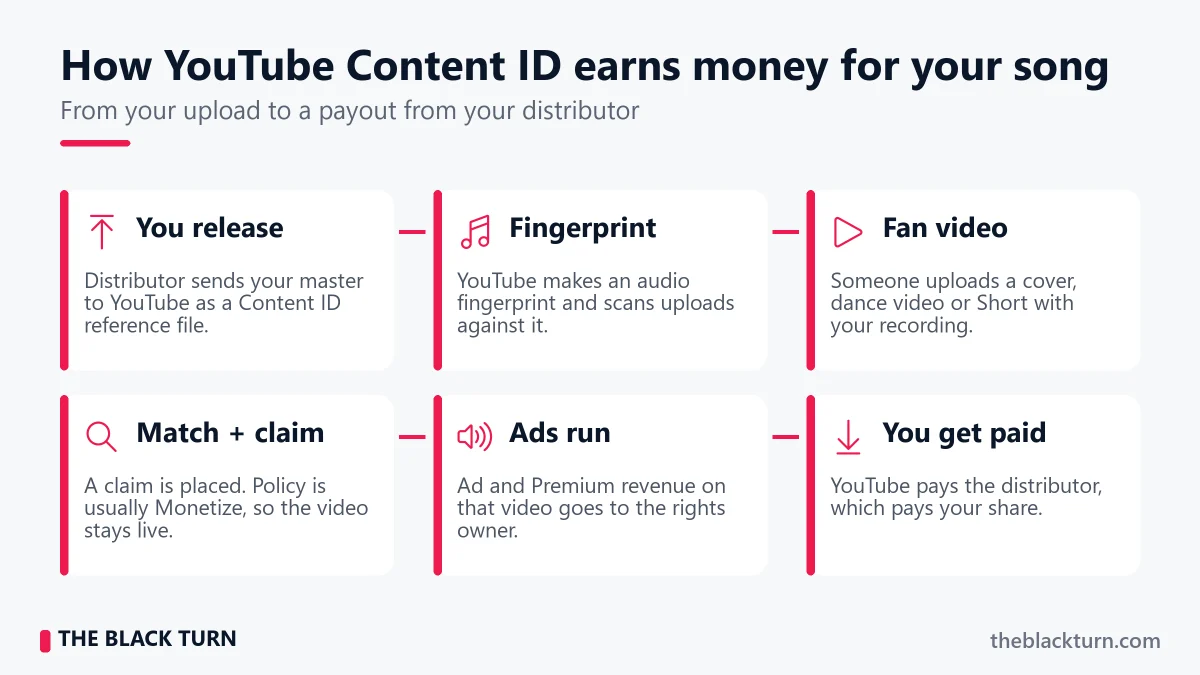
Content ID is YouTube’s system for finding copyrighted audio and video inside videos uploaded by anyone on the platform. Your distributor sends your master recording to YouTube as a reference file, YouTube creates a fingerprint of it, and every new upload is scanned against that fingerprint. When a fan uploads a video that uses your song (full cover track, dance video with your song in the background, a Short, a reaction video, a compilation), a Content ID claim is placed and the rights owner’s policy decides what happens. According to YouTube Help: How Content ID works, there are three options:
- Monetize: ads run on the video and the revenue goes to the rights owner (sometimes shared with the uploader). This is the setting distributors normally use.
- Track: the video stays up and you only get viewing statistics.
- Block: the video is hidden from viewers.
With Monetize, fan content stays live instead of being taken down, and a claim is not a copyright strike on the uploader’s channel. Content ID converts unauthorized but typically harmless uses of your music into a recurring revenue stream. YouTube only gives Content ID access to rights owners who hold exclusive rights to a large catalogue that is frequently uploaded, so independent artists use it through a distributor. To use Content ID, you need a music distributor that offers it. See our detailed Content ID guide in Hindi for the full mechanics.
Is Your Song Eligible for Content ID?
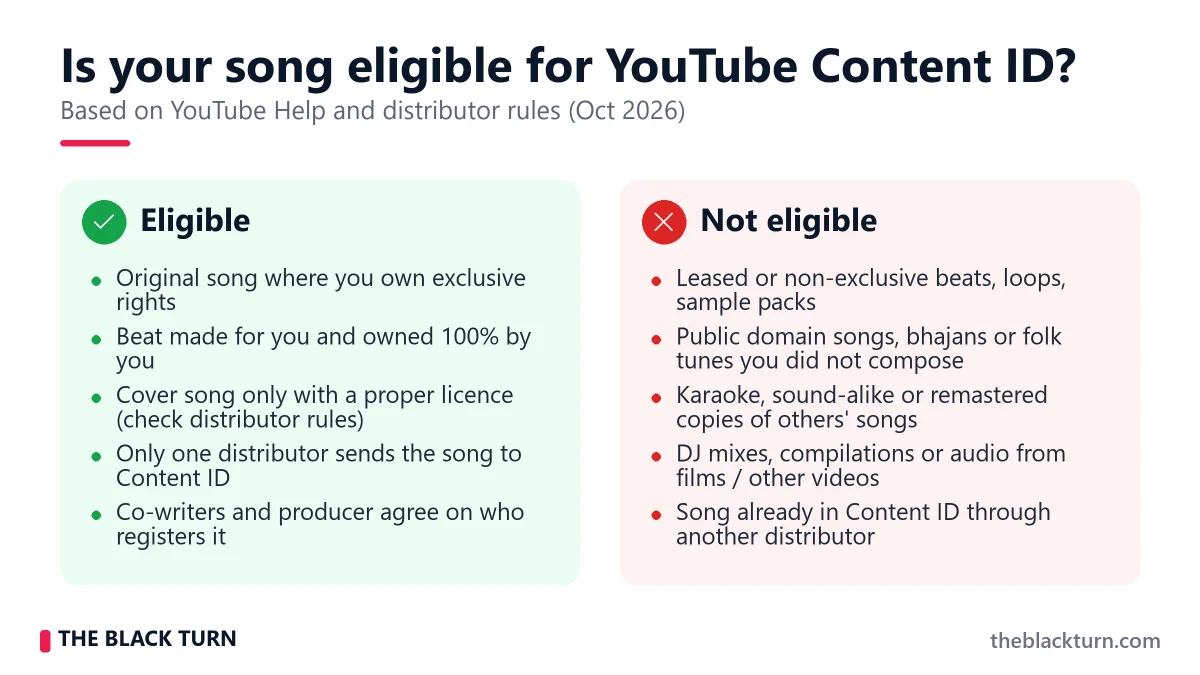
This is the part most Indian artists miss. YouTube’s rule is simple: you must have exclusive rights to the audio in the reference file for the territories where you claim it (YouTube Help: Content eligible for Content ID). If your song is not eligible, a good distributor will reject it for Content ID even though it still goes live on Spotify, JioSaavn and other stores.
- Not eligible: leased or non-exclusive beats. A beat bought on a non-exclusive lease (the usual “buy this beat” deal on YouTube and beat stores) is also sold to other artists, so you cannot claim it. Loops, sample packs and free sounds from DAWs are also out.
- Not eligible: public domain material. Public domain recordings and compositions cannot go into Content ID. Distributors such as TuneCore also exclude covers of traditional, religious and public domain songs, which matters for bhajan, aarti and folk releases.
- Not eligible: karaoke, sound-alike and remastered copies, plus DJ mixes, compilations, and audio taken from films, TV or other YouTube videos.
- Covers need a licence first. A cover uses someone else’s composition, so you need permission or a licence before you release it. Rules for covers in Content ID differ by distributor: DistroKid accepts licensed covers into Content ID, while TuneCore rejects karaoke, sound-alike and tribute-style covers. Ask your distributor before you upload.
- Only one company can register a song. If your producer, label or a second distributor has already sent the same recording to Content ID, the claims conflict. Agree on who registers it before release.
Why YouTube Content ID Matters Especially for Indian Artists
Content ID matters globally, but it matters particularly for Indian artists for specific reasons:
Reason 1: YouTube India Is Huge
YouTube is often the first place Indian listeners discover music, especially in regional languages. Fan engagement through cover videos, dance videos, and reaction content is enormous in the Indian market.
Reason 2: Cover Culture Is Strong in India
Cover songs are a major content format in Indian music YouTube. Independent artists, local musicians, and home creators frequently cover popular Indian songs. When a cover video uses your original recording (for example as a karaoke-style backing track), Content ID can claim it and earn for you instead of creating a copyright headache.
Reason 3: Reels-Style Shorts Are Often Re-Uploaded to YouTube
Viral Reels videos are frequently re-uploaded to YouTube as Shorts. Re-uploads that contain your recording can be matched and claimed by Content ID, so the same song can earn on YouTube even when the trend started on Instagram.
Reason 4: Compilation Channels Use Indian Music Heavily
Indian music compilation channels on YouTube (“Top Punjabi songs of the month,” “Best devotional songs,” etc.) frequently use multiple songs in single videos. Content ID identifies and monetizes these uses, capturing revenue from a distribution channel artists usually have no direct control over.
The passive earnings advantage: Streaming royalty requires listeners to actively play your song. Content ID requires nothing from you. Once registered, it runs in the background, identifying fan uploads automatically and paying you from videos other people make. One honest caveat: a claimed video only earns when ads can actually run on it, so uploads on small channels that are not monetised, or videos YouTube marks as not advertiser-friendly, may earn little or nothing.
Which Distributors Include Content ID in 2026, and What They Charge
The Black Turn
Disclosure: this guide is published by The Black Turn, so we list ourselves first. Every point below can be checked on a pricing page, and right after them we say where other distributors do better.
- ✓Free Content ID, you keep 95%The same 95% lifetime royalty applies to every income stream, including Content ID.
- ✓No per-song social media feeDistroKid needs its Social Media Pack ($4.95 per single per year) plus a 20% cut for Facebook, Instagram and YouTube claims.
- ✓Unlimited releases & artistsOn the Custom Label plan (₹4,999/year). DistroKid’s price rises as you add artists.
- ✓Free unlimited mix & masteringMaster every song before release with TrackFix.
- ✓Caller tunes on all 4 networksJio, Airtel, Vi and BSNL – not offered by DistroKid or TuneCore in India.
- ✓Earnings continue without renewalOn every plan, your 95% keeps paying.
- ✓In-person supportFor every artist. DistroKid, TuneCore and Ditto use help centres, tickets, email or chat, with no support phone line on their official sites (checked October 2026, Ditto’s contact page).
Where others are better: if Content ID revenue share is your only criterion, RouteNote Premium and Amuse’s higher plans pass on 100%, and TuneCore has no up-front Content ID fee.
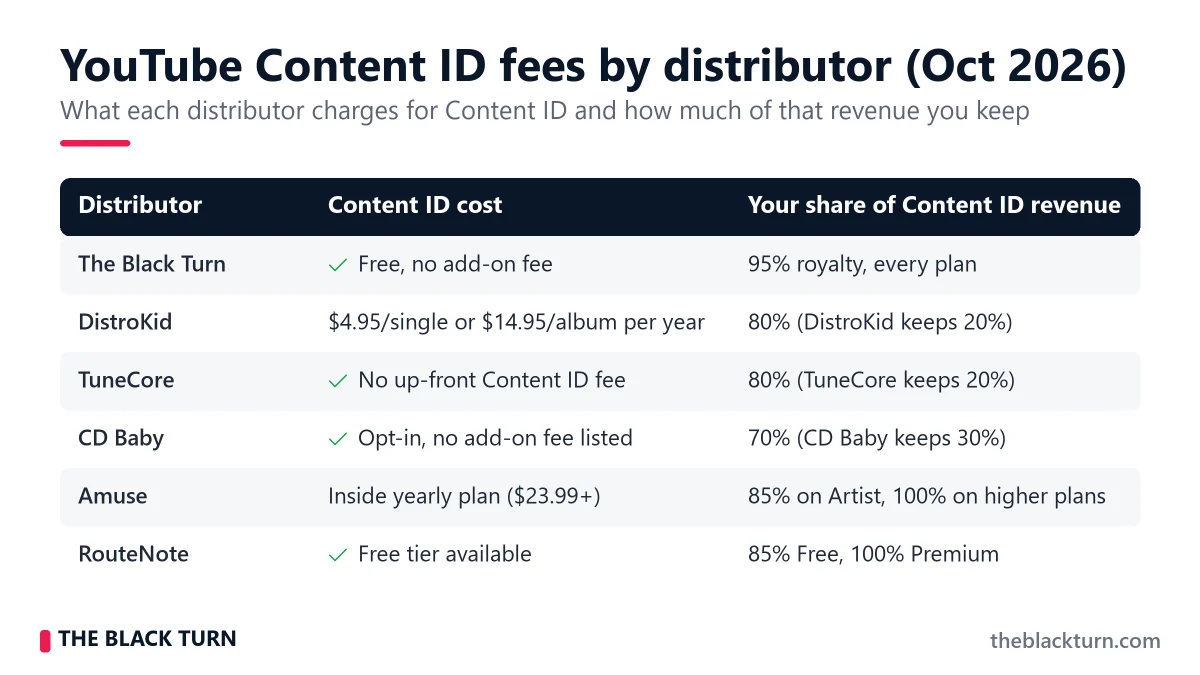
Content ID cost and revenue share at major distributors, checked on each company’s official pricing and help pages, as of October 2026. These terms change, so confirm on the distributor’s own site before you pay.
| Service | Content ID Cost (as of October 2026) | Share of Content ID Revenue You Keep | Distribution Pricing Model |
| The Black Turn | Free, no add-on fee | 95% lifetime royalty on every plan | One-time per release in INR (₹599 / ₹799 single, ₹1,999 album/EP) |
| DistroKid | Social Media Pack add-on: $4.95 per single per year or $14.95 per album per year | 80% (DistroKid keeps 20% of Social Media Pack revenue) | Yearly subscription in USD |
| TuneCore | No up-front or annual Content ID fee | 80% | Yearly plans in USD; plans and per-release purchases renew every year |
| CD Baby | Optional opt-in (Social Video Monetization), no separate add-on fee listed | 70% (CD Baby keeps 30%) | Per-release fee in USD |
| Amuse | Included in all paid plans (Artist $23.99/year, Artist Plus $39.99/year, Professional $59.99/year) | 85% on Artist (15% fee); 100% on Artist Plus and Professional | Yearly subscription in USD |
| RouteNote | Free on both Free and Premium distribution | 85% on Free; 100% on Premium (paid per release, then $9.99/year from the second year) | Free with revenue share, or paid Premium |
DistroKid’s add-on price and its 20% cut are listed on its own Album Extras help page. Note that the revenue share is applied to what YouTube pays the distributor, not to the total ad money a video earns. YouTube takes its own share first and does not publish that percentage.
The honest takeaway: If Content ID revenue share is your only criterion, RouteNote Premium and Amuse’s higher plans let you keep 100%, and TuneCore charges nothing up front for it. DistroKid’s base plan is cheap, but adding Content ID costs extra on every release, every year, plus 20%. CD Baby keeps the largest cut at 30%. The Black Turn includes Content ID free with a one-time INR fee and a 95% royalty. For Indian artists, the bigger difference is usually what else comes in the same release: caller tunes, INR pricing, and whether you pay again every year.
Content ID Plus India Revenue Streams: What Actually Differs
Since most distributors offer Content ID in some form, the question for Indian artists becomes: which distributor offers Content ID together with the India-specific features that actually move income? Here is what each combination unlocks:
Content ID + Streaming Royalty (All Distributors)
Every distributor above sends your music to streaming services like Spotify and Apple Music and can register it for Content ID. This is the baseline combination.
Content ID + Caller Tune Revenue
Caller tunes on Jio, Airtel, Vi and BSNL are a separate income stream that global distributors are not built around. The Black Turn’s ₹799 single plan includes caller tune delivery to all four networks along with Content ID, and an already released song can be added for caller tunes for ₹499 (live in 1–3 weeks). For Bollywood-style, devotional, romantic, Punjabi or regional songs, where caller tunes can matter as much as streaming, check whether your distributor delivers to Indian telecom networks before you choose. See full caller tune revenue analysis.
Content ID + One-Time Pricing
Content ID keeps earning as long as fans keep uploading videos, which can be years after release. With DistroKid, the Social Media Pack renews every year per release, and TuneCore plans renew every year. With The Black Turn, you pay once per release, and the 95% royalty continues for life even without renewal, on every plan.
Content ID + INR Pricing and Support
The Black Turn prices every plan in rupees, pays royalty quarterly, and offers call and WhatsApp support, which helps when you need a claim on your own video released quickly. Global services bill in USD on an international card.
The pattern: Content ID is something most distributors offer, at different costs and cuts. The real value for Indian artists is the combination of Content ID with caller tunes, INR pricing and no yearly renewal. That is the practical way to judge the “best distributor with free Content ID” for your own release.
How Much Indian Artists Actually Earn From Content ID
There is no fixed rate per view, and anyone who quotes one magic number is guessing. Content ID income depends on how many claimed videos actually show ads, which countries the viewers are in (viewers in the US or UK usually bring more ad revenue than viewers in India), the type of ads served, YouTube Premium views, and your distributor’s cut. Instead of a guess, use this calculation:
- Step 1: Revenue generated by claimed videos (ads + YouTube Premium views on videos using your song).
- Step 2: Minus YouTube’s own share (not public). What remains is what YouTube reports to your distributor.
- Step 3: Multiply by your distributor share. If YouTube reports ₹1,000 for your song: at CD Baby (70%) you get ₹700, at DistroKid or TuneCore (80%) ₹800, at RouteNote Premium (100%) ₹1,000, at The Black Turn (95%) ₹950. On DistroKid, also subtract the yearly Social Media Pack fee.
Your distributor’s Content ID report shows the real numbers per song after a few reporting cycles. Songs with strong dance, cover or meme potential usually earn more than songs in genres with little re-upload activity.
For the broader context of how Content ID fits into total Indian artist revenue alongside streaming, caller tune, sync, and other streams, see our music royalties explained guide for India.
The Black Turn Content ID + India Combination Detailed
Honest breakdown of what The Black Turn includes with each release:
| Feature | What The Black Turn Provides |
| YouTube Content ID | Free, no add-on fee |
| Streaming stores | 150+ stores, including Spotify, Apple Music, YouTube Music and JioSaavn |
| Caller tune (Jio, Airtel, Vi, BSNL) | Included on the ₹799 single plan; ₹499 for an already released song (live in 1–3 weeks) |
| ISRC and UPC | Free |
| Mix and mastering | Free unlimited mix & mastering with TrackFix |
| Royalty | 95% lifetime royalty, paid quarterly; earnings continue even without renewal, on every plan |
| Speed | Approval within 24 hours, live on most stores in 1–3 days |
| Pricing model | One-time: ₹599 single (no caller tune), ₹799 single with caller tune, ₹1,999 album/EP up to 7 songs; custom label unlimited ₹4,999/year |
| Support | Call and WhatsApp |
Where others are better: RouteNote Premium and Amuse’s higher plans pass on 100% of Content ID revenue against our 95%, and RouteNote’s free tier lets you start without paying anything up front. See The Black Turn pricing and complete feature list or read about our caller tune distribution for Jio, Airtel, Vi and BSNL.
How to Use Content ID Effectively as an Indian Artist
1. Check the Real Content ID Cost Before You Pick a Distributor
Look at both the fee and the cut. A yearly add-on per release adds up over a catalogue, and a 30% cut takes a big slice of every claimed video. For a complete distributor comparison see best music distribution India 2026.
2. Encourage Fan Content (Do Not Take It Down)
Once Content ID is active, fan uploads of your song earn you money. Encourage covers, dance videos, and reuploads rather than treating them as infringement. This grows the revenue stream that Content ID monetizes automatically.
3. Make Songs Cover-Friendly, and Content ID-Eligible
Songs with clear hooks, recognizable melodies, and dance-friendly tempos get covered more. Just as important: produce on a beat you own exclusively, avoid sample packs and loops, and get written agreement from your producer. A hit built on a leased beat cannot earn from Content ID at all.
4. Track Your Content ID Performance
Through your distributor dashboard, track how much Content ID is identifying and earning for each song. Songs with strong Content ID earnings reveal which of your music has fan content traction, which informs future release strategy.
5. Combine With Caller Tune for India Revenue
For Indian genres, the Content ID plus caller tune combination is what unlocks the most passive revenue. Fan uploads on YouTube + caller tune subscriptions on telecom networks = two recurring revenue streams from the same release. See caller tune distributor selection.
Got a Copyright Claim on Your Own Song? How to Release It
This surprises many artists: you upload your own song’s video on your own channel and get a Content ID claim. That is normal. Content ID scans every upload, including yours, and the claim usually comes from your own distributor (or the partner company it uses, so the claimant name may not look familiar; DistroKid’s claims, for example, appear as “Interstreet Recordings”). A Content ID claim is not a copyright strike and does not hurt your channel.
- To release a claim on your own video: ask your distributor to release it or to allowlist (whitelist) your channel or video. DistroKid has a YouTube Allowlist tool, TuneCore lets you whitelist your channel, and Amuse has a “release a claim” option in its Content ID menu. With The Black Turn, send the video link to our support on call or WhatsApp.
- If a brand or creator you licensed gets claimed: use the same process to release the claim on that specific video.
- If a stranger’s company claims your original song: dispute the claim in YouTube Studio only if you hold all the rights. YouTube does not decide copyright disputes, and disputing without a valid reason can lead to a removal request and a copyright strike. Common cause: the beat you used was leased to many artists, and another buyer registered it.
Common Mistakes Indian Artists Make on Content ID
1. Ignoring the Yearly Add-On and the Commission
Some distributors charge Content ID as a paid add-on per release per year, and all of them keep a share of the revenue. Always check both before committing.
2. Choosing Distributor on Content ID Alone
Since Content ID is offered almost everywhere, choosing solely on this criterion misses the factors that actually drive earnings for Indian artists: caller tune, INR pricing, and whether you pay again every year.
3. Taking Down Fan Content Instead of Monetizing It
Some artists request takedowns of fan covers thinking it protects them. With Content ID active, those fan uploads earn you money instead. Takedown is rarely the right call for harmless fan content.
4. Ignoring Content ID Earnings in Royalty Reports
Content ID earnings appear separately from streaming royalty in most dashboards. Many artists never check this section and miss seeing the passive revenue building. Check it every time a royalty report comes in.
5. Switching Distributors Without Moving Content ID Properly
Only one company can register a recording in Content ID. When you switch distributors, ask the old one to remove the song from Content ID before the new one registers it, otherwise the claims conflict. Keep the same ISRC so your streaming history carries over. See ISRC code guide for migration.
6. Registering Songs Made on Leased Beats
Submitting a song built on a non-exclusive beat, loops or samples breaks YouTube’s rules. Distributors can block your account from Content ID for repeated violations, so keep such songs out of it.
Frequently Asked Questions
Which music distributors include YouTube Content ID?
As of October 2026: The Black Turn (free, no add-on fee), TuneCore (no up-front fee, you keep 80%), CD Baby (opt-in, you keep 70%), Amuse (in all paid plans; 15% fee on the Artist plan, none on higher plans), RouteNote (free; you keep 85% on Free, 100% on Premium) and DistroKid (paid Social Media Pack add-on, you keep 80%).
How much does DistroKid charge for YouTube Content ID?
As of October 2026, DistroKid’s Social Media Pack costs $4.95 per single per year or $14.95 per album per year, and DistroKid keeps 20% of the revenue it collects. This is on top of the DistroKid membership.
What is YouTube Content ID and how does it work?
Content ID compares every YouTube upload with reference files from rights owners. When your song is found in someone’s video, a claim is placed and, with a Monetize policy, ads run and the revenue goes to you through your distributor. See detailed Content ID guide.
Which songs are not eligible for Content ID?
Songs on leased or non-exclusive beats, songs with loops or sample-pack audio, public domain recordings or compositions, karaoke and sound-alike versions, DJ mixes and compilations. Covers need a licence, and distributor rules for covers differ.
How much can Indian artists earn from YouTube Content ID?
There is no fixed rate. Earnings depend on how many claimed videos show ads, where viewers are, and your distributor’s share. Calculate it as: revenue YouTube reports for your song × your share (for example 70% at CD Baby, 80% at DistroKid or TuneCore, 95% at The Black Turn).
Why did I get a copyright claim on my own song?
Because your distributor registered the song in Content ID, and Content ID scans your uploads too. It is not a strike. Ask your distributor to release the claim or allowlist your channel.
How do I release a Content ID claim?
Through your distributor: DistroKid’s YouTube Allowlist tool, TuneCore’s channel whitelist, Amuse’s “release a claim” option, or The Black Turn’s call and WhatsApp support. Share the video URL. Only dispute in YouTube Studio if someone else claimed a song you fully own.
Can I add Content ID to my music after the song is already released?
Yes. Most distributors let you opt an existing release into Content ID, or you can move the release to a distributor that includes it, keeping the same ISRC. Make sure the old distributor removes it from Content ID first. See ISRC guide.
What is the difference between Content ID and YouTube Music distribution?
YouTube Music: your official version on the streaming platform (streaming royalty). Content ID: identifies your song in OTHER users’ videos and monetizes them (ad revenue). Two different revenue streams, tracked and paid separately.
How long does YouTube Content ID take to start earning?
Claims usually start appearing a few weeks after the song is registered (CD Baby, for example, says 2–3 weeks). The first payment then depends on your distributor’s reporting cycle; The Black Turn pays royalty quarterly.
Conclusion
YouTube Content ID is genuinely valuable for Indian artists and you are right to look for a distributor that includes it. But “includes Content ID” hides big differences: DistroKid charges a yearly add-on plus 20%, CD Baby keeps 30%, TuneCore keeps 20%, while RouteNote Premium and Amuse’s higher plans pass on 100%. And none of it works unless your song is eligible, which means a beat and recording you own exclusively.
For Indian artists, look at Content ID together with the India-specific revenue streams: caller tunes on Jio, Airtel, Vi and BSNL, INR pricing, and whether you pay again every year. The Black Turn includes Content ID free, caller tunes on the ₹799 plan, a one-time fee per release, and a 95% lifetime royalty. Compare that with the table above and pick what fits your catalogue.
Ready to release with Content ID and caller tunes in one payment? Get started with The Black Turn and distribute your music to Spotify, Apple Music, JioSaavn, YouTube Music, YouTube Content ID, all 4 caller tune networks and 150+ stores with a one-time INR payment per release.
 Jyoti Singh – Independent artist (32) who has worked at several music distribution companies and has released music through distributors – so these guides come from both sides of a release.