Most articles about music income talk about Spotify streams and stop there. That is like saying the only way to earn from a restaurant is dine-in customers. What about takeaway, catering, delivery apps, cooking classes, branded merch? Same idea.
Indian artists in 2026 have access to at least 12 legitimate revenue streams most of which did not exist ten years ago. Some are passive (earn while you sleep), some are active (trade time for money), and one is uniquely Indian and massively underutilised.
This guide covers every single one: who pays you, when the money starts, and what decides the amount. We have deliberately avoided “magic numbers” that nobody can verify. Instead you get the rules platforms actually publish and a simple way to calculate your own income, so you can decide which streams to activate first.
All 12 Revenue Streams at a Glance
| # | Revenue Stream | Type | Effort | Passive? | India-Specific? |
| 1 | Streaming Royalties | Digital | Low (once live) | Yes | No |
| 2 | Caller Tune (CRBT) | Telecom | Low | Yes | India Only |
| 3 | YouTube Content ID | Digital | Low | Yes | No |
| 4 | YouTube Channel Revenue | Digital | High | Semi | No |
| 5 | Instagram & Facebook (Meta) Music | Social | Medium | Semi | No |
| 6 | Live Performances | Physical | High | No | No |
| 7 | Sync Licensing | Licensing | Low (once placed) | Yes | No |
| 8 | Beat Selling | Digital | Medium | Semi | No |
| 9 | Teaching / Courses | Service | High | No | No |
| 10 | Merchandise | Physical/Digital | Medium | Semi | No |
| 11 | Publishing Royalties | Licensing | Low | Yes | No |
| 12 | Fan Funding / Tips | Direct | Medium | No | No |
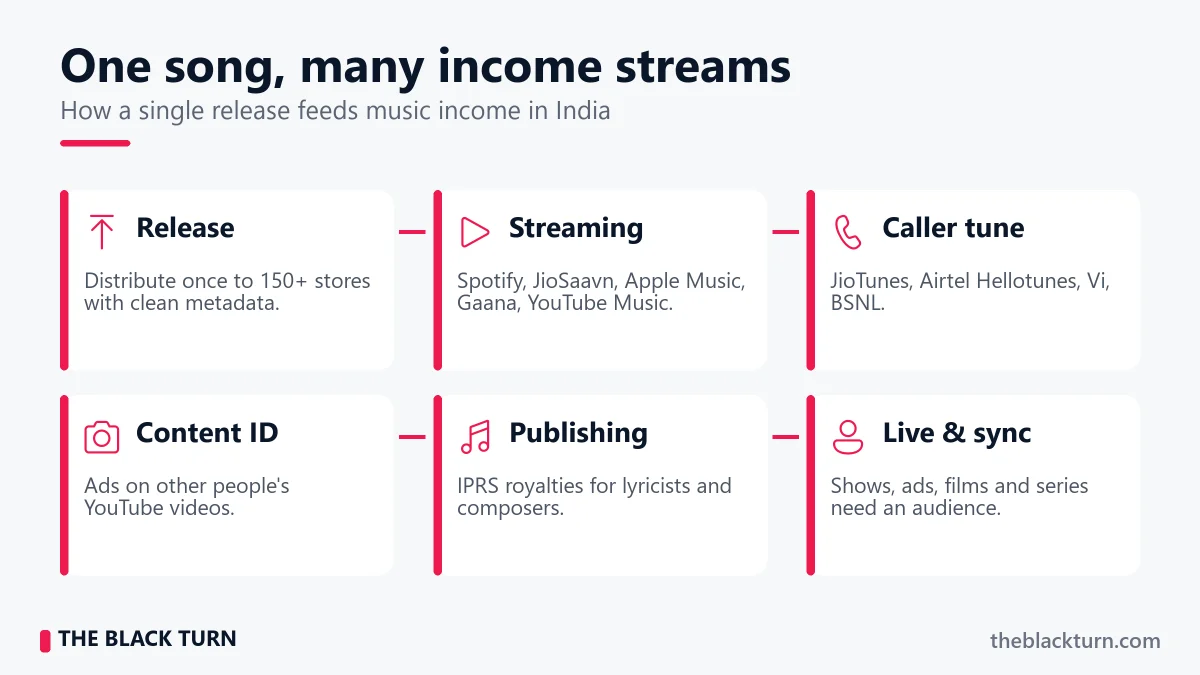
Streams 1, 2, 3, 5 and 11 all start from the same place: a properly released song with clean metadata. The rest (live, sync, beats, teaching, merch, fan funding) depend on the audience that release builds. Now let us break down each one.
1. Streaming Royalties : Your Foundation
Every time someone plays your song on Spotify, Apple Music, JioSaavn, Gaana, YouTube Music, Amazon Music or any other streaming platform, a royalty is generated. The store pays your distributor, and your distributor pays you your share.
There is no fixed “per stream” rate. Most platforms pay from a revenue pool, so the value of one stream changes with:
- Listener type: a paid subscriber’s stream is usually worth more than a free, ad-supported one.
- Listener country: streams from markets with higher subscription prices usually pay more than Indian streams.
- Platform: each store has its own pool and its own deal with distributors.
- Your distributor’s cut: 0%, 5%, 15% or more, depending on who you use.
So instead of trusting one number from the internet, use this:
Your streaming income = streams × effective rate per stream (from your distributor statement) × your royalty share
After your first one or two statements, divide the amount earned on each platform by its streams. That is your real rate, and it is far more useful than any table online. We covered how Spotify’s pool works in our Spotify pay per-stream analysis. Streaming royalties alone rarely make anyone rich, but they are the foundation. Every other revenue stream builds on top of having your music on all platforms.
How to Earn from Spotify in India
You cannot upload to Spotify directly. You release through a distributor, Spotify pays the distributor, and the distributor pays you. Two rules matter:
- The 1,000-stream rule: since April 2024, a track needs at least 1,000 streams in the previous 12 months (plus a minimum number of unique listeners that Spotify does not publish) to earn recorded-music royalties. Eligibility is checked every month. Source: Spotify for Artists – Track monetization eligibility.
- No paid streams or paid playlists: Spotify says services that sell streams or “guaranteed” playlist placement break its terms. Royalties can be withheld and songs removed.
Claim your Spotify for Artists profile, pitch every new release to editorial playlists from there before release day, and push fans to save the song. Saves and repeat listeners matter more than a one-day spike.
2. Caller Tune (CRBT) Revenue : India’s Hidden Goldmine
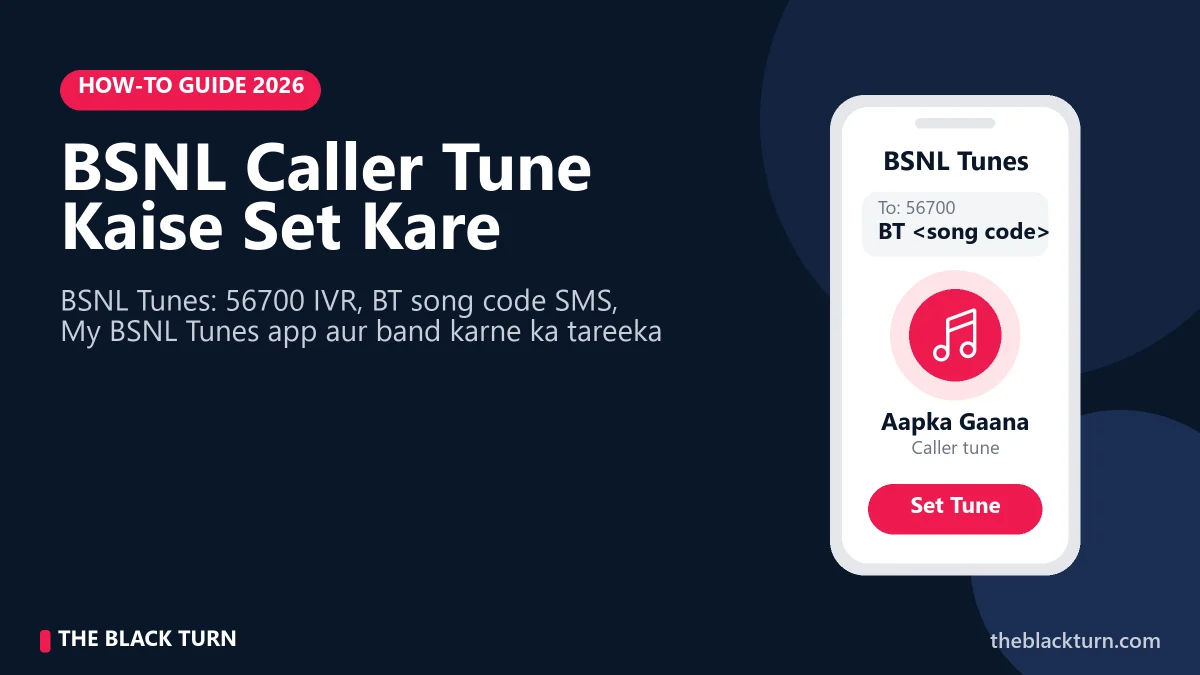
This is the revenue stream that international articles never mention because it is uniquely Indian. When someone sets your song as their caller tune on Jio (JioTunes), Airtel (Hellotunes), Vi or BSNL, every person who calls them hears your music. The telecom shares the caller tune revenue with the rights holder, and it reaches you through your distributor.
India has around 130 crore wireless subscribers (TRAI data, June 2026), so the potential reach is enormous. And it is almost entirely passive: once your caller tune is live, it keeps earning as long as fans keep it set. For the complete process, read our caller tune distribution guide.
Note for Airtel fans: Wynk Music shut down in 2024. Airtel Hellotunes are now set from the Airtel Thanks app (or by SMS with the song code to 543211). Share our Airtel Hello Tune setup guide with fans when you announce your tune.
What decides caller tune earnings: how many people set your tune, how long they keep it, and on which network. A catchy 30-second hook matters more here than anywhere else, so choose the clip carefully.
Not available on most international distributors: DistroKid and TuneCore, for example, do not deliver Indian caller tunes. You need an Indian distributor that delivers to Jio, Airtel, Vi and BSNL. If your distributor does not support CRBT, you are missing this entire revenue stream.
3. YouTube Content ID : Money from Other People’s Videos
Content ID is YouTube’s audio fingerprinting system. When anyone uses your song in their video — vlogs, reels, wedding videos, gaming clips — Content ID detects it and can monetise that video with ads. Your share of that ad revenue comes to you through your distributor.
India has one of YouTube’s biggest audiences, and a huge number of videos use popular music. If your song is registered with Content ID, every one of those videos becomes a revenue source without you lifting a finger.
What decides Content ID earnings: how many videos use your song, how many views those videos get, and the ad rates on them. One viral trend can matter more than a hundred small uploads.
One rule to remember: Content ID only works for audio you own exclusively. Covers of other people’s songs, or beats leased non-exclusively, cannot be registered, and trying can get your account flagged.
Most good distributors offer Content ID. The difference is what they charge for it. DistroKid, for example, puts it in a paid Social Media Pack (a yearly fee per release plus 20% of the revenue, as of October 2026). Indian distributors like The Black Turn include Content ID free with zero additional revenue share.
4. YouTube Channel Ad Revenue : Build Your Own Media
This is separate from Content ID. It is money from ads on your own YouTube channel: music videos, lyric videos, live sessions, behind-the-scenes content. YouTube’s current Partner Program rules for India (as of October 2026):
| YPP Level | Requirement | What You Get |
| Lower tier | 500 subscribers + 3 public uploads in 90 days + either 3,000 watch hours (12 months) or 3 million Shorts views (90 days) | Fan funding (Super Chat, Super Thanks, memberships), Shopping |
| Ad revenue tier | 1,000 subscribers + either 4,000 public watch hours (12 months) or 10 million Shorts views (90 days) | Share of ad revenue and YouTube Premium revenue |
Source: YouTube Help – Expanded YouTube Partner Programme. Once you are in, YouTube shares 55% of ad revenue on long-form videos with the creator; Shorts revenue is pooled and creators get 45% of their share.
How Much Do Music Videos Earn on YouTube in India?
There is no standard figure, because it depends on your RPM (revenue per 1,000 views, after YouTube’s share). Indian views usually earn less per view than views from the US or UK, but Indian audiences watch a lot of music content, so volume helps. To estimate:
Monthly earnings = (monthly monetised views ÷ 1,000) × your RPM
You can see your exact RPM in YouTube Studio → Analytics → Revenue once you are monetised. Longer videos, a bigger share of viewers from abroad and festive-season ad demand usually push RPM up.
5. Instagram & Facebook Music : Viral = Streams
There is no fixed per-use payment when someone uses your song in a Reel. Meta pays rights holders through licensing deals, and that money (usually small per use) reaches you through your distributor if it delivers to Meta’s music library. The bigger value is indirect: Reels drive streams on Spotify, Apple Music and JioSaavn. One viral Reel can bring a big jump in streams within days. We covered the exact mechanics in our Instagram Reels music guide.
Reels Play Bonus has ended in India. Instagram stopped new and renewed Reels Play bonus deals in India on 9 March 2023, and the program is no longer active (Instagram Help Centre). Ignore older articles that still list it as an income source.
What decides earnings here: how many Reels use your sound and how many of those viewers go on to stream the full song. Make the hook easy to find (put it in the first 15 seconds of the Reel clip you choose) and use the song yourself first.
6. Live Performances — Highest Per-Event Income
Live shows remain the single highest-paying revenue event for most musicians. College fests, corporate events, club nights, weddings, private parties, music festivals. India’s live music scene is booming.
The catch: you need a following first. Nobody books an unknown artist for a college fest. Bookers look at your monthly listeners, Instagram engagement and, most of all, videos of you performing live. Fees vary enormously by city, genre, your following and whether travel and sound are covered, so set your own rate card and raise it as demand grows.
| Event Type | What Decides the Fee | Frequency |
| Local cafe/open mic | Venue size, ticket or cover charge, your local draw | Weekly possible |
| College fest | Fest budget, your streaming/Instagram numbers, slot (opener vs headliner) | Seasonal (Aug–Mar) |
| Club night | City, set length, how many people you bring | Weekly/monthly |
| Corporate event | Company budget, set length, sound and travel included or not | Occasional |
| Wedding sangeet | Family budget, band size, travel | Wedding season heavy |
| Music festival | Your pull with festival audiences, slot, agent/booker | Seasonal |
Tip: always take an advance (many artists ask for 50%) and put travel, stay and sound requirements in writing before confirming.
7. Sync Licensing – Your Song in Films, Ads, and Web Series
Sync licensing is when your song is placed in a film, TV show, web series, advertisement, or video game. The production company pays you a licensing fee for the right to use your music.
India’s OTT boom (Netflix, Prime Video, JioHotstar and others) has increased demand for independent music. Music supervisors actively look for fresh, unheard tracks that fit specific moods and scenes.
What decides the fee: the type of project (a national brand ad usually pays far more than an indie web series), how long the music plays, where it will be shown, for how many years, and whether the licence is exclusive. Fees are negotiated deal by deal, so read every licence carefully before signing.
How to get started: Pitch to music libraries such as Artlist, Musicbed or Epidemic Sound (each has its own submission process and deal terms), and approach Indian ad agencies, production houses and music supervisors directly. Keep instrumentals available because many sync placements want music without vocals. Having clean, well-mastered tracks with proper metadata makes you discoverable.
8. Beat Selling – Producers’ Passive Income Machine
If you produce beats, you can sell them to rappers, singers, and content creators. Platforms like BeatStars, Airbit, and even your own website let you sell beats as leases (non-exclusive, cheaper, the same beat can be sold many times) or exclusives (one buyer, priced much higher). You set your own prices.
India’s hip-hop and rap scene is exploding. Hundreds of new rappers release songs every month, and most of them need beats. If you can produce quality instrumentals, this is a scalable income source.
What decides earnings: the size of your catalogue, how consistently you upload and market, and clear licence terms (streams allowed, credit, Content ID rights). Keep exclusive rights in mind: once you sell a beat exclusively, stop leasing it.
9. Teaching Music / Online Courses – Share What You Know
You do not need to be a superstar to teach. If you know music production, mixing, mastering, songwriting, guitar, vocals, or any instrument, there are people willing to pay to learn from you.
Options include one-on-one lessons (online or offline), group workshops, YouTube tutorials (monetised with ads), and full courses on platforms like Udemy, Skillshare, or your own website.
How to calculate: course price × copies sold, minus platform fees. For example, a course priced at ₹1,999 that sells 50 copies in a month brings in about ₹1 lakh before fees and taxes. Whether you can sell 50 copies depends entirely on your audience, which is why teaching works best alongside a YouTube or Instagram presence.
10. Merchandise – Turn Fans into Customers
T-shirts, hoodies, posters, phone cases, stickers, anything with your brand, artwork, or lyrics on it. Print-on-demand services (including Indian ones that ship domestically) let you sell merch with zero inventory. You design, they print and ship, and you keep the margin above their cost.
Merch works best once you have an engaged fanbase. Even 1,000 dedicated fans buying one ₹999 t-shirt each is about ₹10 lakh in sales, before printing, shipping and platform costs.
What decides earnings: fanbase size, how good the design is, and your margin per item. Drop merch around a release or a show, when fans are most excited.
11. Publishing Royalties – The Songwriter’s Income
If you write your own songs, you are entitled to publishing royalties, which are separate from the recording (streaming) royalties your distributor collects. These include mechanical royalties (when your song is reproduced/streamed) and performance royalties (when it is played publicly, such as radio, TV, live venues).
In India, lyricists, composers and publishers can join IPRS (The Indian Performing Right Society) to collect these royalties. Check the current membership process and any fee on the IPRS website before applying. Many artists never register and lose this income entirely. PPL India separately licenses sound recordings (the master side) for public performance, which matters more to labels and artists who own many masters.
What decides earnings: how much your songs are streamed, broadcast and performed publicly, and whether every song is registered with correct writer splits.
12. Fan Funding and Tips – Direct Support from Your Audience
Platforms like YouTube Super Chat and channel memberships (available from YouTube’s lower tier at 500 subscribers), Instagram Live gifts, Patreon, Buy Me a Coffee, and even UPI-based tipping let fans directly support artists they love. This works especially well for artists with small but dedicated fanbases.
Some artists offer exclusive content, early access to new songs, behind-the-scenes access, or personalised shoutouts in exchange for monthly support.
How to calculate: supporters × monthly amount, minus platform fees. 500 supporters at ₹100/month is ₹50,000/month before fees. Most artists start with far fewer, and that is fine: even 50 loyal supporters cover a mix or a video shoot.
How to Estimate Your Own Music Income (and When Each Stream Pays)
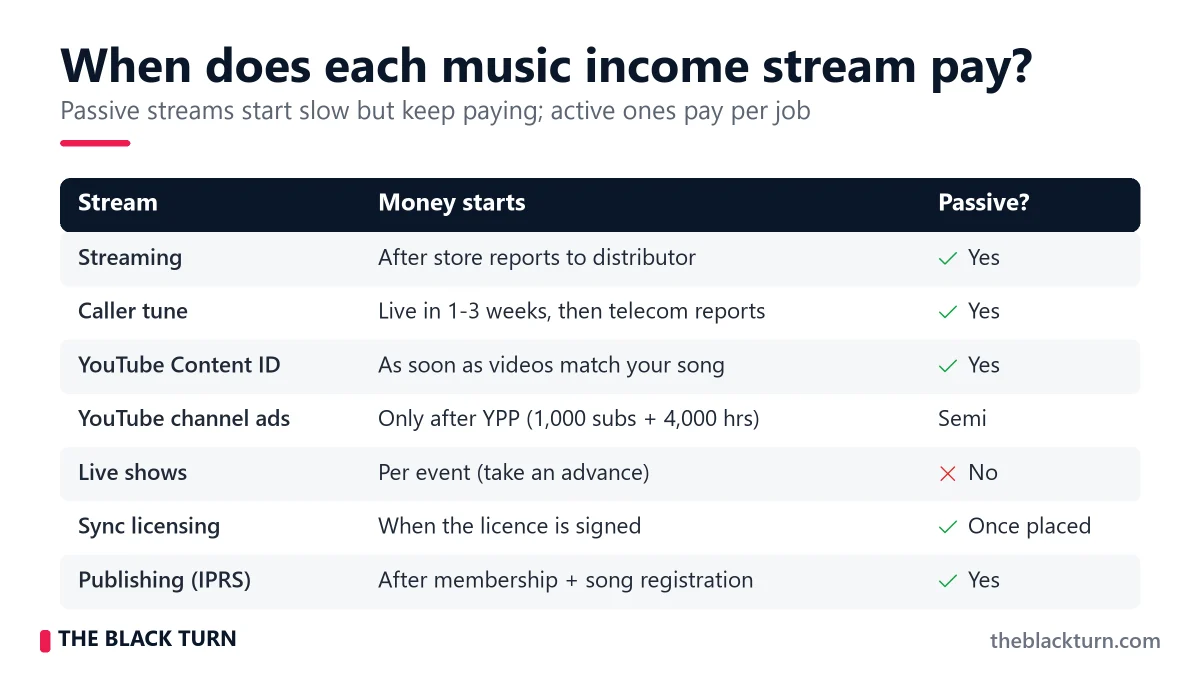
Here is the real power of diversification. Rather than copy a made-up “₹X per month” scenario, use this table to estimate your own numbers. It also shows when money from each stream actually starts arriving, which matters for planning:
| Revenue Stream | How to Estimate | When Money Starts |
| Streaming (all platforms) | Streams × your effective rate (from distributor statement) × your share | After stores report to your distributor; usually a couple of months after streams, then per your distributor’s payout cycle |
| Caller Tune (CRBT) | Number of fans who set it × how long they keep it (shown in reports) | After the tune goes live on networks (typically 1–3 weeks) and telecoms report |
| YouTube Content ID | Claimed views on other people’s videos × ad rates | As soon as matches start; paid through distributor reports |
| YouTube Channel Ads | (Monetised views ÷ 1,000) × RPM | Only after you join YPP (1,000 subs + 4,000 hours or 10M Shorts views) |
| Instagram/Facebook music | Small licensing share + extra streams it drives | Through distributor reports; the stream boost is immediate |
| Live Shows | Shows per month × your fee − travel/band costs | Per event (take an advance) |
| Sync | Negotiated fee per placement | When the licence is signed |
| Teaching / Merch / Beats | Price × units sold − costs | On each sale |
| Publishing (IPRS) | Depends on public use of your registered songs | After membership and song registration, per IPRS distribution cycles |
Notice the pattern: the passive streams (streaming, caller tune, Content ID) are slow to start but keep paying for years. The active ones (live, teaching, sync) pay quickly but stop when you stop. A healthy music income mixes both.
And catalogue size multiplies everything. An artist with 50 songs has 50 chances at streams, caller tunes and Content ID matches; an artist with 5 has five.
How to Start: First 3 Revenue Streams to Activate
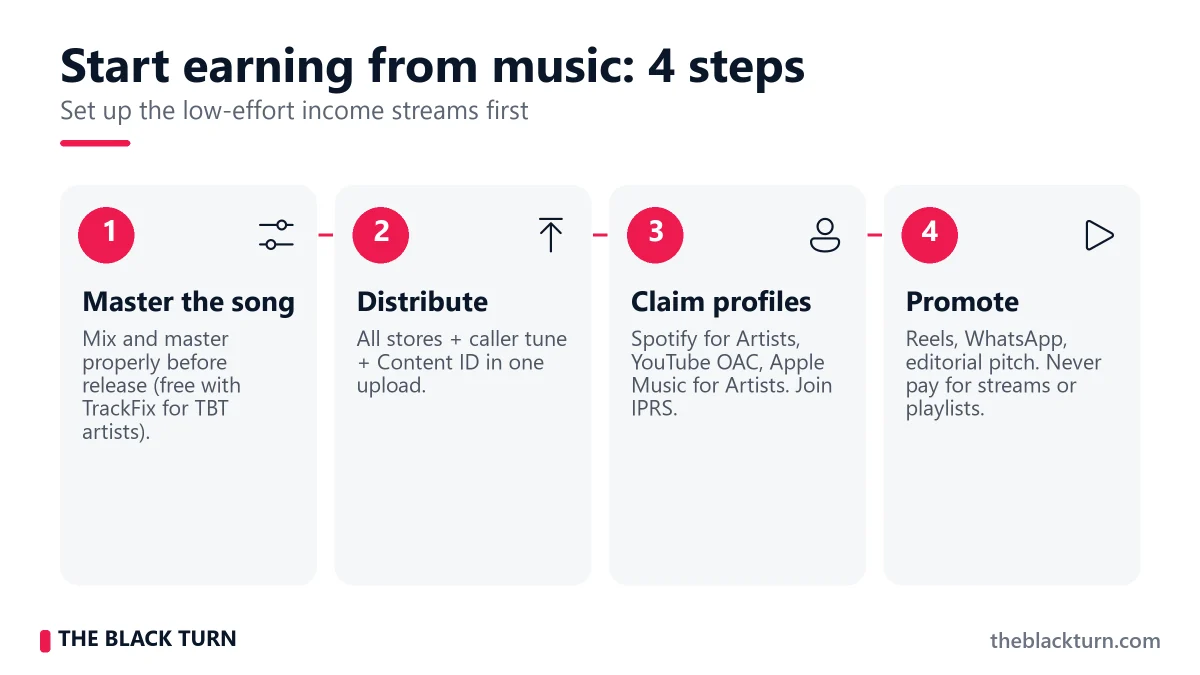
Do not try to activate all 12 at once. Start with these three because they require the least effort and generate income fastest:
Step 1: Distribute Your Music to All Platforms + Caller Tune
This single action activates revenue streams #1 (streaming), #2 (caller tune), and #3 (Content ID) simultaneously. One upload through The Black Turn gets your song on Spotify, Apple Music, JioSaavn and 150+ platforms, with YouTube Content ID free. The single-song plan is ₹599 one-time; the ₹799 plan adds caller tunes on Jio, Airtel, Vi and BSNL (see pricing). You keep 95% of royalties for life, paid quarterly, and earnings continue even if you never renew anything.
Before you upload, make sure the song is mixed and mastered properly. The Black Turn artists get free unlimited mix & mastering with TrackFix.
For the complete step-by-step process, read our guide to distributing music in India.
Step 2: Promote on Instagram Reels
This drives streams (revenue #1), Content ID usage (#3), and builds the audience you need for live shows (#6) and merch (#10). Read our Instagram Reels promotion guide for the exact strategy.
Step 3: Claim Your Profiles and Register with IPRS
Claim Spotify for Artists, Apple Music for Artists, and YouTube for Artists (Official Artist Channel). Register with IPRS for publishing royalties. Claiming profiles is free and gives you listener data and pitching tools you would otherwise miss.
Can You Earn Money by Listening to Music in India?
A lot of people search for this, so here is the honest answer. Spotify, JioSaavn, Gaana, YouTube Music and other streaming apps do not pay listeners. Apps that promise “earn money by listening to songs” usually pay tiny rewards in points or vouchers, and some are outright scams that ask for a joining fee or your bank details. If an app asks you to pay first, walk away.
If you love music and want to earn from it without investment, these are the realistic routes:
- Make content around music: reviews, reaction videos, song breakdowns or lyrics explainers on YouTube and Instagram can be monetised once you meet platform rules (use music legally).
- Curate playlists: a popular playlist builds an audience and credibility, but Spotify does not pay curators, and selling placements breaks Spotify’s rules.
- Freelance music work: writing about music, DJing, event playlists, subtitles/lyric transcription for labels and creators.
- Create your own music: even a phone recording can be released. Without a release, none of the 12 streams above can start.
5 Mistakes That Kill Music Income in India
1. Relying on one platform
Artists who only track Spotify earnings miss everything else their song can earn: caller tunes, Content ID, JioSaavn, YouTube Music and more. Distribute everywhere because each platform adds to the total.
2. Ignoring caller tunes
If your distributor does not support CRBT, you are leaving a uniquely Indian revenue stream completely untapped. Already released a song without it? It can still be added later as a caller tune.
3. Not registering with IPRS
Publishing royalties are generated whether you collect them or not. But if you are not registered, nobody sends you the money. Register yourself and every song you write.
4. Releasing one song and waiting
One song is one lottery ticket. Twenty songs is twenty lottery tickets. The more music you have on platforms, the more total streams, Content ID matches, and caller tune sets you generate. Release consistently.
5. Not promoting actively
Revenue streams 1–3 are technically passive, but they need an initial push. Instagram Reels, WhatsApp sharing, editorial playlist pitching, and collaborations drive the first wave of streams. Avoid anyone selling “guaranteed streams” or paid playlist spots; it can get your royalties withheld. After the first push, algorithms and caller tune subscribers take over.
Frequently Asked Questions
Can you really make money from music in India?
Yes. Independent artists are earning real income in 2026 through a combination of streaming, caller tunes, YouTube, live performances, and other revenue streams. The key is diversifying because no single source is enough alone, but 4–5 combined create meaningful income.
How much can an Indian artist earn from music per month?
There is no honest single number. It depends on your catalogue size, where your listeners are, whether they are paid or free users, and which streams you have activated. A beginner with one song often earns very little at first (on Spotify, a track needs 1,000 streams a year just to qualify for royalties). Use the estimate table above with your own distributor statements to calculate your real monthly figure.
What is the most profitable revenue stream for Indian musicians?
It depends on your profile. Live performances have the highest per-event income. YouTube Content ID is the most passive. Caller tunes are uniquely Indian and widely underestimated. The smartest approach is activating multiple streams rather than optimising for just one.
Do I need a record label to earn money from music?
No. Every revenue stream in this article is accessible to independent artists without a label. A music distributor handles distribution for a one-time fee, and you keep your rights and 95% of royalties.
How important is caller tune revenue?
Very important and widely underestimated. India has around 130 crore wireless subscribers, and caller tunes keep earning for as long as fans keep them set. This revenue stream is unique to India and not offered by international distributors like DistroKid or TuneCore. Learn more about caller tune distribution.
How do I earn from Spotify in India?
Release your song through a distributor, which delivers it to Spotify and pays you the royalties Spotify sends. Each track needs at least 1,000 streams in the last 12 months (and a minimum number of unique listeners) to earn. Claim Spotify for Artists to pitch songs to editorial playlists before release.
Can I earn money from a Spotify playlist in India?
Spotify does not pay playlist curators, and accepting money for playlist placement breaks Spotify’s rules. A big playlist can help you build an audience for your own music or brand, but the playlist itself is not an income source.
Can I earn money by listening to music in India without investment?
Not from streaming apps — they do not pay listeners, and apps that promise money for listening usually pay tiny rewards or are scams (never pay a joining fee). Realistic no-investment routes are music content creation, freelance music writing or DJing, and releasing your own songs.
How do I start earning from music as a beginner?
Record your song, get it mixed and mastered, distribute to all platforms through a distributor (₹599 one-time, or ₹799 with caller tune at The Black Turn), claim your artist profiles, promote through Instagram Reels, and release consistently. For the full beginner walkthrough: Apna gaana kaise release kare.
Start Building Your Music Income Today
The artists earning well from music in India are not necessarily the most talented. They are the ones who understood that music income is a portfolio, not a single stock. Streaming alone is not enough. But streaming + caller tunes + Content ID + live shows + merch? That is a career.
The first step is getting your music on every platform. Everything else builds from there.
Distribute your music with The Black Turn: 150+ platforms, caller tunes on Jio, Airtel, Vi and BSNL, YouTube Content ID free, free mix & mastering with TrackFix, and a 95% lifetime royalty that keeps paying even without renewal. Your music income starts the day your song goes live.
 Jyoti Singh – Independent artist (32) who has worked at several music distribution companies and has released music through distributors – so these guides come from both sides of a release.