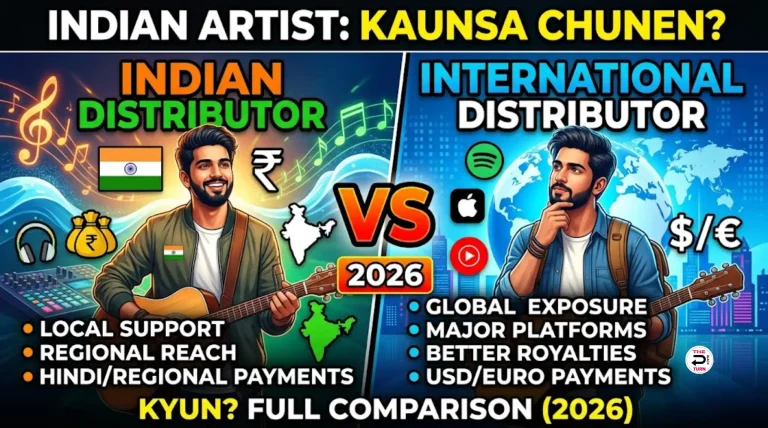
Punjabi music is one of the few genres in the world with two full-sized home markets: Punjab, and the diaspora across Canada, the UK, the US and Australia. Serving only one of them wastes half your audience. The practical problem is that Western distributors reach the diaspora but have inconsistent coverage of JioSaavn, Gaana and Wynk, and none of them offer caller tunes on Jio, Airtel, Vi or BSNL, which in Punjabi music is a genuine revenue stream and a cultural default. An Indian distributor covers both sides at once: Indian platforms plus caller tunes plus Spotify, Apple Music and every global service, typically ₹599-799 per song (roughly $7-9) paid once, with no annual renewal.
That is the summary. Now the detail, because Punjabi music’s structure is genuinely unusual and the standard advice written for American indie artists does not fit it at all.
Two Markets, One Release
Most genres have a home audience and, if they are lucky, some overseas listeners. Punjabi music has two centres of gravity:
Punjab and India. JioSaavn, Wynk, Gaana, YouTube, caller tunes, radio, the wedding and event circuit. Consumption is heavily mobile, heavily YouTube-driven, and caller tunes are a normal part of how people engage with a song they like.
The diaspora. Brampton and Surrey in Canada, Birmingham, Southall and Wolverhampton in the UK, California and New Jersey in the US, Melbourne in Australia. Spotify and Apple Music dominate, alongside YouTube, with a live circuit of weddings, melas, club nights and community events that can be more lucrative per show than anything back home.
A single release has to work in both, and the distribution choice decides whether it can. This is a category decision before it is a brand decision, laid out in Indian vs international distributors.
What Western Distributors Cannot Do For You
Not a criticism of their quality, simply a description of their scope:
- Caller tunes do not exist in their markets. No US, UK, Canadian or European distributor delivers CRBT to Jio, Airtel, Vi or BSNL, because there is no equivalent product to build for. For Punjabi music, where caller tunes are widely set and widely earned from, this removes an entire income line. How it works and pays is in caller tune revenue for artists.
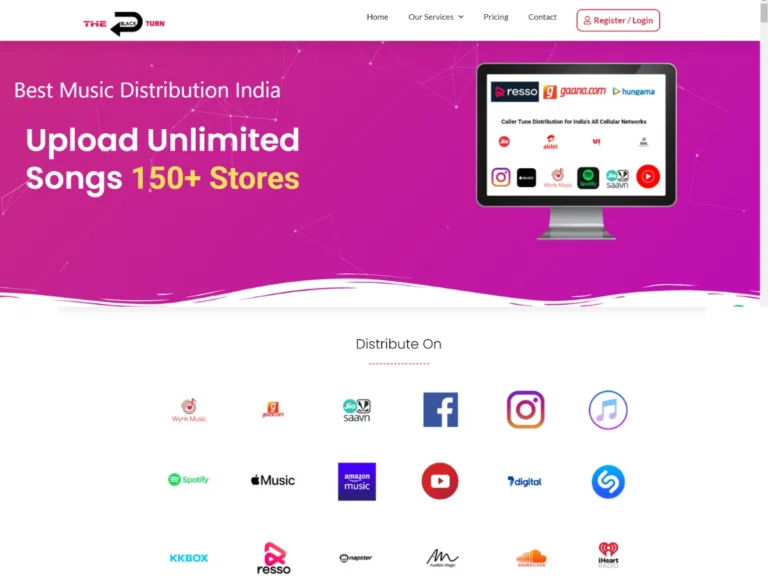
- Indian platform coverage is inconsistent. JioSaavn is often included; Gaana, Wynk and Hungama frequently are not. Confirm the explicit list rather than trusting a “150+ stores” claim, an issue documented in the DistroKid India review.
- Language and regional metadata handling. Correct Punjabi tagging is how Indian platforms route your track into regional editorial and discovery surfaces.
- Annual renewal risk. Most Western services remove your catalogue if you stop paying, examined in what happens when you stop paying.
An Indian distributor solves all four while still delivering everywhere your diaspora audience already listens. You are not choosing Punjab over Toronto. You are refusing to choose.
Releasing From Abroad: What Actually Changes
Very little, practically:
- You do not need to be in India. Distribution is handled online from anywhere. The full walkthrough for artists abroad is in releasing music in India from the USA
- Payment methods for international artists vary by distributor, so ask directly how you will be paid and in which currency before signing up
- Global reach is unaffected. Spotify, Apple Music, Amazon, YouTube Music, Instagram and TikTok are all still covered
- Caller tunes work regardless of where you live, and can be added to songs already released through another distributor
Six Things Punjabi Artists Should Get Right
- Turn caller tune on. For this genre specifically, it is usually the highest-impact single decision after distribution itself. Family, friends and listeners in India will ask for the code; having it ready is both revenue and promotion. Details in the caller tune distribution guide.
- Lock one spelling of your artist name. Punjabi names transliterate several valid ways, and inconsistent spellings across releases split your streams between duplicate profiles. Choose one Latin-script spelling and use it identically forever.
- Tag the language as Punjabi. Not Hindi, not “Indian”. This is how regional playlists and discovery sections find you.
- Plan for two time zones. Your Punjab audience and your Canadian or British audience are awake at opposite ends of the day. Stagger release-day posting rather than firing everything at once, and treat them as two campaigns sharing one song. The week-by-week structure is in the music marketing guide.
- Get covers licensed. Punjabi and Bollywood covers are hugely popular and legally risky. A mechanical licence from the rights holder is required; the process is in the cover song legal guide.
- Keep Content ID free of cuts. Punjabi music travels through YouTube more than almost any other genre: wedding videos, bhangra dance covers, reels, community event uploads. Every one can generate Content ID revenue, and a distributor taking 20-30% of it keeps taking it forever, as broken down in Content ID fees compared.
The Money Structure That Fits This Genre
Punjabi artists abroad tend to have an unusual earning pattern: streams from two markets, YouTube income that spikes around weddings and festivals, live income concentrated in the diaspora, and caller tune income from India.
Two structural points follow.
One-time distribution suits irregular release schedules. Many Punjabi artists release a few strong singles a year rather than constant volume. Subscription models penalise that pattern, since you pay annually regardless of output. The full comparison across models is in one-time vs yearly vs commission.
Every revenue stream matters, because they peak at different times. Streaming builds slowly, YouTube spikes seasonally, caller tunes earn quietly for months, live pays in bursts. Losing one of them, usually caller tunes, is not a small trim; it removes an entire leg of the table.
FAQ: Punjabi Music Distribution From Abroad
Can I release a Punjabi song in India while living in Canada or the UK?
Yes. Use an Indian distributor, which delivers to Indian platforms and caller tune networks as well as all the global platforms your diaspora audience uses.
Will my song reach Punjab if I use DistroKid or TuneCore?
Partly. Spotify and Apple Music reach Indian listeners, but coverage of JioSaavn, Gaana and Wynk is inconsistent and caller tunes are not offered at all.
Can Punjabi artists abroad get caller tunes on Indian networks?
Yes, through an Indian distributor, on Jio, Airtel, Vi and BSNL, including for songs already released elsewhere.
Do I lose my Canadian, UK or US listeners by using an Indian distributor?
No. Indian distributors deliver to Spotify, Apple Music, Amazon, YouTube Music and every major global platform alongside Indian ones.
How much does it cost?
Typically ₹599-799 per song, roughly $7-9, paid once with lifetime distribution rather than an annual subscription.
Can I release Punjabi covers of film songs?
Only with a mechanical licence from the rights holder. Unlicensed covers face rejection, claims or takedowns. See the cover song legal guide and the 12-point distributor checklist before releasing.
Conclusion
Punjabi music built a global audience long before streaming existed, through cassettes carried in suitcases, wedding halls in Birmingham and satellite TV in Surrey. The infrastructure finally caught up, but only if you use the part of it that reaches both ends of that audience.
The Black Turn works with artists wherever they live: ₹599-799 per song (roughly $7-9) paid once with lifetime distribution, 95% royalty, 150+ Indian and international platforms, free YouTube Content ID at 0% cut, caller tunes on Jio, Airtel, Vi and BSNL including for older releases, and support by phone and WhatsApp in Punjabi, Hindi and English. Your audience was never in one country. Your distribution should not be either.
![Best Music Distribution Companies in India 2026: Complete Guide for Independent Artists [Free + Paid]](https://theblackturn.com/blogs/wp-content/uploads/2026/04/best-music-distribution-companies-in-india-2026.png-768x403.webp)