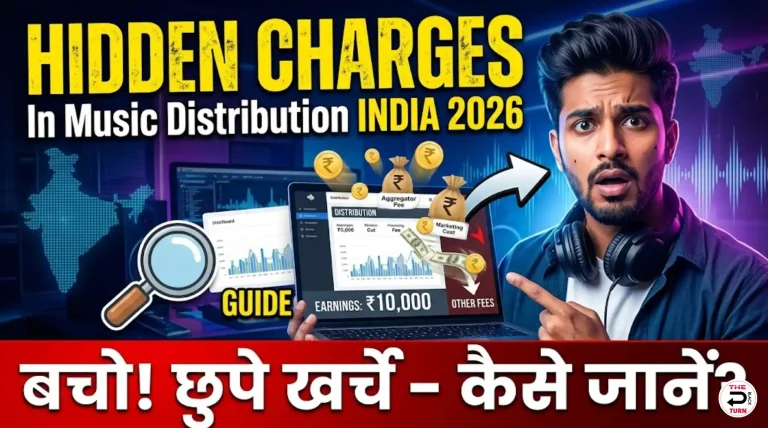
The headline price is rarely the price. Across the industry, the charges that actually determine your cost sit outside the pricing page: revenue shares on YouTube Content ID (0-30%), forex on USD billing (2-3.5% per transaction), payout thresholds that withhold earnings, per-release fees to keep music live after cancellation, paid add-ons for custom release dates or splits, takedown charges, and store-specific extras. None of these are secret; they are simply not on the page you compared. This checklist collects all 14 into one place so you can price a distributor properly before paying, not after.
That is the summary. Use the checklist below as a literal list, sending the questions to any distributor you are considering, including the one you already use.
Fee structures differ by company and change frequently. Nothing here describes any specific service; it describes what to check everywhere.
Why Pricing Pages Do Not Tell You the Price
Not because distributors are dishonest, but because a pricing page has one job: make comparison easy in the direction that favours the seller. Every industry does this. Airlines quote fares without baggage, hotels quote rooms without resort fees, distributors quote plans without revenue shares.
The result is that two services advertised at “$19.99/year” and “₹599 one-time” can differ by thousands of dollars over five years, and nothing on either page would tell you which.
The only reliable method is to price the whole relationship, not the entry point.
The 14 Charges to Check
Revenue-Based Charges
- Streaming royalty share. The advertised percentage, and whether it is your plan’s actual rate or the top-tier rate. “Up to 90%” means lower tiers pay less.
- YouTube Content ID share. Often different from, and higher than, the streaming rate. This single line can outweigh everything else on the list, as detailed in Content ID fees compared.
- Different rates by revenue type. Streaming, YouTube, caller tune, sync and publishing can each carry separate percentages. Ask for all of them, separately.
- Gross versus net calculation. Whether your percentage applies before or after platform fees and intermediary deductions.
Recurring Charges
- Annual or monthly plan fee. The obvious one, but count it across five years rather than one.
- Per-artist or per-label fees. Some plans charge extra for additional artist names or label accounts under one login.
- Storage or catalogue-size fees. Rare, but check if you have a large back catalogue.
Charges That Appear Later
- Legacy or “keep music live” fees. The per-release charge some subscription services apply so your catalogue stays online after you stop paying. If you might ever stop, this belongs in your total, and the wider consequence is covered in what happens when you stop paying.
- Takedown fees. Charges for removing your own release. Free removal is the reasonable standard.
- Transfer or migration fees. Any cost to move your catalogue elsewhere, discussed in can you leave your distributor.
- Correction and re-delivery fees. Charges to fix a typo, replace artwork, or update credits after release.
Money-Movement Charges
- Currency conversion and forex. USD billing on a non-US card typically adds 2-3.5% per transaction, every year, and payouts in a foreign currency lose more on the way back.
- Payout thresholds and withdrawal fees. A $20 or $50 minimum does not take your money but delays it, sometimes for years on a small catalogue. A low threshold releases earnings sooner.
Feature Charges
- Add-ons for core functions. Custom release dates, splits, pre-save links, Content ID, priority support, store-specific delivery. If a feature you actually need costs extra, it is part of your price, not a bonus.
The Copy-Paste Email
Send this to any distributor before paying. Their answer, and how fast it arrives, tells you two things at once:
“Before signing up, could you confirm in writing:
- My exact royalty percentage on streaming, and separately on YouTube Content ID
- Whether Content ID is included free or carries a fee or revenue share
- Total cost for five years for [X] releases, including any renewals
- What happens to my released music if I stop paying, and any fee to keep it live
- Any fees for takedowns, corrections, or transferring to another distributor
- Payout threshold, payout currency, and any withdrawal fees
- Which features cost extra beyond the plan price”
A company that answers all seven clearly is showing you how it operates. One that answers three and deflects four has also answered you. The same documentation principle runs through the distribution agreement red flags guide.
Working Out Your Real Five-Year Cost
- Estimate annual earnings, split into streaming and YouTube
- Multiply by five
- Subtract each percentage from the relevant revenue type
- Add five years of plan fees, plus forex at roughly 2-3.5% on USD charges
- Add any add-ons you will actually use
- Add legacy fees if there is a realistic chance you will stop paying
- Add back revenue streams one option enables and another does not, such as caller tune income for artists with Indian audiences
The number you end up with is the price. Everything else was marketing. The model-level version of this calculation is in one-time vs yearly vs commission.
What a Genuinely Simple Structure Looks Like
For contrast, a structure with nothing on the list above except line one: The Black Turn charges ₹599-799 per song (roughly $7-9) once, pays 95% of streaming royalties, takes 0% of Content ID revenue, has no annual fee, no legacy fee, no takedown fee, no forex on INR billing, a low payout threshold, and includes ISRC, UPC and caller tune delivery rather than selling them separately.
That is not an argument that simple is always better. It is an argument that you should be able to state your distributor’s total cost in one sentence. If you cannot, you have not finished comparing.
FAQ: Hidden Distribution Fees
What is the most expensive hidden fee in music distribution?
Usually the YouTube Content ID revenue share, at 15-30% depending on the service, because it applies permanently to a stream of income that grows independently of your own uploads.
Do distributors charge to remove your music?
Some do. Free and prompt takedown is the reasonable standard; a fee to remove your own release functions as soft lock-in.
What are legacy fees?
Per-release charges some subscription services apply so your catalogue stays live after you stop paying. Without them, the music comes down.
Does forex really matter on a $20 plan?
It is small annually and adds up across five years, and it applies again when earnings are converted on the way back to you.
Are payout thresholds a fee?
Not technically, but a high minimum can withhold earnings for years on a small catalogue, which has a real cost to you.
How do I compare distributors properly?
Price the whole five-year relationship using the steps above, then compare totals. See the 12-point checklist and best music distribution companies 2026.
Conclusion
Nobody chooses a distributor badly on purpose. They choose the number they were shown, which is designed to be the smallest true number available.
Run the checklist before you pay, not after your first royalty statement raises questions. Fourteen items, one email, ten minutes of arithmetic. Whatever you choose, choose it knowing the total, because that is the figure your catalogue will actually be paying for the next five years.