Imagine this: a vlogger in Brazil uses your song in the background of a travel video. A gaming channel in Russia adds your beat to a montage. A fan in India creates a lyric video of your track. None of them asked your permission. None of them paid you.
Without Content ID, you earn nothing from any of this. With Content ID, YouTube automatically detects your music in all three videos, places ads on them, and sends the revenue to you. You did not file a single claim. You did not even know these videos existed.
That is the power of YouTube Content ID and for Indian artists, where YouTube is the single largest music consumption platform, it is not optional. It is essential. This guide explains exactly how it works, how to get it, what it costs, and how much you can earn.
What Is YouTube Content ID?
Content ID is YouTube’s automated system for detecting copyrighted audio and video. Here is how it works in simple terms:
- Your music gets fingerprinted. When your distributor registers your song with Content ID, YouTube creates a unique digital fingerprint (called a “reference file”) of your audio.
- YouTube scans every upload. Every video uploaded to YouTube is scanned against this fingerprint database.
- Match found = claim created. If someone’s video contains your music (even a 10-second clip), Content ID flags it and creates a claim.
- You choose what happens. You get three options: monetise (place ads, keep the revenue), track (see analytics but no ads), or block (remove the video). Most artists choose monetise.
- Ad revenue flows to you. When ads play on that video, the revenue goes to you through your distributor.
The beauty is that this happens automatically, across millions of videos, 24/7, without you doing anything after the initial registration.
Key distinction: Content ID is NOT a copyright strike. A Content ID claim lets you earn money from someone’s video while keeping it live. A copyright strike takes the video down and penalises the uploader’s channel. They are completely different tools. As a musician, Content ID (monetise) is almost always the better choice.
Why Content ID Is Critical for Indian Artists
India is YouTube’s largest market globally. Over 460 million monthly active users. Indians watch music videos, use songs in wedding videos, create reels and shorts, make fan edits, and produce thousands of user-generated content pieces daily. Your music is being used on YouTube whether you know it or not.
Without Content ID, every one of those usages is money lost. Someone uploads a dance video with your song, they might earn ad revenue from it, but you earn nothing. With Content ID registered, that ad revenue comes to you instead.
Think about it practically:
- Wedding videographers routinely use popular songs. One popular wedding video can get 50K-500K views.
- Reels re-uploaded to YouTube Shorts : millions of Indian Reels are re-posted on YouTube daily. If your song is in them, Content ID catches it.
- Fan-made lyric videos and status videos : fans creating WhatsApp status clips with your song often upload them to YouTube too.
- DJ mixes and remix uploads featuring your track.
- Gaming, vlog, and lifestyle content using your music as background.
Every single one of these is a potential revenue source that Content ID activates automatically.
How to Get Content ID for Your Music
Here is what most artists do not realise: you cannot apply for Content ID directly with YouTube. YouTube only grants Content ID access to certified partners such as music distributors and rights management companies.
As an independent Indian artist, you get Content ID through your music distributor. When you distribute your song, your distributor registers it with YouTube’s Content ID system on your behalf. But here is where it gets complicated because not all distributors handle Content ID the same way:
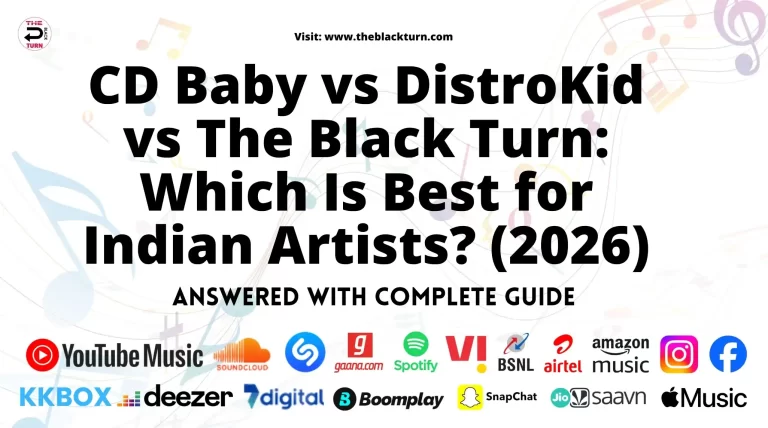
Content ID Cost Comparison Across Distributors
| Distributor | Content ID Fee | Revenue Share | Your Take |
| The Black Turn | Free — included | 0% — you keep all | 100% of Content ID |
| DistroKid | $4.95/song/year | 20% of revenue | 80% of Content ID |
| TuneCore | Breakout plan (₹1,999/yr) | 0% on paid plans | 100% of Content ID |
| CD Baby | Included | 9% of everything | 91% of Content ID |
| RouteNote Free | Included | 15% of everything | 85% of Content ID |
Notice the DistroKid column: $4.95 per song per year plus 20% of all Content ID revenue. For Indian artists where YouTube is the biggest platform, that 20% cut is significant money. The Black Turn includes Content ID free with zero revenue share which means you keep everything YouTube pays.
For a detailed comparison of distributor costs, read our free vs paid music distribution comparison.
How Much Can Content ID Earn for Indian Artists?
Content ID earnings depend on three factors: how many videos use your music, how many views those videos get, and the ad rates in the viewer’s country. Here are realistic estimates:
| Scenario | Videos Using Your Song | Combined Monthly Views | Estimated Monthly Earning |
| New artist | 10–50 | 10K–100K | ₹300–1,000 |
| Growing artist | 100–500 | 1L–10L | ₹3,000–10,000 |
| Popular song | 1,000–5,000 | 10L–50L | ₹10,000–50,000 |
| Viral hit | 10,000+ | 50L+ | ₹50,000–2,00,000+ |
Indian CPM (cost per 1,000 ad impressions) is typically ₹30–100, lower than US/UK (₹500–1,500). But India’s massive view volume compensates. A song used in 1,000 Indian wedding videos averaging 50K views each = 5 crore total views. Even at Indian CPM, that is substantial income.
The compounding effect is what makes Content ID powerful: your song keeps earning from every video that uses it, forever. A video uploaded today using your song will still generate Content ID revenue five years from now if people keep watching it.
Content ID Revenue vs Your YouTube Channel Revenue
Many artists confuse these two. They are separate income streams:
| Content ID Revenue | Channel Ad Revenue | |
| Source | Other people’s videos using your music | Your own channel’s videos |
| Effort | Passive (automatic detection) | Active (you create and upload content) |
| Requirements | Distributed music + Content ID registration | YouTube Partner Program (1K subs + 4K hours) |
| Scale | Unlimited (any video on all of YouTube) | Limited to your channel’s views |
| Payment via | Your distributor | Google AdSense directly |
Both are valuable, and both are covered in our 12 revenue streams guide for Indian musicians. The ideal setup is having Content ID active while also running your own YouTube channel with music videos and content. You earn from both simultaneously.
Content ID Claiming Your Own Videos : Do Not Panic
This happens to almost every artist and causes unnecessary anxiety. You upload a music video to your own YouTube channel, and suddenly you see a Content ID claim on it. Your first reaction might be to dispute it. Do not.
Here is what is actually happening: Content ID scanned your video, detected your own song (because your distributor registered it), and claimed it. This is normal and correct behaviour. The revenue from that claim goes to you anyway i.e. through your distributor.
You have two options:
- Leave the claim as-is. Revenue goes to you through your distributor. Simple.
- Ask your distributor to whitelist your channel. This prevents claims on your own channel’s uploads. Revenue from those videos goes to you directly through AdSense instead.
Either way, you are not losing money. The claim is not a punishment. It is Content ID doing exactly what it was designed to do.
Never dispute your own Content ID claim. If you dispute a claim that your distributor placed, it creates a conflict in YouTube’s system. Your distributor may get penalised. The correct process is to contact your distributor and ask them to whitelist your channel or release the specific claim.
What Music Is (and Is Not) Eligible for Content ID ?
Eligible : Register This
- Original music you fully own : you wrote, produced, and own all rights
- Music you own master rights to : you hired a producer and own the final recording
- Music with exclusive beat licenses : you have an exclusive license to the beat
Not Eligible : Do NOT Register This
- Non-exclusive beat leases : Other artists can use the same beat. Registering it with Content ID will create false claims against them.
- Cover songs without mechanical licenses
- Music with stock samples or loops from Splice, GarageBand, YouTube Audio Library, or similar libraries
- Public domain or royalty-free music
- Remixes of other artists’ songs without proper clearance
- Generic instrumentals, meditation music, or binaural beats made from common sound libraries
Registering ineligible music is serious: If you register a non-exclusive beat with Content ID, every other artist who legitimately bought and used that beat will get a false claim on their videos. YouTube penalises false claimants. Your Content ID access can be revoked, and in severe cases, your entire distribution account may be terminated.
Content ID and Instagram Reels: The Connected Loop
Here is something most guides miss. When your song goes viral on Instagram Reels, thousands of those Reels get re-uploaded to YouTube as Shorts. Content ID detects your music in every single one. You did not create any of this content, but you earn from all of it.
This creates a virtuous cycle: Instagram Reels drives music discovery → creators re-upload Reels to YouTube → Content ID claims those uploads → you earn ad revenue. The more your song trends on social media, the more Content ID revenue you generate on YouTube without lifting a finger.
5 Ways to Maximise Your Content ID Earnings
1. Distribute to all platforms including social media
The more places your music exists, the more people use it in videos. Distribute to all platforms such as streaming, Instagram, TikTok, Facebook. Every usage on social media eventually creates YouTube uploads that Content ID can catch.
2. Make your music easy to use in videos
Songs with strong hooks, catchy choruses, and emotional moments get used in more user-generated content. Think about your music from a video creator’s perspective: does it work as a background for transitions, dance clips, or emotional storytelling?
3. Encourage fan content
Ask fans to create lyric videos, dance covers, reaction videos, and edits using your music. Every fan video that gets uploaded to YouTube = more Content ID revenue for you. Some artists even run contests encouraging fan-made content.
4. Choose a distributor with zero Content ID commission
If your distributor takes 20% of Content ID revenue (like DistroKid), you lose a fifth of this income stream. Switching to a distributor like The Black Turn that includes Content ID free with zero cut directly increases your earnings by 20%.
5. Release consistently
More songs registered = more fingerprints in the system = more matches across YouTube. An artist with 20 songs in Content ID generates far more passive revenue than one with 2 songs.
Common Content ID Problems and How to Fix Them
Problem: Content ID claims your own video
This is normal. Contact your distributor to whitelist your channel, or leave the claim, revenue goes to you either way. Do NOT dispute the claim yourself.
Problem: Someone else claimed your original music
This means someone else registered your music (or similar music) with Content ID. Contact your distributor immediately. They will investigate and resolve the dispute through YouTube’s official process. Keep proof of ownership (project files, stems, contracts).
Problem: Content ID is not finding matches
Give it 1–2 weeks after registration. Content ID only matches uploads after your fingerprint is active. Also, very short clips (under 8–10 seconds) may not always trigger matches. If your music is not being used in many videos yet, then promote your music to increase usage.
Problem: False claims from your Content ID on other creators
This happens when you registered music made with non-exclusive beats or common samples. Release the false claims immediately and review your Content ID eligibility. Repeated false claims can result in losing Content ID access.
Content ID + Caller Tunes: The India Advantage
Indian artists have a combination that artists in no other country have: Content ID monetising your music across YouTube, and caller tune distribution monetising your music across 800+ million mobile phones. These are two completely passive income streams that work simultaneously.
Content ID catches your music on YouTube. Caller tunes earn from Jio, Airtel, Vi, BSNL subscribers. Streaming royalties come from Spotify, JioSaavn, Apple Music. Together, they create a three-legged income stool where every leg generates money independently.
No international distributor offers all three. This is why Indian distributors that include Content ID, caller tunes, and all-platform streaming distribution in one package provide significantly better value for Indian artists.
Frequently Asked Questions
What is YouTube Content ID?
An automated system that fingerprints your music and scans every YouTube upload for matches. When your music is found in someone’s video, you can monetise that video with ads and earn the revenue. It works 24/7 across all of YouTube without you doing anything.
How do I get Content ID for my music?
Through your music distributor. You cannot apply directly with YouTube. When you distribute through a service like The Black Turn, they register your tracks with Content ID on your behalf, included free with no revenue share.
How much does Content ID pay Indian artists?
Depends on how widely your music is used. A growing artist with 100–500 videos using their song can earn ₹3,000–10,000/month. Viral songs earn ₹50,000–2,00,000+/month from Content ID alone. Indian CPM is lower (₹30–100) but volume is massive.
Will Content ID claim my own YouTube videos?
Yes, and that is normal. Contact your distributor to whitelist your channel, or leave the claim, revenue goes to you either way. Never dispute your own claim.
Is Content ID the same as a copyright strike?
No. A Content ID claim monetises the video (you earn from it, video stays live). A copyright strike removes the video and penalises the uploader. Completely different. Content ID is the income-generating option.
Do all distributors include Content ID?
No. DistroKid charges $4.95/song/year + 20% revenue share. CD Baby includes it but takes 9% of everything. RouteNote Free includes it but takes 15%. The Black Turn includes it free with 0% cut. Compare options in our distributor comparison guide.
What music is NOT eligible for Content ID?
Music with non-exclusive beats, stock samples, public domain content, cover songs without licenses, remixes without clearance, and generic instrumentals from sound libraries. Only register music you fully own the rights to.
How long does Content ID take to start working?
1–2 weeks after your distributor registers your song. Once active, it scans both new uploads and existing videos. You may receive claims on old videos that used your music months ago.
Get Your Music Protected and Monetised on YouTube
YouTube is India’s biggest music platform, and Content ID turns the entire platform into a revenue source for your music. Every wedding video, every Reel re-upload, every fan lyric video, every gaming montage that uses your song — all of it becomes income.
The only thing you need is a distributor that registers your music with Content ID without taking a chunk of the earnings.
Music Distribution with The Black Turn : YouTube Content ID included free with 0% revenue share, plus Spotify, Apple Music, JioSaavn, 150+ platforms, and caller tune distribution on all Indian networks. One-time payment, 95% royalties, lifetime distribution.
Your music is already being used on YouTube. Make sure you are getting paid for it.