Your label has signed 5 artists. You have 20 songs ready to release this quarter. You log into your distributor account, and you realise you have 5 separate logins, 5 separate metadata workflows, 5 separate royalty payout cycles, and zero ability to see your label’s total performance in one place.
This is the moment most Indian indie labels realise: distributing as a label is fundamentally different from distributing as an individual artist. What worked for one solo artist breaks completely when you have a roster.
This guide covers everything about music distribution for labels in India in 2026. Bulk uploads, multi-artist dashboards, automatic royalty splits, white-label options, caller tune integration at scale, comparison of label distribution services, and how to migrate from individual artist distribution to label-tier distribution. By the end, you will know exactly how to set up label distribution that scales as your roster grows.
Individual Artist Distribution vs Label Distribution
Most distributors are built for individual artists. A few offer label-tier services. The differences are significant once you scale beyond 3-5 artists.
| Aspect | Individual Artist Distribution | Label / Bulk Distribution |
| Account structure | One artist = one account | One label = many artists |
| Dashboard | Personal artist analytics | Roster-wide consolidated view |
| Upload workflow | Manual one-by-one | Bulk uploads via CSV |
| Royalty handling | Single payout to artist | Auto-split to multiple parties |
| Branding on platforms | Distributor name as label | Your label name as rights holder |
| Cost per release | ₹599 to ₹799 each | ₹300 to ₹1,500 each |
| Reporting | Per-artist reports only | Label-wide consolidated reports |
| Best for | 1-2 artists releasing solo work | 3+ artists or 20+ releases per year |
When to Switch from Individual to Label Distribution
Not every label needs bulk distribution from day one. The transition typically happens at specific roster milestones:
- 1-2 artists, 5-10 releases per year: Individual accounts work fine. The complexity of label distribution is overkill
- 3-5 artists, 15-25 releases per year: Time to evaluate. Bulk distribution starts saving time and money
- 5-10 artists, 25-50 releases per year: Bulk distribution is essential. Individual accounts become impossible to manage
- 10+ artists, 50+ releases per year: Premium label distribution with white-label options and dedicated support
Decision framework: If you spend more than 5 hours per month managing distributor accounts and royalty payouts across multiple artists, you have already crossed the threshold where bulk distribution saves time. The cost of bulk distribution typically pays for itself in time savings alone, before counting the operational benefits.
8 Core Features Every Label Distribution Service Must Have
1. Multi-Artist Dashboard with Consolidated View
A single login showing all your label’s artists, releases, streams, and earnings in one place. You should be able to filter by artist, by release, by platform, by date range, and by territory. Without this, you are toggling between accounts to understand label-wide performance.
2. Bulk Upload via CSV or Spreadsheet
Manual upload of 50 songs takes 50 hours. Bulk CSV upload takes 2 hours. Your distributor should let you prepare metadata, audio files, and artwork in spreadsheet format and import everything at once. Critical for labels with quarterly batch releases.
3. Automatic Royalty Splits
You set the split percentages per release (e.g., Artist 60%, Producer 20%, Label 20%) and the platform calculates and pays each party automatically. No manual spreadsheet calculations. No artist disputes. No payment delays.
Some distributors include this in base pricing, others charge ₹100-500 extra per split per release. Compare distributor pricing models in our review.
4. White-Label Branding
Your label name appears as the rights holder on Spotify, Apple Music, JioSaavn, and YouTube. Not the distributor’s name. This is critical for label brand building. When listeners click the label name on Spotify, they see other releases from your label, building catalog discovery.
Without white-label: Releases appear with the distributor’s name. Listeners associate the music with the distributor brand, not your label. You lose the catalog cross-promotion benefit and look amateur compared to professionally branded labels.
5. Caller Tune Distribution at Scale
Indian labels need caller tune (CRBT) distribution to Jio, Airtel, Vi, and BSNL networks for every release. International distributors do not offer this. Your label distributor must include CRBT in the base package or your label loses 10-30% potential revenue per release.
6. Label-Specific Analytics and Reporting
Per-artist breakdown: which artist drives the most streams
Per-platform breakdown: Spotify vs JioSaavn vs Apple Music performance
Geographic data: which states/cities perform best for which artist
Caller tune downloads: which networks generate most CRBT revenue
Trend analysis: which genres and release types perform best for your label
Roster ROI: which artists have positive net contribution after marketing costs
7. Team Access with Role-Based Permissions
Your label may have multiple team members: A&R manager, marketing manager, finance person, accountant. Each needs different access levels. The distributor should support multiple logins with role-based permissions:
- Admin: Full access to everything
- Editor: Can upload releases and manage metadata
- Viewer: Can see analytics but not modify anything
- Finance: Can see revenue but not metadata
8. ISRC Code Management at Scale
Labels with IMI (Indian Music Industry) registration have their own master ISRC code prefix. The distributor should support this. They should let you upload releases with ISRC codes you generate yourself, not force you to use the distributor’s pool ISRC. This protects your label’s branding and ensures correct royalty tracking.
Label Distribution Services in India Compared (2026)
| Feature | The Black Turn | DistroKid | TuneCore | Believe Music |
| India focus | Yes | No | No | Partial |
| Caller Tune CRBT | Included | Not available | Not available | Available |
| Multi-artist dashboard | Yes | Limited | Yes | Yes |
| Royalty splits | Built-in | Extra fee | Extra fee | Built-in |
| Bulk upload | CSV supported | Limited | CSV supported | CSV supported |
| White-label option | Available | Limited | Premium tier | Available |
| Pricing model | Per release | Annual subscription | Annual + per release | Custom contracts |
| Royalty pass-through | 95% | 100% (after fees) | 100% (after fees) | Variable |
| YouTube Content ID | Included | Extra fee | Included | Included |
| Best for Indian labels | Excellent fit | Poor fit | Decent for English | Major label tier |
The Black Turn is purpose-built for Indian indie labels. Per-release pricing from ₹599, caller tune included, multi-artist dashboard, automatic royalty splits, white-label setup available, IMI ISRC support, and dedicated label-tier support. Compared to setting up 10 individual artist accounts on international distributors, the operational savings are substantial.
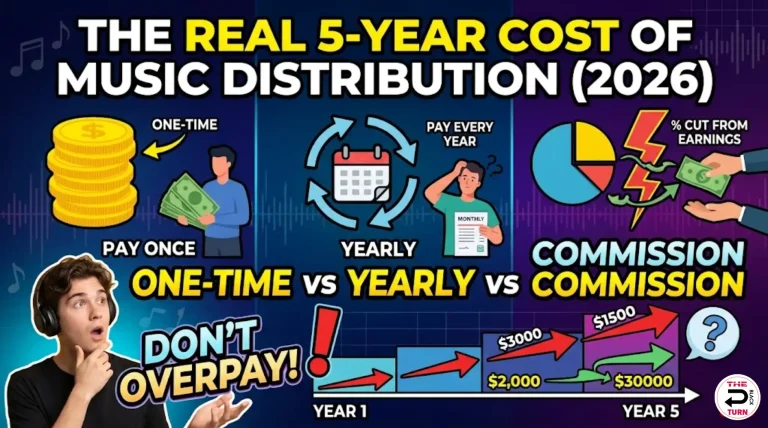
Label Distribution Pricing Models Explained
Model 1: Per-Release Pricing (Indian Indie Standard)
You pay a one-time fee per song or per album release. No annual subscription. No recurring charges. Each release stays distributed forever.
- Cost: ₹599 to ₹1,500 per single. ₹1,500 to ₹5,000 per album
- Best for: Labels with 10-30 releases per year
- Predictability: Easy to budget, costs scale with release volume
- Risk: None. No recurring liability
Model 2: Annual Subscription (International Style)
You pay an annual fee that covers unlimited releases for the year. If you stop paying, your music is removed from platforms (DistroKid model).
- Cost: ₹2,500 to ₹15,000 annual base, scales with feature tiers
- Best for: Labels with 50+ releases per year
- Risk: Music gets removed if subscription lapses. Many lakhs of accumulated streams can disappear
- Hidden costs: Most charge extra for splits, Content ID, additional artists
Model 3: Custom Label Contracts (Major Label Tier)
Custom-negotiated deals with distributors like Believe, Ingrooves, Orchard. Often include marketing services, advances against royalties, and integrated promotion.
- Cost: ₹2 lakh to ₹10 lakh annual minimum
- Best for: Labels with 100+ releases per year and significant revenue
- Trade-off: Lower percentage royalty pass-through (70-85% vs 95% for indie tiers)
- Benefits: Marketing support, industry connections, advances
Pricing recommendation: Most Indian indie labels (10-50 releases per year) get the best value from per-release pricing models. Annual subscriptions become risky because if your label hits a tough financial period, you lose all your music distribution. Per-release pricing means each release is a completed asset that stays live regardless of future business conditions.
Setting Up Automatic Royalty Splits for Your Label
This is the single most useful feature of label distribution. Done manually, royalty calculations across 10 artists for 4 platforms over 12 months becomes a nightmare. Done automatically, the platform handles everything.
Common Royalty Split Structures
Structure 1: Simple Artist-Label Split
- Artist: 60-80%
- Label: 20-40%
- Direct: simple, transparent
Structure 2: Multi-Party Split
- Artist: 50%
- Producer: 15%
- Featured artist: 10%
- Label: 25%
- Common for collaborative releases with multiple credits
Structure 3: Recoupment Split
- 100% to label until label recoups advance/recording costs
- After recoupment: switch to standard split (e.g., 60% artist / 40% label)
- Common for labels providing significant upfront investment
Structure 4: Tiered Performance Split
- First ₹10,000 revenue: 50/50
- ₹10,001 to ₹1 lakh: 60/40 (favoring artist)
- Above ₹1 lakh: 70/30 (favoring artist)
- Common for performance-incentive deals
How to Implement Splits in Your Distributor
- Set up artist payment profiles for each artist (bank account, PAN, UPI)
- During release upload, define split percentages for that specific release
- Distributor automatically calculates and pays each party per their share
- Each artist receives transparent statements showing their portion of each platform’s revenue
- Tax compliance handled separately through label’s CA
White-Label Distribution. Why Your Label Brand Matters
White-label distribution is what separates professional labels from hobby labels. When listeners click the label name on Spotify, what do they see?
Without White-Label
- Spotify shows distributor name (e.g., “DistroKid Music” or “CD Baby Records”)
- Other releases under that distributor name from random artists also appear
- No catalog cross-promotion for your label
- Looks amateur to industry contacts
With White-Label
- Spotify shows your label name (e.g., “Black Turn Records” or “Your Label Name”)
- Listeners see all your label’s artists in one place
- Catalog cross-promotion works automatically
- Industry contacts (curators, brands, journalists) take you seriously
White-Label Setup Requirements
- Registered legal entity (LLP or Pvt Ltd recommended)
- GST registration
- IMI ISRC prefix (highly recommended)
- Trademark for label name (recommended for protection)
- Documented artist contracts proving rights ownership
If you have not set up these foundations yet, follow our record label setup guide for India before applying for white-label distribution. Most premium label distributors require these as prerequisites.
Setting Up Bulk Release Uploads for Your Label
If your label releases 5-10 songs per quarter, bulk uploads save dozens of hours. Here is the typical workflow:
Step 1: Prepare Metadata Spreadsheet
Create a CSV/Excel file with these columns for each release:
- Artist Name (must match Spotify for Artists profile exactly)
- Track Title
- Release Type (single, EP, album)
- Release Date (Friday recommended for industry alignment)
- Genre (primary and secondary)
- Language
- ISRC Code (your IMI prefix or distributor pool)
- Composer/Lyricist credits
- Producer credits
- Featured artist credits
- Royalty Split Percentages for each contributor
Step 2: Organize Audio and Artwork Files
- Audio: WAV format, 16-bit/44.1kHz minimum, 24-bit/48kHz preferred
- Artwork: 3000×3000 pixels minimum, JPG or PNG, sRGB color space, under 10MB
- File naming convention: Use a standard format like “ArtistName_TrackTitle.wav” so the distributor can match files to spreadsheet rows
Step 3: Upload to Distributor Portal
- Upload spreadsheet first to populate metadata
- Upload audio and artwork files (most distributors support drag-and-drop or FTP)
- Distributor system matches files to spreadsheet rows
- Verify before submission
Step 4: Submit and Track
- Bulk submission goes through QC (quality check) by distributor
- Approval typically 24-72 hours for clean submissions
- Songs go live on platforms based on release date
- Track delivery status in dashboard
Bulk upload best practices: Always do a test upload of 1-2 releases first when you start with a new distributor. Once you confirm the process works correctly, scale up to bulk batches. Errors caught in test uploads are easy to fix. Errors caught in 50-release batches mean re-doing significant work.
Caller Tune Distribution at Scale for Labels
Caller tune is a uniquely Indian opportunity that international distributors completely miss. Read our complete caller tune distribution guide for the full picture. For labels distributing 20-50+ songs per year, caller tune at scale becomes a major revenue line.
Why Caller Tune Matters for Indian Labels
- Genre boost: Bollywood, devotional, romantic, regional songs perform exceptionally well as caller tunes
- Revenue significance: CRBT royalties can equal 30-50% of streaming royalties for the right genres
- Audience reach: 1.1+ billion mobile subscribers across Jio, Airtel, Vi, BSNL = massive potential reach
- Recurring income: Monthly subscription fees from CRBT subscribers create predictable monthly revenue
Setting Up Caller Tune for Multiple Releases
Your label distributor must include caller tune in their base service. The Black Turn includes Jio, Airtel, Vi, and BSNL caller tune distribution for every release at no extra cost. Each release gets multiple CRBT codes (chorus, verse, hook variations) and the codes are automatically generated and tracked in your label dashboard.
Caller Tune Performance Tracking
- Per-release CRBT downloads by network
- Active subscriber count for each release
- Monthly CRBT revenue per release
- Network-wise breakdown to understand which artists work best on which networks
YouTube Content ID for Label Catalogs
YouTube Content ID is automatic monetization of fan-uploaded videos that use your music. For details, read our YouTube Content ID guide for musicians. For labels, Content ID at scale becomes a significant revenue stream.
How Content ID Works for Labels
- Each release gets fingerprinted in YouTube’s Content ID database
- When fans use your music in their videos, YouTube automatically detects it
- YouTube places ads on those videos and shares revenue with rights holders
- Your label receives consolidated Content ID earnings monthly
Content ID Best Practices for Labels
- Register every release in Content ID (most distributors do this automatically)
- Encourage fan content (Reels, dance videos, lip-sync) since each becomes a Content ID match
- Monitor for false claims (other labels claiming your music)
- Resolve disputes through your distributor when needed
Migrating from Individual Artist Accounts to Label Distribution
Many founders start as solo artists, build a roster, and need to migrate from individual distributor accounts to label-tier distribution. This migration is sensitive because royalty cycles, ISRC codes, and platform metadata are involved.
Migration Approach 1: Keep Old Releases, New Releases on Label
Easiest approach. Existing releases stay on individual artist accounts. New releases go through the label account. This avoids any risk to existing royalty streams or stream counts.
- Pro: Zero risk to existing releases
- Pro: Simple to execute
- Con: Maintains complexity of two systems for the back catalog
- Best for: Labels with limited resources to handle migration carefully
Migration Approach 2: Full Migration to Label
All releases (old and new) move to label distribution. Existing releases get re-delivered with updated metadata showing label as rights holder. ISRC codes can stay the same or get updated.
- Pro: Unified catalog under label brand
- Pro: Consolidated reporting
- Con: Risk of stream count discontinuity if platforms re-treat releases as new
- Con: Time-intensive if you have many releases
- Best for: Labels migrating early before catalog gets too large
Migration Steps
- Audit existing releases: list every release across all individual artist accounts
- Decide migration approach: new-only or full migration
- Set up label distributor account with white-label and full features
- Coordinate takedown timing if doing full migration (avoid gaps in availability)
- Re-deliver releases through label account with updated metadata
- Verify metadata correctness on platforms after re-delivery
- Update Spotify for Artists access for each artist
- Communicate with artists about the transition timeline
Migration timing matters: Never start a full migration during peak release season or when an artist has a viral moment building. The platform metadata changes can disrupt algorithmic momentum. Plan migrations during quieter periods (typically January or August in the Indian music industry calendar).
8 Mistakes Indian Labels Make in Distribution
1. Using individual artist distribution at scale
Trying to manage 10 artists through 10 separate DistroKid or TuneCore accounts. The operational overhead kills productivity. Switch to bulk distribution before reaching this pain threshold.
2. Choosing distributors without caller tune
DistroKid, TuneCore, CD Baby do not offer Indian caller tune distribution. Indian labels using these miss 10-30% potential revenue. Choose Indian-focused distributors or specifically those with confirmed CRBT delivery.
3. Not setting up automatic royalty splits
Manually calculating royalty splits across multiple artists, multiple platforms, multiple months becomes an administrative nightmare. Use automatic splits from day one. Worth any small extra fee.
4. Skipping IMI registration
Without your own IMI ISRC prefix, releases are tagged with distributor pool prefixes. This affects branding, royalty tracking, and professional credibility. Register with IMI within 6-12 months of label operations.
5. Annual subscription distributors as a label
Annual subscription model is risky for labels. If the label hits a tough financial period and lapses on subscription, all music gets removed. Years of accumulated streams disappear. Per-release pricing protects your catalog regardless of future business conditions.
6. Not investigating white-label requirements
Many labels start with non-white-label distribution and assume they can switch later. Switching is expensive and complex. Investigate white-label options upfront and choose distributors that support it from the start.
7. Inadequate metadata standardization
Different artist name spellings across releases (“DJ Sufi” vs “Dj Sufi” vs “DJ.Sufi”) split your label’s profile across multiple Spotify entities. Establish strict metadata standards from day one. One artist name format. One genre taxonomy. One credit format.
8. Not tracking caller tune performance separately
Caller tune revenue is reported separately from streaming. Most labels lump them together and miss patterns. Track CRBT performance separately to identify which artists/genres work best as caller tunes and optimize CRBT promotion accordingly.
Frequently Asked Questions
What is bulk music distribution for record labels in India?
A service designed for labels managing multiple artists. Single dashboard, bulk uploads, automatic royalty splits, white-label options, and consolidated reporting. Significantly more efficient than running individual distributor accounts for each artist.
How is label distribution different from individual artist distribution?
Single dashboard vs multiple accounts. Bulk operations vs single uploads. Automatic royalty splits to multiple parties. White-label branding showing label name on platforms. Label-wide consolidated reporting.
Do small labels need bulk distribution?
Below 5 artists or 20 releases per year, individual accounts work. Above that, bulk distribution becomes essential. Most Indian indie labels switch within 12 months of operations.
How much does label distribution cost?
Per-release pricing (₹599 to ₹1,500 per release): best for 10-30 releases per year. Annual subscription (₹25K to ₹1L per year unlimited): for 50+ releases. Custom contracts (₹2L+): for major-tier labels. The Black Turn offers per-release with caller tune included, 95% royalties, lifetime distribution.
Can I split royalties automatically between multiple artists?
Yes. Modern label platforms include automatic split tools. Set percentages once per release, platform handles distribution to each party’s bank account. Eliminates manual calculations and disputes.
What happens to existing releases when migrating to label distribution?
Two approaches: keep old releases on individual accounts and only put new on label (lower risk), OR full migration of all releases to label (more complex but unified catalog). Plan carefully to avoid royalty disruption.
Does bulk distribution include caller tune?
Depends on distributor. The Black Turn includes Jio, Airtel, Vi, BSNL caller tune for every release. International distributors (DistroKid, TuneCore, CD Baby) do not offer Indian CRBT at all.
Can label distributor handle white-label releases?
Some can. White-label means your label name appears as rights holder on platforms. Critical for label branding. Premium tiers from Indian distributors offer this. International distributors charge significantly more.
Build Distribution That Scales With Your Label
As your label grows from 1 artist to 5 to 10 to 25, your distribution needs to scale with you. The wrong distribution choice forces you to spend more time on operations than on artist development. The right distribution choice handles complexity automatically and lets you focus on what matters: signing great artists, releasing great music, and building a catalog that compounds in value.
For Indian indie labels in 2026, the requirements are clear. Multi-artist dashboard. Automatic royalty splits. White-label branding. Caller tune included. IMI ISRC support. Per-release pricing protecting catalog from subscription risks. YouTube Content ID. Bulk upload workflows.
Set up label distribution with The Black Turn to get all of these in a single integrated platform. Built specifically for Indian indie labels managing growing rosters. One-time payment per release, 95 percent royalty pass-through, caller tune to all 4 networks included, multi-artist dashboard, lifetime distribution. From your first signing to your hundredth release, the same platform scales with you.
Aapke label ka distribution layer aapki growth ko define karega. Agle 100 releases ke liye foundation ab build karo.