Almost every rejection comes from one of five categories: audio file problems, artwork that breaks platform rules, metadata errors, rights issues, or content flags. The most common single causes are artwork containing text, URLs or social handles, artist name mismatches between your submission and your existing profile, missing composer and lyricist credits, uploading a compressed MP3 instead of a WAV, and releasing a cover without a mechanical licence. Nearly all are fixable within an hour, and nearly all are avoidable with a pre-submission check. The real damage is rarely the rejection itself, it is the missed release date while you wait for support to explain what went wrong.
That is the summary. Below is every common cause with its specific fix, ordered by how often it happens.
Category 1: Audio File Problems
- Wrong file format. Platforms want lossless: WAV or FLAC, 16-bit minimum, 44.1kHz or higher. An MP3 gets rejected on quality grounds or delivers badly.
*Fix:* export a fresh WAV from your session or ask your engineer for the master, and do not send it through any messaging app that compresses files.
- Silence at the start or end. Long silence, or a track that clips abruptly, fails automated checks.
*Fix:* trim to a clean start, leave a short natural tail.
- Distortion or clipping. Over-loud masters that clip get flagged.
*Fix:* re-master with headroom rather than pushing for maximum loudness.
- Track length extremes. Very short tracks (under about 30 seconds) can be flagged as spam on some platforms; extremely long single files sometimes fail ingestion.
*Fix:* check the platform’s stated minimum, and split very long content into parts if needed.
Category 2: Artwork Problems
- Text, URLs or handles on the cover. The most common rejection of all. No website addresses, no social handles, no “out now”, no email addresses.
*Fix:* artist name and release title are fine; everything else comes off.
- Wrong dimensions or resolution. Must be square, 3000×3000 pixels is the safe standard, RGB, under the platform’s file size limit.
*Fix:* export at the correct size rather than upscaling a small image, which fails quality checks.
- Blurry, pixelated or screenshot artwork. Screenshots and compressed images fail resolution checks.
*Fix:* use the original high-resolution file, never a screenshot or a messaging-app copy.
- Third-party imagery you do not own. Stock photos without a licence, celebrity images, logos, brand marks, and copyrighted characters all get rejected.
*Fix:* use original artwork, properly licensed stock, or AI artwork that does not imitate a real person or brand.
Category 3: Metadata Problems
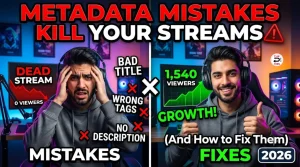
- Artist name mismatch. Your submission says “DJ Rahul Official” but your existing profile is “DJ Rahul”. Platforms cannot match them, so it either gets rejected or lands on a duplicate profile.
*Fix:* choose one exact spelling and capitalisation and use it identically on every release forever.
- Missing composer and lyricist credits. Increasingly required, and rejected when blank or filled with the artist name where the writer is someone else.
*Fix:* enter the legal names of the actual writers, not stage names, and not the band name.
- Promotional text in titles. “(Official Video)”, “(Prod. by X)”, “New Song 2026”, featured artists written into the title rather than the featured field.
*Fix:* clean titles only. Use the version field for “Remix” or “Live”, and the featured-artist field for features.
- Wrong language or genre tags. A track in one language tagged as another will not reach the right editorial or regional surfaces, and mismatched genre tags can be flagged as manipulation.
*Fix:* tag the actual language and the actual genre.
Category 4: Rights Problems
- Unlicensed cover songs. Recording someone else’s composition requires a mechanical licence. Distributors check this, and platforms remove unlicensed covers after release.
*Fix:* obtain the licence before submitting. The process is in the cover song legal guide.
- Uncleared samples. Any recognisable portion of another recording needs clearance from both the master owner and the publisher.
*Fix:* clear it, replace it, or re-record the part yourself.
- Impersonation or misleading naming. An artist name too close to an existing act, or metadata that routes your release onto someone else’s profile, is treated as fraud.
*Fix:* choose a distinct name and verify it is not already in use before your first release.
The Bonus Category: Content Flags
Not strictly rejections, but they cause the same delay: undeclared explicit content, AI-generated material submitted without disclosure where the platform requires it, and mass uploads that trigger spam filters. Declare accurately and release at a normal cadence.
How to Avoid Rejection Entirely
A five-minute pre-submission check catches almost everything:
- Audio is a WAV, exported fresh, not sent through a compressing app
- Artwork is 3000×3000, square, no text beyond artist and title, no borrowed imagery
- Artist name matches your existing profile exactly, character for character
- Composer and lyricist fields contain real legal names
- Title contains no promotional text
- Language and genre are accurate
- Any cover or sample is licensed and the paperwork is saved
- Explicit and AI declarations are honest
Keep a text file with your exact artist name spelling, writer credits and label name, and paste from it every time rather than typing. Typos and autocorrect cause a surprising share of rejections, especially when submitting from a phone.
What to Do When You Are Already Rejected
- Read the exact reason, not the general category. “Metadata error” is not actionable; the specific field is
- If the reason is unclear, ask immediately. This is where support quality decides whether you make your date, discussed in distributor support reality check
- Fix and resubmit rather than creating a new release, so you keep the same submission history
- Push your release date back if the timeline is now tight. Better a later release than a rushed broken one
- Record what went wrong so it does not repeat on release two
Timing context matters here: with a fast distributor a rejection can be fixed and re-delivered within days, while a slow review cycle turns one error into a missed month. Typical timelines are in how long distribution takes.
FAQ: Release Rejections
What is the most common reason songs get rejected?
Artwork containing text, URLs or social handles, followed by artist name mismatches and missing writer credits.
Can I use an MP3 for distribution?
No. Platforms require lossless audio, normally WAV at 16-bit or higher and 44.1kHz or above.
Why was my artwork rejected?
Usually text or promotional elements on the cover, insufficient resolution, non-square dimensions, or imagery you do not have rights to use.
Do I need to credit composers and lyricists?
Yes, increasingly it is mandatory, and the credits must use the writers’ legal names rather than stage or band names.
Can I release a cover song?
Only with a mechanical licence for the composition. Unlicensed covers are rejected before release or removed afterwards.
How fast can a rejection be fixed?
The fix itself is usually under an hour. What varies is how quickly your distributor tells you what is wrong and re-delivers, which is why review speed and support access matter, as covered in the 12-point distributor checklist.
Conclusion
Rejections feel personal and almost never are. They are automated checks catching predictable errors, and the same fifteen causes account for the overwhelming majority of them.
Run the eight-point check before you submit, keep your metadata in a text file you paste from, and choose a distributor that tells you exactly what is wrong quickly enough to still make your date. The Black Turn delivers in 1-3 days with support reachable by phone and WhatsApp rather than a ticket queue, alongside one-time pricing per song and free Content ID at 0% cut. Get the boring details right once, and rejection stops being part of your release process.