Music distribution pricing looks simple on most homepages. A price per single. A yearly plan. “Free” with a revenue share. Then you sign up, release a few songs, and start noticing charges you did not see on day one. A renewal on your card statement a year later. A paid add-on before your song can earn from YouTube and Instagram, plus a cut of that income. A withdrawal fee every time you cash out. A charge to keep an old song online after you stop paying. The real cost ends up higher than the headline price.
At The Black Turn we have spent 6+ years distributing music for 200K+ Indian artists, and many of them come to us from other distributors. The fee questions we hear most are rarely about the headline price. They sound like this: “Why was my card charged again?”, “Why did my song vanish from Spotify?”, “Why is my YouTube income so small when the views are big?” and “Is the free plan actually free?” This guide answers those questions with each distributor’s own pricing and help pages, checked in October 2026.
This is usually not fraud. Most big distributors do disclose their fees. The problem is that the details sit across a pricing page, an add-ons page and several help articles, and Indian artists also deal with USD billing, card forex markups and GST that Western pricing pages don’t spell out.
Short answer: the hidden charges that hit Indian artists most are (1) yearly renewals, (2) the fee to keep songs live after you stop paying, (3) paid add-ons and extra cuts for YouTube, Facebook and Instagram income, (4) a revenue share on “free” plans, and (5) withdrawal, forex and GST costs. Almost every one of them can be avoided or reduced if you know where to look, and this guide shows you how for each service.
Hidden Charges at a Glance: DistroKid, TuneCore, CD Baby, RouteNote (as of October 2026)
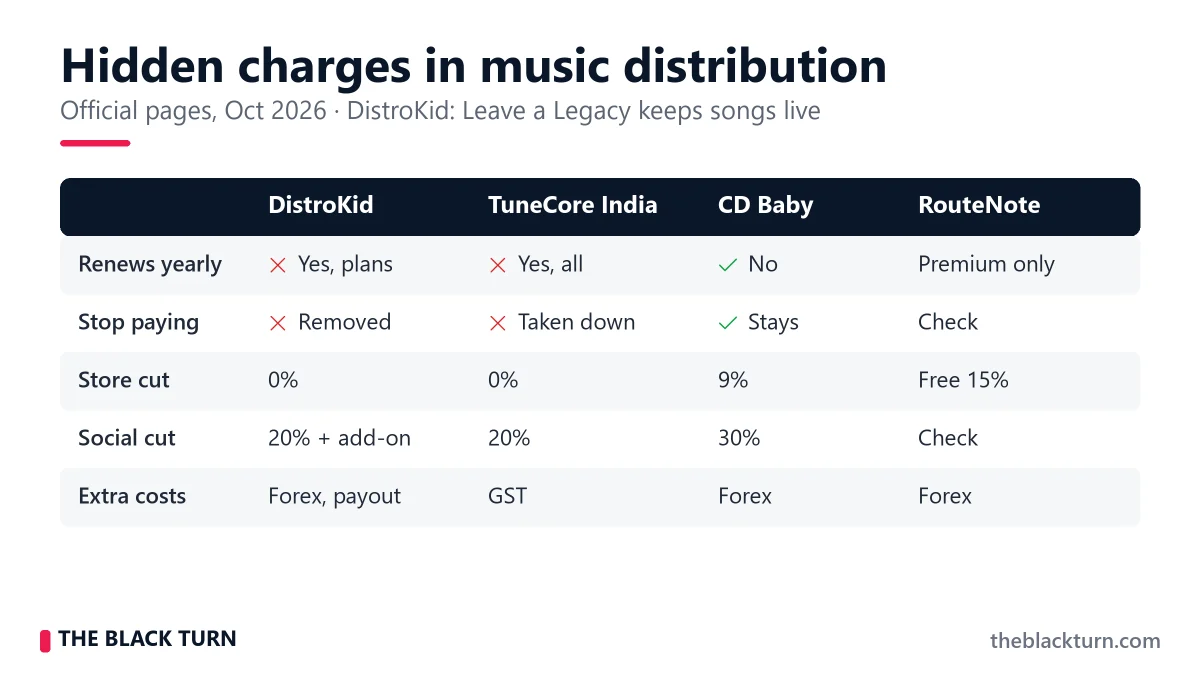
Everything in this table comes from each company’s official pricing or help pages, as of October 2026. Prices change, so open the linked page on the day you pay.
| Service | Headline price | Charge that is easy to miss | Can you avoid it? |
| DistroKid | $24.99/year (Musician), $44.99 (Musician Plus), $89.99 (Ultimate); keep 100% of store earnings | Songs are removed if you stop renewing, unless you buy Leave a Legacy ($29 per single, $49 per album, one-time per release). Social Media Pack (needed for YouTube Content ID, Instagram and similar income): $4.95 per single per year or $14.95 per album per year, and DistroKid keeps 20% of that income. Withdrawal fees depend on the payout method. | Partly. Skip the Social Media Pack if you don’t need social income. Buy Legacy only for songs you want online forever. |
| TuneCore India | ₹1,599/year (Rising Artist), ₹2,799 (Breakout), ₹4,499 (Professional); single ₹1,599, album ₹2,799 | GST is added at checkout. Plans and per-release purchases renew every year. 20% fee on TikTok, Facebook, Instagram and YouTube income. The free plan ended in June 2025. | Partly. Keep auto-renew on so songs don’t come down. If you release often, one unlimited plan beats paying per release. |
| CD Baby | $9.99 per single, $14.99 per album, one-time, no annual fees | Keeps 9% of digital distribution revenue. Keeps 30% of social video monetisation income. | The 9% can’t be avoided; the social-video service can be switched off. |
| RouteNote | Free plan: no fee, you keep 85%. Premium: you keep 100% | Free takes 15% for as long as the song is on Free. Premium costs $10 (single) to $45 (extended album) upfront, then $9.99 per release per year from the second year. | Yes, by choosing the right plan for each release (see the break-even maths below). |
| The Black Turn | ₹599 per single one-time; ₹799 with caller tune | We keep 5% (you get 95% for life). Royalty is paid quarterly, not on demand. | No yearly renewal on single releases; no per-song fee for Facebook, Instagram or YouTube claims. |
Sources: DistroKid pricing, TuneCore India pricing, CD Baby cost, RouteNote pricing models, and The Black Turn pricing. For a full plan-by-plan comparison, read our DistroKid vs TuneCore vs CD Baby vs The Black Turn guide.
The 11 Hidden Charges to Check Before You Pay a Music Distributor
1. Yearly Renewal Fees on Lifetime-Sounding Marketing
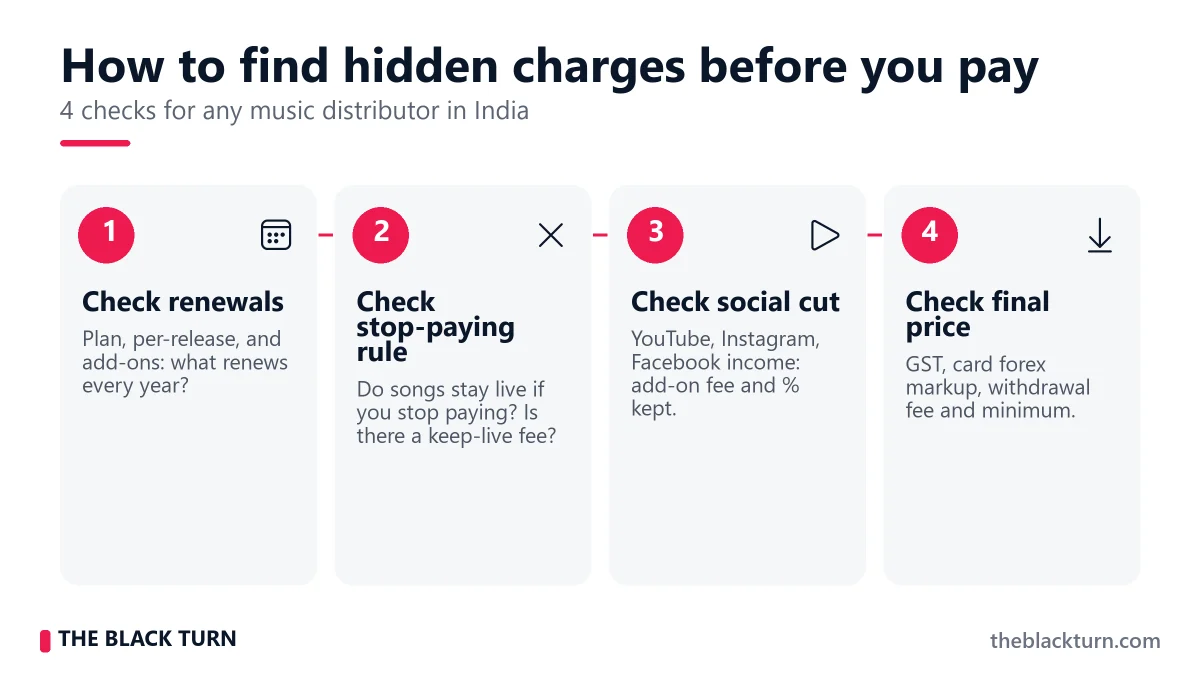
Phrases like “unlimited uploads” and “one price” can hide the fact that the fee renews every year. DistroKid’s plans are yearly. TuneCore’s unlimited plans renew yearly, and so do its per-release purchases: TuneCore’s release renewals article says accounts are enrolled in auto-renewal and a release is taken down once the 42-day grace period after a missed renewal ends. RouteNote Premium adds $9.99 per release per year from the second year. CD Baby is a genuine one-time fee per release. We break down each renewal in music distribution renewal fees explained.
2. The Fee to Keep Songs Live After You Stop Paying
This is the charge artists notice last, usually when a song disappears. DistroKid’s help centre says that if you don’t renew your subscription, your music is removed from stores. The exception is releases with the Leave a Legacy extra, which costs $29 per single or $49 per album, one-time per release. The fair part: DistroKid restores releases automatically if a failed payment goes through later. At TuneCore, an unpaid renewal leads to a takedown once the grace period ends. We explain what each distributor does in what happens when you stop paying your distributor.
3. Paid Add-ons and Extra Cuts for YouTube, Facebook and Instagram Income
Many Indian songs earn on Reels, Shorts and YouTube videos that use them. This is where the headline “keep 100%” can mislead, because social income usually runs under different terms:
- DistroKid: YouTube Content ID, Instagram and similar income come through the Social Media Pack. It costs $4.95 per single per year or $14.95 per album per year (album extras), and DistroKid keeps 20% of that revenue (how much DistroKid keeps).
- TuneCore: you keep 100% from digital stores but 80% from YouTube Content ID, Facebook/Instagram, TikTok and CapCut (TuneCore help). The India pricing page lists this as a 20% fee.
- CD Baby: you keep 70% of social video monetisation revenue and CD Baby keeps 30% (CD Baby help).
- The Black Turn: YouTube Content ID is free, with no per-song fee for Facebook, Instagram or YouTube claims. The same 95% applies to all income, including Content ID.
4. Royalty Commission Below 100 Percent
| Service | You keep (store income) | You keep (social / video income) |
| The Black Turn | 95% | 95% (Content ID free) |
| DistroKid | 100% (yearly fee instead) | 80% with paid Social Media Pack |
| TuneCore | 100% (yearly fee instead) | 80% |
| CD Baby | 91% (9% commission) | 70% |
| RouteNote Free | 85% (15% commission) | Check RouteNote |
| RouteNote Premium | 100% of streaming and downloads (yearly fee instead) | Check RouteNote |
Figures as of October 2026, from the official pages linked in this guide (RouteNote: what percentage RouteNote takes). For a full royalty comparison, see our best royalty music distributor in India analysis.
5. Revenue Share on Free Tier Services
“Free” means the distributor is paid from your earnings instead of your card. On RouteNote Free you keep 85% for as long as the release stays on Free. Free plans can also disappear: TuneCore ended its free New Artist plan in June 2025 (more on that in the conclusion). A free tier is a fair way to start. Just know the cut, and know what happens to your songs if the plan changes. See is free music distribution worth it analysis.
6. Withdrawal Fees and Payout Minimums
DistroKid doesn’t process a withdrawal if your balance is under $6 (minimum payout), and a payment-processor fee that depends on the method is deducted from each withdrawal (withdrawal fees). Each withdrawal pays its own fee, so withdrawing less often costs less. Before signing up anywhere, check three things: the minimum balance, the fee per method, and how often you can withdraw.
7. Forex Costs on USD Prices and USD Payouts
DistroKid, CD Baby and RouteNote list prices in US dollars. When you pay with an Indian card, your bank converts the amount and usually adds a forex markup, so the rupee amount on your statement is often more than a simple conversion. Check your card’s foreign-transaction charge. On payouts, DistroKid’s help centre says an FX fee of up to 3% may apply when the payment currency differs from the country you select. TuneCore India prices in rupees, which removes the card forex problem.
8. GST Added at Checkout
An INR price is not always the final price. TuneCore India’s pricing page says “Applicable GST charges will be added to cart”, so ₹1,599 is not what you actually pay. When you compare an INR price with a USD price, compare the final checkout amounts.
9. The Add-on Stack
The base plan gets your song to stores. The extras are sold separately: social monetisation, keeping a release live, and sometimes custom release dates, extra artists or a custom label name on higher tiers. None of these is wrong, but add up the extras you will actually need before comparing a base price with a distributor that includes them.
10. Missing Revenue Streams (Functionally a Hidden Cost)
In October 2026 we could not find caller tune (CRBT) distribution for Jio, Airtel, Vi or BSNL on the official pages of DistroKid, TuneCore, CD Baby or RouteNote. This is not a fee. But if your music is Hindi, Punjabi, Haryanvi, Bhojpuri, devotional or regional, a caller tune is one more way fans use your song, and with these services you would need another route for it. See best caller tune distributor.
11. Compound Annual Cost Over a Multi-Year Catalogue
A yearly fee times the number of years you want your songs online is the number that matters, not the first-year price. Per-release renewals multiply again by the number of releases. Always work out a 3–5 year total before you sign up.
Where Hidden Fees Are Genuinely Avoidable (Service by Service)
Fair is fair: most of these charges are optional or can be reduced. Here is what you can do with each service.
DistroKid
- Buy the Social Media Pack only for songs likely to be used in videos. A song that only streams doesn’t need it.
- Buy Leave a Legacy only for the releases you want online forever, not for every demo.
- Keep a valid card on file. If a payment fails, releases are restored once it goes through.
- Withdraw less often so you pay fewer per-withdrawal fees.
TuneCore
- If you release more than one or two songs a year, compare the Rising Artist plan (₹1,599/year) with paying per release, because every per-release purchase also renews.
- Keep auto-renew on and act on the renewal emails, or songs come down after the grace period.
- Check the price with GST at checkout, not the list price.
CD Baby
- There’s no renewal to forget. The one-time fee and no annual charge are real.
- The 9% store commission can’t be avoided. Social video monetisation is opt-in or opt-out (CD Baby help), so you choose whether its 30% applies.
RouteNote
- Choose per release. Premium’s yearly $9.99 is cheaper than Free’s 15% only once a release earns more than about $66.60 a year ($9.99 ÷ 0.15). Below that, Free costs you less.
- Start on Free and move a release to Premium when its earnings pass that line.
The Black Turn
- Single release: ₹599 one-time, or ₹799 with caller tunes on Jio, Airtel, Vi and BSNL (up to 2 caller tune clips per song). No yearly renewal on single releases. Earnings continue even without renewal, on every plan.
- Free YouTube Content ID, free ISRC and UPC, and no per-song fee for Facebook, Instagram or YouTube claims.
- Royalty is paid quarterly. If you want to withdraw any time, DistroKid is more flexible here.
Calculating True Total Cost (3-5 Year Analysis)
To compare distributors properly, add up the cost over a realistic 3 to 5 years. Headline prices alone mislead.
Example Cost Calculation: Indian Artist with 6 Singles Over 3 Years
This is a hypothetical example. Suppose you release 6 singles over 3 years, and together they earn ₹20,000 from streaming stores in that time. Prices are as of October 2026. USD amounts are not converted, because your card’s rate and markup decide the rupee figure.
| Distributor | Fees over 3 years | Commission on ₹20,000 store income | If you stop paying after year 3 |
| The Black Turn | 6 × ₹599 = ₹3,594 (₹4,794 with caller tunes) | 5% = ₹1,000 | Nothing to renew on singles; earnings continue |
| DistroKid (Musician) | 3 × $24.99 = $74.97 + card forex markup | ₹0 | Songs removed, unless Legacy is bought (6 × $29 = $174) |
| TuneCore (Rising Artist) | 3 × ₹1,599 = ₹4,797 + GST | ₹0 | Taken down after the renewal grace period |
| CD Baby | 6 × $9.99 = $59.94 + card forex markup | 9% = ₹1,800 | Nothing to renew |
| RouteNote Free | ₹0 | 15% = ₹3,000 | Nothing to renew |
| RouteNote Premium | 6 × $10 upfront + 6 × $9.99 × 2 years = $179.88 | ₹0 | Check with RouteNote |
The calculation lesson: at this level of earnings, most options end up in a similar range. The gap shows up in two places. First, what happens after you stop paying. Second, how the totals move as your numbers change. If the same 6 songs earned ₹2,00,000, the percentage cuts would grow tenfold, and a 0% yearly plan would come out ahead on cost as long as you keep paying. If you released 20 songs instead of 6, an unlimited yearly plan would get cheaper per song. Put your own song count and a realistic earnings figure into the table before you decide.
Honest Distributor Transparency Check
The Black Turn: What You Pay
Our pricing for Indian artists, in full:
- Single release ₹599 one-time, or ₹799 with caller tunes on Jio, Airtel, Vi and BSNL
- 95% lifetime royalty on all income, including YouTube Content ID, paid quarterly
- Earnings continue even without renewal, on every plan
- YouTube Content ID included free, with no per-song fee for Facebook, Instagram or YouTube claims
- ISRC and UPC codes free
- Yearly only if you choose it: the Custom Label plan (unlimited releases and artists) is ₹4,999/year
See current pricing for album/EP and caller-tune-only options.
Reasonably Transparent: DistroKid
DistroKid’s base subscription is clear, and its extras (Social Media Pack, Leave a Legacy and others) are listed on its help centre with prices. Where artists get surprised: the yearly model compounds, songs are removed when you stop renewing, social income needs a paid add-on with a 20% cut, and USD billing brings card forex costs. In its favour: unlimited uploads, 0% on store income, and withdrawals whenever you want. We also could not find caller tune delivery on its official pages. See DistroKid alternative analysis.
Reasonably Transparent: CD Baby
CD Baby’s one-time per-release pricing is clearly disclosed, and “no annual fees” is true. The ongoing costs are the 9% commission on digital distribution, 30% on social video monetisation, and card forex on USD prices. For an artist who wants to pay once and never think about renewals, CD Baby is a fair choice. See CD Baby alternative analysis.
Reasonably Transparent: TuneCore
TuneCore India prices in rupees, which helps. The details to read carefully: GST is added at checkout, per-release purchases renew every year (TuneCore’s release renewals article confirms this, so check the renewal price in your account), the social cut is 20%, and the free plan ended in 2025. See TuneCore alternative analysis.
Free Tier Services: Transparent, But Do the Maths
RouteNote states its 85/15 split plainly. The cost isn’t hidden; it simply grows with your earnings, and most artists never calculate it. Use the $66.60 break-even line above to decide when a release should move to a paid plan.
How to Spot Transparent Music Distribution
Apply these checks to any distributor:
- Pricing page states the total cost upfront • including tax, renewals and the price of extras you will need
- Royalty share clearly disclosed • a specific percentage for store income and, separately, for social/video income
- Stop-paying rule stated • what happens to your songs and earnings if you don’t renew
- Payment cycle, minimum and fees stated • you know when, how much, and at what cost before signing up
- Standard features included • ISRC, UPC, YouTube Content ID, and caller tune coverage for Indian artists
- Refund or cancellation policy clear • what happens if you change your mind
- Customer support responsive • pre-signup questions about fees answered in writing
- Terms of service readable • not buried in complex legal language
Red Flags Indicating Hidden Costs
- Vague language about “additional fees may apply” without specifics
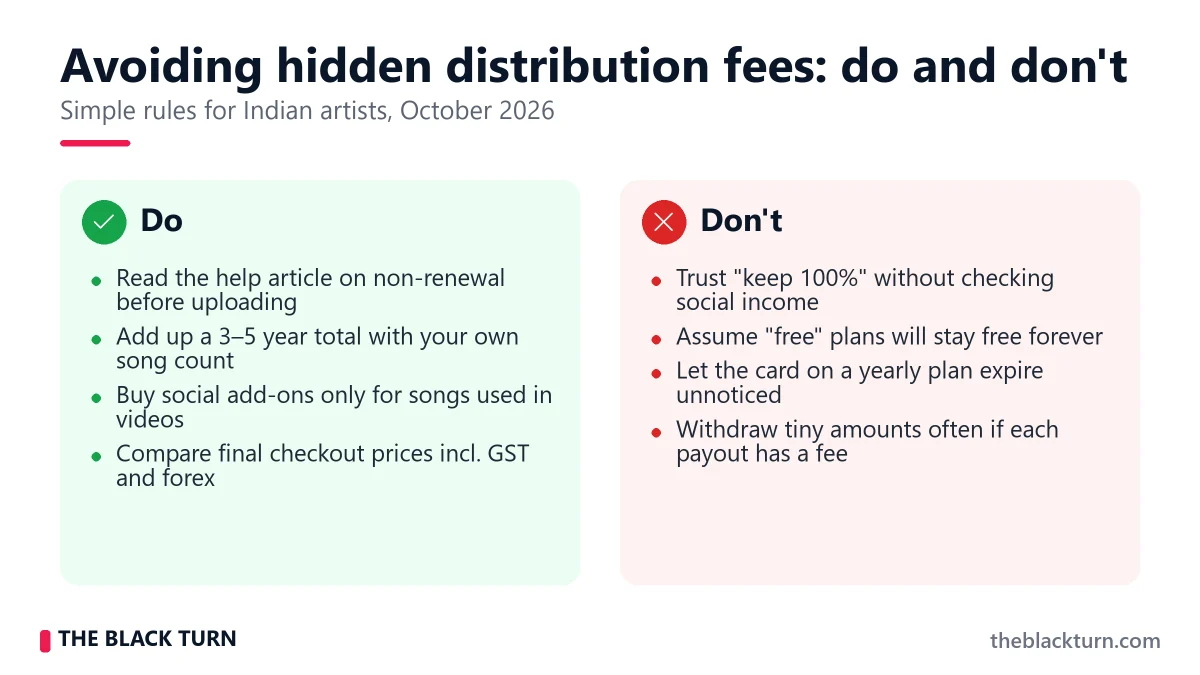
- “Keep 100%” with no mention of social/video income, which often has a separate cut
- “One-time” with no word on renewals anywhere in the help centre
- No stated rule for what happens when you stop paying
- Premium tiers required for basic features like Content ID
- “Contact us for pricing” instead of clear public pricing
- Marketing emphasises “free” without explaining the revenue share
Common Hidden Cost Mistakes Indian Artists Make
1. Comparing Only Upfront Prices
Comparing ₹0 (free tier), ₹599 (The Black Turn single) and $24.99/year (DistroKid) only on the upfront price misleads. Work out a 3–5 year total that includes revenue share, renewals, social cuts, forex and GST.
2. Not Checking the Stop-Paying Rule
Many artists find out what happens when they stop paying only after their song disappears. Read the help-centre article on non-renewal before you upload, not after.
3. Ignoring Forex and GST
A USD price on an Indian card and an INR price before GST are both smaller than what you actually pay. Compare final checkout amounts.
4. Staying on a Free Tier After Songs Start Earning
Free is a fine starting point. Once a release earns well, recheck the maths: on RouteNote the break-even is about $66.60 a year per release.
5. Not Reading Terms of Service
Most hidden fees are discovered months after signing up. Reading the terms first catches most of them. See music distribution glossary for definitions of the terms you will meet.
6. Not Calculating the Add-on Stack
Base plan + social monetisation pack + keep-live fee + higher tier for custom release dates can add up quickly. Total the add-ons you actually need before comparing with a distributor that includes them.
Frequently Asked Questions
What hidden charges to watch for in music distribution?
Yearly renewals, the fee to keep songs live after you stop paying, paid add-ons and extra cuts for YouTube/Facebook/Instagram income, revenue share on free plans, withdrawal fees and minimums, forex on USD prices, GST at checkout, and missing revenue streams like caller tunes. Always add up a 3–5 year total.
Does DistroKid have hidden fees?
The base plan is clear ($24.99/year and up, 0% on store income, as of October 2026). The extras to know: Social Media Pack for YouTube Content ID and Instagram income ($4.95 per single per year or $14.95 per album per year, plus 20% of that income), Leave a Legacy to keep a release live after you stop paying ($29 per single, $49 per album, one-time), and withdrawal fees by method. See DistroKid alternative.
Does DistroKid remove songs if you stop paying?
Yes. DistroKid’s help centre says music is removed when you don’t renew, except releases with the Leave a Legacy extra. If a payment fails and later goes through, releases are restored automatically.
Does TuneCore have hidden fees?
TuneCore India prices are listed in rupees, but GST is added at checkout. Plans and per-release purchases renew every year, social income (YouTube Content ID, Facebook, Instagram, TikTok) carries a 20% fee, and the free plan ended in June 2025. See TuneCore alternative.
Does CD Baby have hidden fees?
CD Baby charges $9.99 per single or $14.99 per album one-time, with no annual fees (as of October 2026). It keeps 9% of digital distribution revenue and 30% of social video monetisation income, and USD pricing means card forex costs for Indian artists. See CD Baby alternative.
What is the true cost of free music distribution?
₹0 upfront, paid from your earnings instead. On RouteNote Free you keep 85%. Say a song earns ₹5,000 a month: 15% is ₹750 a month, or ₹9,000 a year. Free plans can also be discontinued, as TuneCore’s was in 2025. See free vs paid.
Is RouteNote Free or Premium better?
It depends on what each release earns. Premium costs $10 to $45 upfront and $9.99 per release per year from the second year, and you keep 100% of streaming and download revenue. Free costs nothing and you keep 85%. Premium works out cheaper once a release earns more than about $66.60 a year.
How to spot transparent music distributors?
The total price is stated with tax and renewals. The royalty share is given separately for store and social income. The stop-paying rule is written down. The payout cycle, minimum and fees are stated. ISRC, UPC and Content ID are included. Support answers fee questions in writing.
Are payout fees normal for music distributors?
Yes, with USD payouts. DistroKid, for example, deducts a processor fee that depends on the payout method, won’t process withdrawals under $6, and says an FX fee of up to 3% may apply when currencies differ. Check the fee for your method and withdraw less often to pay fewer fees.
Does The Black Turn have hidden charges?
Our prices are on our pricing page: ₹599 one-time per single (₹799 with caller tunes), 95% lifetime royalty, free YouTube Content ID, ISRC and UPC, and no per-song fee for Facebook, Instagram or YouTube claims. Single releases have no yearly renewal, and earnings continue even without renewal. Royalty is paid quarterly. See pricing.
Conclusion
In June 2022, TuneCore moved to unlimited yearly plans and launched a free New Artist plan for releases to Facebook, Instagram, TikTok and YouTube, where artists kept 80% (Digital Music News, Record of the Day). Three years later, TuneCore ended free social distribution on 23 May 2025 and discontinued the New Artist plan on 18 June 2025. Artists who did not upgrade saw their social-only releases taken down (TuneCore support). Nobody hid anything. The terms were public. But artists who chose “free” in 2022 had a decision forced on them in 2025.
That is the real lesson about hidden charges. The fee you see today matters less than three questions: what renews, what happens when you stop paying, and what cut applies to each kind of income. Find those answers on the distributor’s own pricing and help pages, put them into a 3–5 year table with your own song count, and the “hidden” part disappears.
If you are an Indian artist who wants a one-time price per single, caller tunes on all four networks, free Content ID and earnings that continue without renewal, have a look at The Black Turn, an Indian music distribution company that publishes its prices and its 5% cut upfront.
 Jyoti Singh – Independent artist (32) who has worked at several music distribution companies and has released music through distributors – so these guides come from both sides of a release.